
Pegs and Pine: The Story of the Alamuchee-Bellamy Covered Bridge
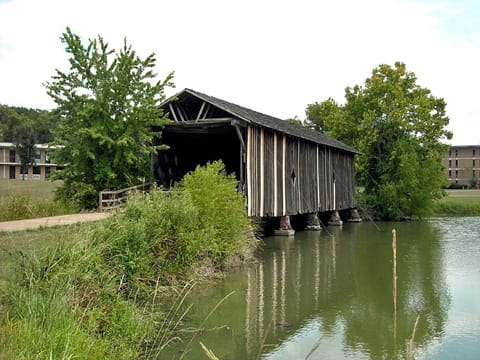
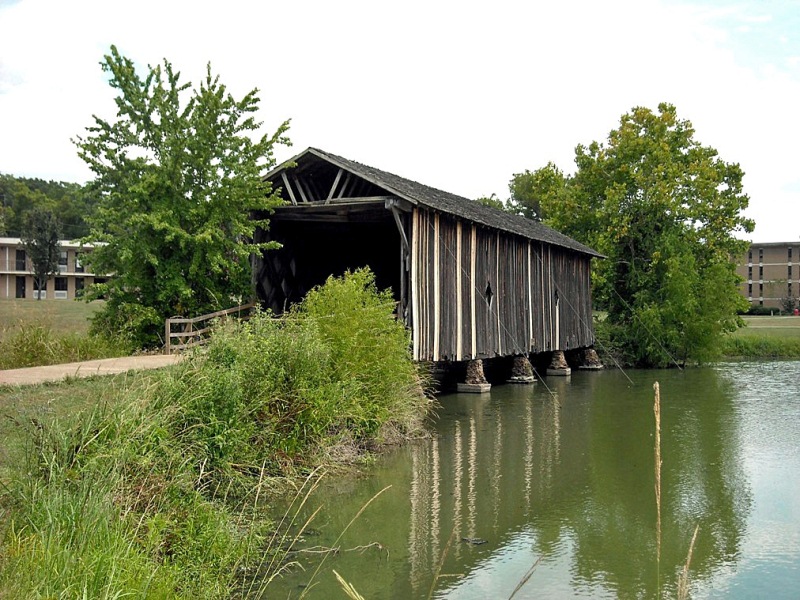
On the edge of a duck pond in Livingston, Alabama, students cut across a small wooden bridge with a pitched roof and weathered, shadowy sides. Few of them stop to think that the timbers underfoot were already in place when the American Civil War began. The Alamuchee-Bellamy Covered Bridge is one of the oldest of its kind in the state, and it has travelled a good deal further than most bridges ever do.
Here is how a wartime river crossing became a campus footpath.
A Crossing Built in 1861
The bridge dates from 1861, when it was raised over the Sucarnoochee River just outside Livingston, the seat of Sumter County in western Alabama. It carried the road towards York, a route that is now part of U.S. Highway 11. Accounts credit its construction to Captain William Alexander Campbell Jones of the Confederate army, working in the first months of the conflict.
The builders used local materials. The frame is made of hand-hewn heart pine, a dense and durable timber, and the joints are held together with wooden pegs rather than iron fittings. That kind of carpentry demanded patience, and it is a large part of why the structure has lasted so long.
The Town Lattice Truss
The bridge is a fine example of the Town lattice truss, a design patented in 1820 by the Connecticut architect Ithiel Town. Instead of heavy beams and complex joints, the truss uses a criss-cross web of sawn planks. Ordinary carpenters could build it quickly, without specialist ironwork.
The finished bridge is about 88 feet long, with an interior roughly 17 feet wide and 14 feet high. That was enough room for a loaded wagon, and later for early motor vehicles. The roof and walls were there for a practical reason: they shielded the timber frame from rain and sun, which can rot an open wooden bridge within a few decades.
Moved to Alamuchee Creek
For more than sixty years the bridge served its first site. In 1924 a concrete bridge replaced it on the Sucarnoochee. Rather than demolish the old structure, the county took it apart and rebuilt it about five miles away, over Alamuchee Creek on the road between Bellamy and Livingston, now County Road 13.
That second home gave the bridge the name it carries today. Together, Alamuchee and Bellamy record where it spent the middle decades of the 20th century, rather than where it began.
Closure and Rescue
The bridge remained in use on the creek until 1958, when a new concrete bridge was built beside it. During that work a truck crossing the old structure damaged it, and its floor gave way. After the accident it was closed to traffic and left without maintenance, and many covered bridges across the United States have been lost in just this way.
It survived because local people stepped in. The Sumter County Historical Society took on the task of saving it. Between 1969 and 1971 the bridge was moved a final time, restored, and set across the north-eastern corner of Duck Pond at the University of West Alabama in Livingston.
A Darker Footnote
Local history also links the bridge's original neighbourhood to a grim episode. In July 1886 Steve Renfroe, a former sheriff known as an outlaw, was hanged by a mob near the crossing outside Livingston. Accounts differ on exactly where, so it is best remembered as part of the area's story rather than as a feature of the bridge itself.
The Bridge Today
Now owned by the county and maintained by the Sumter County Historical Society, the bridge is a pedestrian route rather than a road. Students use it as a short cut across the campus, and visitors come to see one of the few historic covered bridges in Alabama. The state counts eleven historic covered bridges in all, and only six of them still stand where they were built. This one is among those that have been moved to save them.
The bridge is considered eligible for listing on the National Register of Historic Places. It appears on the Alabama covered bridge trail, which also takes in sites such as the Kymulga Grist Mill and its bridge near Childersburg. A visit is easy to combine with a stroll around the pond and the rest of the campus.
A Bridge That Kept Its Place
Few structures can claim to have outlasted a war, two roads and a decision to leave them to rot. The Alamuchee-Bellamy Covered Bridge did so through sound carpentry and the determination of a local historical society. It no longer carries traffic, but it still does what bridges are for: it joins one place to another, and one generation to the next. It also shows how much a community can save when it chooses to.