
Twenty-Nine Names: The Story of the SS Edmund Fitzgerald
On the evening of 10 November 1975 a gale was driving across eastern Lake Superior, with waves as tall as a house and snow cutting visibility to almost nothing. A crew member aboard one freighter watched a second ship's lights on the radar screen. Then the lights were gone. The ship was the SS Edmund Fitzgerald, a vessel that had spent seventeen years carrying iron ore across the lakes and had never before made headlines.
Here is how the Fitzgerald came to be, how she was lost, and why her story still draws people to the shore.
A Record-Breaker from River Rouge
The ship was ordered by Northwestern Mutual Life Insurance Company, which wanted a vessel to carry iron ore for steelmakers. She was built by the Great Lakes Engineering Works at River Rouge, Michigan, and named after the company's chairman. She was launched on 8 June 1958 before a large crowd. At 729 feet (222 metres), she was the longest ship then working the Great Lakes.
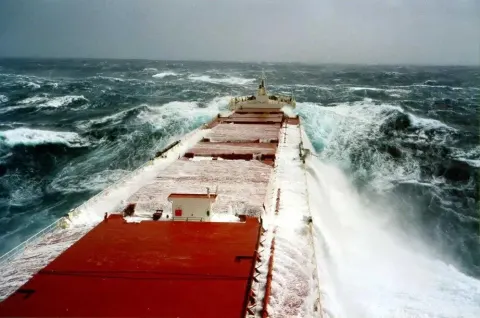
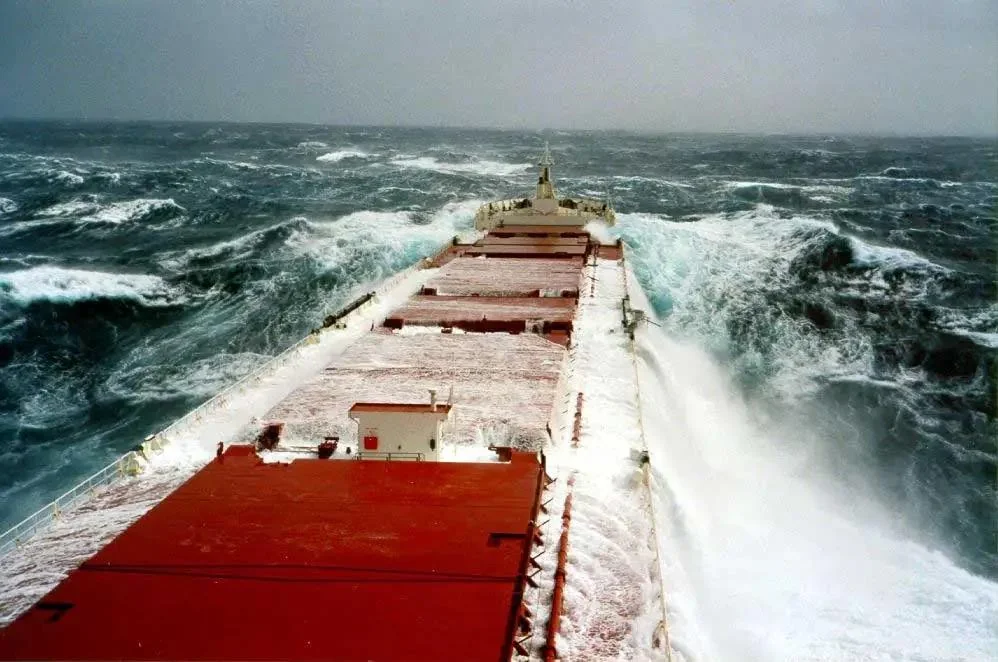
She was a lake freighter, built for inland waters rather than the open ocean. Her pilothouse sat at the bow and her engines at the stern, with a single long cargo hold between them. That arrangement was typical of the Great Lakes fleet. It left a vast expanse of deck between the two ends of the ship.
Seventeen Years on the Ore Run
The Fitzgerald was managed for the owners by Oglebay Norton's Columbia Transportation Division. Her work was steady and repetitive. She loaded taconite pellets, a processed iron ore, at Superior, Wisconsin, and carried them to steel plants on the lower lakes, chiefly near Detroit and Toledo. She regularly broke cargo records, and sailors nicknamed her the "Big Fitz". She was known as a comfortable ship that crews were glad to join.
By 1975 her master was Captain Ernest McSorley, an experienced lake officer in his sixties. The season was nearly over, and November is the month when sailors most respect Lake Superior.
The Last Voyage
The Fitzgerald left Superior on the afternoon of 9 November 1975, loaded with more than 26,000 tons of taconite and bound for Zug Island, near Detroit. Another freighter, the Arthur M. Anderson, left the same area shortly afterwards, and the two ships kept in loose company. A storm system was building, and forecasts worsened through the following day.
As the gale grew, the Fitzgerald reported damage to fence rails and vents and a list to one side, and her radar failed. The Anderson, following behind, offered guidance. Shortly after 7 pm the Fitzgerald's captain told the Anderson that his ship was holding her own. Minutes later she disappeared from the Anderson's radar. No distress call was received.
Rescue ships and aircraft searched through the night in violent seas. They found lifeboats and debris but no survivors. All 29 men aboard were lost. The wreck lies in Canadian waters about 17 miles from Whitefish Point, in roughly 530 feet of water.
Searching for Answers
An aircraft detected the wreck within days, and later surveys showed it in two main sections on the lake bed. The investigations that followed reached different conclusions. The United States Coast Guard concluded that the hatch covers had probably not been properly secured, allowing water to flood the hold. The Lake Carriers' Association argued instead that the ship had struck a shoal and was damaged beneath the waterline. Neither explanation has ever been proved, and other theories involve structural failure or the effect of enormous waves.
The ship's bell was raised from the wreck on 4 July 1995, in an expedition arranged with the families' consent. A replica engraved with the names of the crew was left on the lake bed. The wreck is regarded as a grave, and diving to it is discouraged.
Remembering the Fitzgerald Today
The original bell is now displayed at the Great Lakes Shipwreck Museum at Whitefish Point, Michigan, close to the stretch of water where the ship was lost. Every 10 November the bell is rung there once for each crew member and once more for all sailors lost on the lakes. A similar service takes place at the Mariners' Church in Detroit.
The ship also lives on in popular culture. Gordon Lightfoot's 1976 ballad, "The Wreck of the Edmund Fitzgerald", brought the story to millions of listeners and prompted many people to visit the lakeshore.
A Lasting Legacy
The loss of the Fitzgerald is remembered as the most famous shipwreck in Great Lakes history, though not the deadliest. It led to stricter rules on load lines, hull surveys and weather safety for lake vessels. Above all it is remembered as the story of 29 men, each with a name, who set out on a routine voyage. The waters of Lake Superior still hold the wreck.