
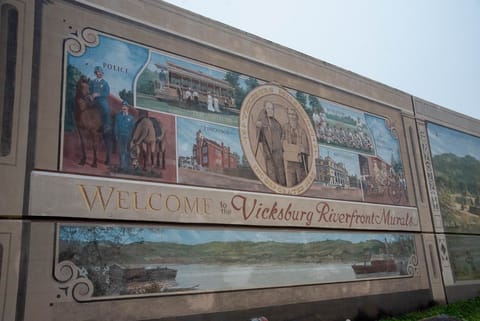
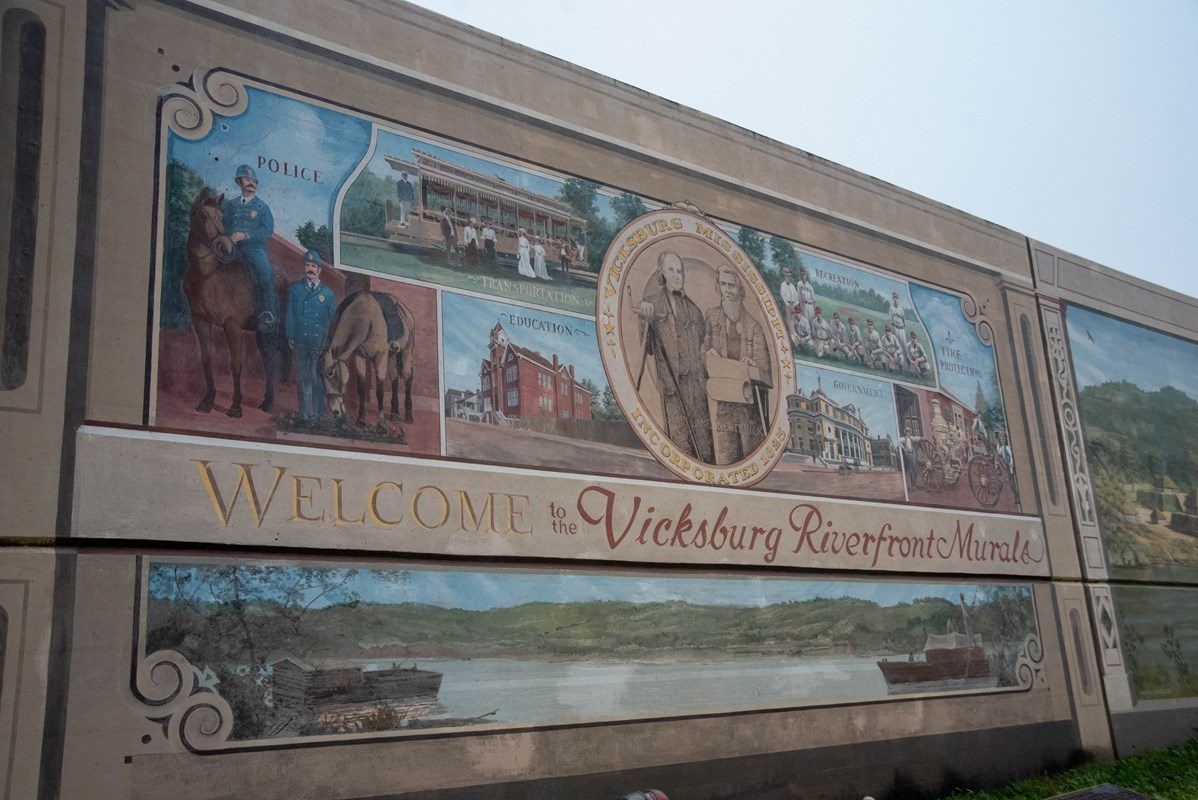
Painted on the Flood Wall: Vicksburg Riverfront Murals
Walk down Levee Street in Vicksburg and the plain grey line of a flood wall turns into something else. Steamboats paddle across it, ferries cross it, and bridges arch over painted water. The wall was built to hold back the Mississippi River. Today it also holds one of the most approachable open-air history lessons in the American South.
This is the story of the Vicksburg Riverfront Murals: how a utilitarian barrier became a canvas, who painted it, and what visitors can see there now.
A Wall Becomes a Canvas
Vicksburg sits on bluffs above the Mississippi, and its low riverside district depends on concrete flood walls for protection. The mural project began with a simple idea. Rather than leave the walls blank, the city would use them to show its own history and to suggest the part it hoped to play in the region's commerce and culture.
The first painting along the wall was an abstract mural by the Vicksburg artist Martha Ferris, completed in 2001. It reflects the three routes that fed the city's character: the river, the railroad and the highway. It was the start of a much larger scheme.
The Artist from Louisiana
The main commission went to Robert Dafford, a muralist born on 14 May 1951 who has spent most of his life in south Louisiana. He arrived with a good deal of experience. He had already painted flood-wall and townscape murals in places such as Portsmouth in Ohio and Paducah in Kentucky, and it was in Paducah that a Vicksburg resident, Nellie Caldwell, saw his work. She went on to chair the committee that brought him to the city.
Dafford was asked to complete a first series of panels, each about 12 feet by 20 feet, on the wall facing Levee Street. The first of them was unveiled in 2002, and the series grew steadily over the following years. By the time the first phase was complete there were 32 panels, with the work generally dated to 2002–2009.
Panels, Pillars and Stories
Each painting is framed by pierced columns, a detail borrowed from local architecture. The frames give the long wall a steady rhythm, so that it reads like a row of windows on the past.
The subjects range across Vicksburg's story in a lyrical and sometimes playful way. Among the titles are the steamer Sprague, known as the “Big Mama of the Miss”, and a panel on the famous Teddy Bear hunt. Another, Crossing the Mississippi: Last of the Ferries, was one of Dafford's own favourites. Some panels carry modern river traffic as well, so the wall looks forward as well as back.
Many visitors expect Vicksburg's art to concentrate on the 1863 siege. The riverfront murals take a wider view, with a focus on the river trade, transport and everyday life. The military story is told elsewhere in the city, most notably at Vicksburg National Military Park.
Why a muralist of this kind?
Dafford's murals are commissioned as public art projects, often to encourage downtown regeneration and local pride in smaller communities. Vicksburg's wall is a good example of that approach: free to view, easy to reach and built around the town's own stories.
The Grove Street Mural
A later addition stands across the road from the main sequence. In 2012 a 55-foot mural was commissioned for the Grove Street flood wall. Because Grove Street climbs a slope, the painting is triangular in shape, with its form following the incline of the wall.
The subject is a group of runners passing places of historical interest in Vicksburg. It is linked to the annual 10k Run Thru History, and the mural sits along the route of that event.
Visiting the Murals Today
The murals lie at about 1200 Levee Street, a short distance from the city's downtown. The wall can be seen from the street, and parking is available along Levee Street itself. There is no entrance or ticket, so you can walk the length of it at your own pace. Allow around an hour to look properly at each panel. Visitors have noted that panels have plaques explaining the pictures, which helps in understanding the details.
The murals pair well with other Vicksburg landmarks, including the Old Court House Museum and the U.S.S. Cairo Gunboat & Museum.
A Wall That Keeps the River in View
The Vicksburg Riverfront Murals show how a working piece of flood defence can double as a place of memory. They also make clear how much of the city's identity has always depended on the Mississippi River. Painted over most of a decade and extended by the Grove Street mural, the wall continues to give Vicksburg a way of introducing itself to visitors before they have reached a single museum door.