
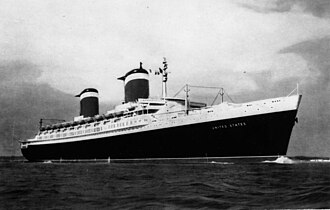
Blue Riband to Blue Water: The SS United States
On the afternoon of Wednesday 11 November 2026, about 22 nautical miles south-west of Destin, Florida, a long grey hull with no funnels slowly lowered itself into the Gulf of Mexico. Boats stood off at a distance. Some spectators had travelled from Philadelphia to watch. The ship going down was the SS United States, the fastest passenger liner ever to cross the Atlantic, and she was reaching the end of a story that began 74 years earlier with a race.
This article follows her from the drawing board to the seabed, and explains why she still draws such loyalty.
A Liner Built for Speed and for War
The ship was designed by the naval architect William Francis Gibbs and built at Newport News Shipbuilding in Virginia for United States Lines. She was launched in 1951. At roughly 990 feet long, she remains the largest passenger ship ever built in the United States, with room for 1,984 passengers.
Her design reflected the Cold War. Gibbs aimed for a hull that was light, fast and fire-resistant, with extensive use of aluminium and very little combustible material in the passenger areas. The ship could also be converted quickly into a troop carrier if the Navy needed her. Her true top speed was kept secret for years.
The Maiden Voyage of 1952
The United States left New York on her maiden voyage in July 1952. She took the Blue Riband, the unofficial prize for the fastest Atlantic crossing, from the Queen Mary, and she made the return trip faster still. Her average speed on the crossing was over 41 mph, and she kept the record for a generation. The ship carried film stars, politicians and wealthy travellers, and she became a symbol of American engineering confidence in the early 1950s.
Her funnels were among her best-known features. Each was around 65 feet tall and shaped like a fin, so they looked quite unlike the traditional stacks of British liners.
The Jet Age Ends the Service
Her career was shorter than her reputation suggests. Transatlantic passenger jets arrived in the late 1950s, and by the late 1960s the liner business was in steep decline. In 1969 the ship was withdrawn from service in a surprise announcement, and she never carried passengers again.
Decades of Waiting
Ownership then passed through several hands. The US Maritime Administration held her for a decade, and private owners followed. In the 1990s she was taken overseas to have hazardous materials removed, then returned to the United States. From 1996 she lay at Pier 82 on the Delaware in South Philadelphia, rusting beside a retail car park. Norwegian Cruise Line bought her in 2003 and considered a return to service, but the plan did not come to anything.
The Campaign to Save Her
In 2009 the SS United States Conservancy began raising money to prevent her from being scrapped. The group took over ownership in 2011. Its supporters came up with several ideas, including a floating hotel, a waterfront venue and a museum. Money was always short, and the cost of mooring the ship in Philadelphia mounted. After a legal dispute over the berth, a court ordered her to leave Pier 82 in 2024.
Okaloosa County in Florida then stepped in with a bold alternative. Having bought the ship, it would clean her out and sink her as the biggest artificial reef anywhere. In February 2025 she was towed away from Philadelphia, down the Atlantic coast and around Florida to Mobile, Alabama, where the preparation work began.
Preparing a Ship to Sink
A reef ship has to be stripped of anything that could harm the sea. Contractors removed hazardous materials and cut openings in the hull to let marine life in and to help her settle level. The county confirmed that her funnels and propeller had been taken off. Rules on environmental protection and explosives meant she could not be blown up, so she was flooded instead.
The county also had a digital model of the whole ship made, to keep a record of what she looked like before she went down. The county said the total budget for buying, cleaning and sinking her topped $14 million.
The Final Descent
Strong winds in the forecast led officials to bring the sinking forward by a day, to Veterans Day. A delay with a valve held things up at first, but she then went down and landed upright on the seabed. Boats were visiting the site within two days. Local dive operators said they had an unexpected rush of business in what is normally the quiet season. The ship now ranks above the USS Oriskany, another Gulf reef, as the largest artificial reef in the world, and above HMHS Britannic as the largest passenger liner ever sunk.
Legacy Beneath the Waves
Reef planners expect species such as grouper, snapper, mackerel and tuna to settle on the wreck over time. Divers can explore a vessel built to be fire-safe and fast, now lying in the dark under the Gulf. The Conservancy plans a museum in Okaloosa County to display what survives of her history above water.
The SS United States never lost a race. Her record stood for decades, and her hull outlasted the fashion for ocean liners by more than half a century. She now rests upright on the seabed, with new marine life gathering on her decks.