
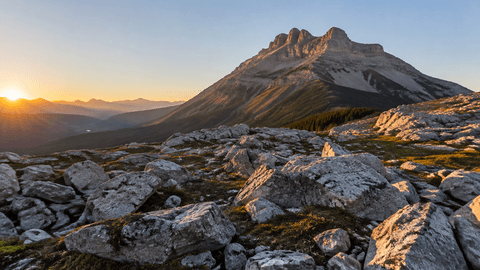
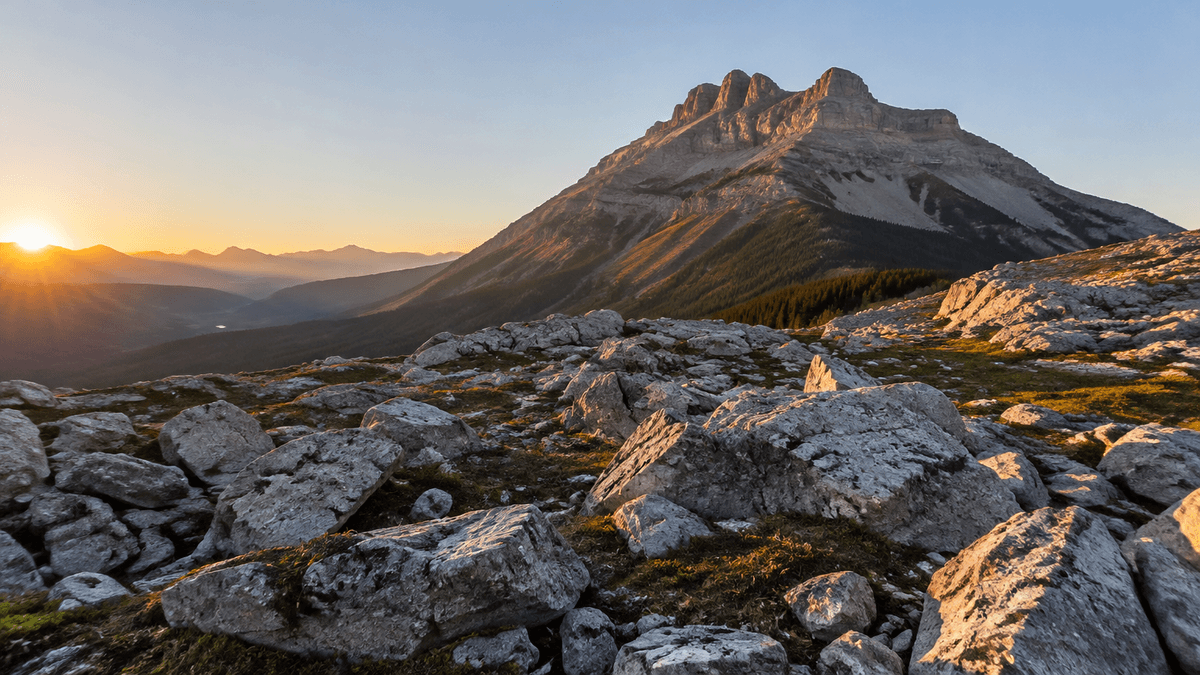
Beneath Turtle Mountain: The Story of the Frank Slide, Alberta
In the small hours of 29 April 1903, the valley of the Crowsnest Pass was cold and still. Then, at about ten past four, a sound like nothing the residents of Frank had ever heard rolled down from the mountain above them. Within roughly a minute and a half, much of the east face of Turtle Mountain had left its place and spread across the valley floor.
Today we walk out across that field of boulders in southern Alberta to see what happened, who lived, and why this coal mining disaster still shapes the landscape and the town.
A Mountain Known to Move
Turtle Mountain is a long ridge of limestone on the southern side of the pass. The Blackfoot and Kutenai peoples knew it as the mountain that moves, and the name suggests that its restless nature was recognised long before any town stood beneath it. Geologists would later explain why. Heavy limestone lay over weaker rock, and the whole mass was cracked and tilted along old fault lines.
None of this troubled the businessmen who arrived at the end of the 19th century, looking for coal to feed the Canadian Pacific Railway and the smelters of the region.
A Boom Town at the Foot of the Slope
The Canadian American Coal and Coke Company opened its mine at the base of the mountain in 1900. A townsite followed, named after Henry Frank, one of the company's backers. It was incorporated in 1901, and by 1903 it had some 600 residents, with a hotel, shops, a bank and rows of cottages for miners and their families. A few homes and a construction camp stood close to the foot of the slope, within reach of anything that fell.
Ninety Seconds Before Dawn
What came down that night is usually estimated at around 82 million tonnes of limestone, though published figures vary. It crossed the Oldman River, climbed the opposite bank, and buried the eastern edge of the town, the mine entrance, a stretch of the railway and several ranch buildings. In all it covered about three square kilometres, and the river backed up into a temporary lake behind the debris.
Most of Frank itself was left standing. The people who lived in the path of the rock were not so lucky. The death toll has never been settled, and estimates range from about 70 to 90, partly because transient workers may have been camping near the mountain. Only a small number of bodies were ever recovered; the rest still lie beneath the rubble.
Stories of Survival
Several accounts from that morning are still told. Seventeen miners were trapped inside the mine when the entrance was sealed, and after many hours of digging upward through the coal they broke out into the open air. A baby, Marion Leitch, was found alive on a pile of hay, though many of her family had been killed. And railway brakeman Sid Choquette is remembered for hurrying across the unstable debris to warn an approaching passenger train before it reached the missing track.
Blame, Fear and Rebuilding
Investigators of the day looked for causes. Coal mining beneath the mountain was the obvious suspect, and modern researchers still consider it a possible contributing factor. Most now emphasise the mountain's own weak structure, along with a wet winter and a sharp freeze on the night itself. No single explanation has won out.
Frank did not disappear. Mining resumed and the railway line was quickly cleared and relaid. But fears of a second collapse remained, and in 1911 the part of the town closest to the mountain was moved further west. In the 1930s, Frank and its neighbours in the pass continued to rely on coal, and the district's mines were worked for years to come. Later, the municipalities of the Crowsnest Pass were merged into a single municipality, with Frank as one of its communities.
The Frank Slide Today
Highway 3 now runs straight through the rubble, and drivers pass between piles of rock, some as large as houses. The site is a designated Provincial Historic Site, and the Frank Slide Interpretive Centre, which opened in 1985, stands on a rise above the debris. Inside, exhibits and first-hand accounts explain the geology and the human cost, and an interpretive trail leads out among the boulders.
The mountain itself is still watched. When the centenary was marked in 2003, the Alberta government announced funding for a monitoring programme, and sensors and surveys have since tracked the movement of Turtle Mountain. Most of the movement is measured in tiny amounts each year, and the aim is to give warning if the mountain starts to move faster.
A Lasting Reminder
The Frank Slide remains the deadliest rockslide in Canadian history, and the rubble field is regarded as a burial ground as much as a visitor attraction. It left a missing slice of the skyline, a town that chose to stay and an enduring lesson about building beneath unstable ground. Stand on the viewing platform on a quiet morning and the scale of that single minute and a half becomes plain.