
Coal at the Valley Floor: The Story of Bargoed Colliery
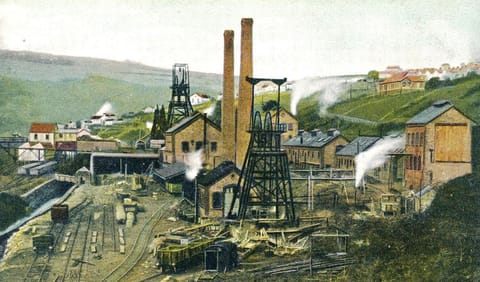
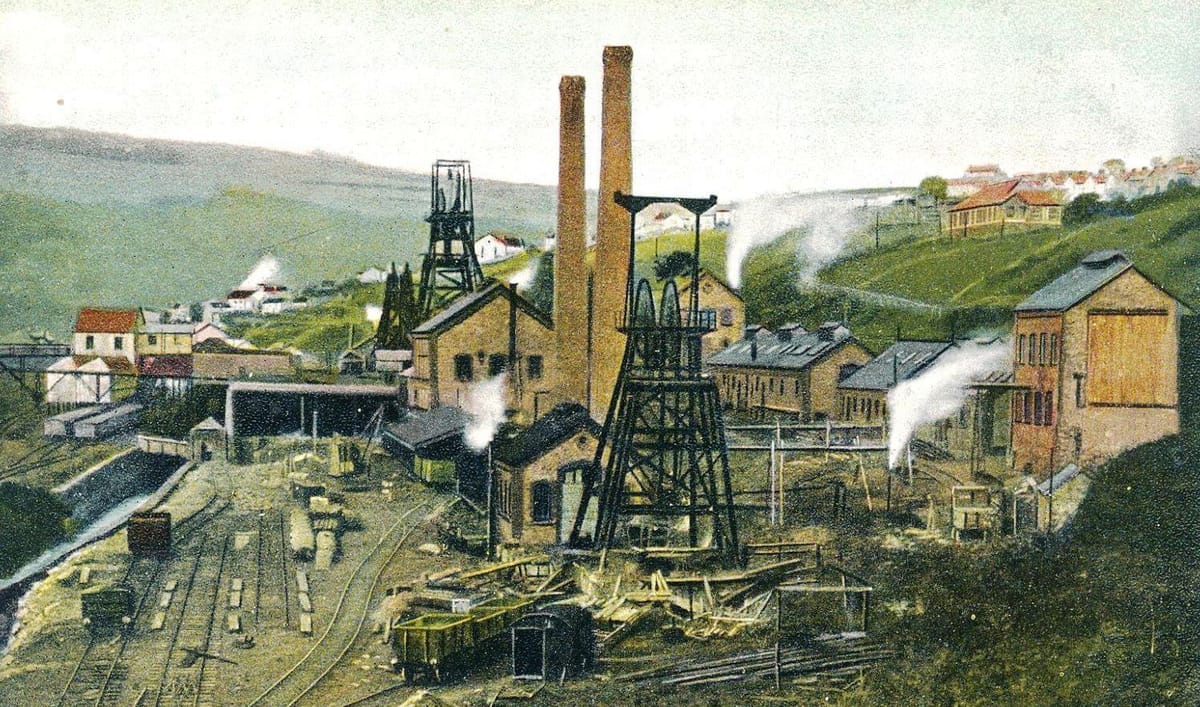
At the bottom of the Rhymney Valley, on a strip of land so narrow that two railways and a River had to squeeze past the winding gear, the pit at Bargoed once ran day and night. Cages dropped men more than 600 yards underground, coal rattled to the surface by the hundred tons, and the smoke of the coke ovens hung over the terraces. Little of it survives, but the story is well documented, and it tells us a great deal about the South Wales coalfield at its height.
A Pit on the Valley Floor
Bargoed Colliery was the work of the Powell Duffryn Steam Coal Company, which began sinking in 1897. The site lay on the valley bottom beside the River Rhymney, and it was served by both the Brecon & Merthyr Railway and the Rhymney Railway. The first coal was raised in 1901, and the engines were formally started in November 1903 by Sir Alfred Thomas, MP for East Glamorgan.
Two main shafts, the South Pit and the North Pit, each 21 feet across, reached the steam coal seams just below the Lower Nine Feet, a depth of more than 600 yards. The South Pit carried fresh air down and wound coal, men and materials. The North Pit took the used air out. A third shaft at Brithdir, sunk shortly afterwards, tapped a shallower seam of house coal at about 193 yards and raised its first coal in 1904.
Engineering Above and Below Ground
By the standards of the day Bargoed was a thoroughly modern colliery. Each shaft had steel double-decked cages, and each deck carried two trams holding about 30 hundredweight of coal. A cage could make the trip from pit bottom to surface in around 50 seconds, which allowed a rate of several hundred tons an hour. A large fan drew roughly 450,000 cubic feet of air a minute through the workings.
Water was a constant problem. Powerful Sulzer pumps worked at the North Pit, and the Brithdir shaft was so wet that an estimated eight tons of water came up for every ton of coal.
On the surface, a washery built in 1905 by the Coppée Company sorted the small coal into five sizes. The finest grades went by aerial ropeway to the coke ovens. There were 150 of these, 100 Koppers and 50 Simplex. A by-product plant recovered tar and other chemicals, and the surplus gas helped to generate electricity for the colliery.
The Record of 1909
Bargoed's name became widely known for its output. On 10 December 1908 a ten-hour shift produced 3,562 tons of coal, a record at the time. The colliery beat its own figure on 23 April 1909, when 4,020 tons were wound in a single shift. That total is said to have stood until 1950.
By 1910 the pit employed 1,943 miners and was the largest in the Rhymney Valley. The town grew around it, and the colliery dominated working life there for generations.
Danger, Depression and Nationalisation
Success came at a human cost. In the last four months of 1902 alone, the colliery's records show deaths from falls of roof and a drowning in the sump at the pit bottom. Such accidents were a grim feature of every South Wales pit.
After the First World War the coalfield lost markets. German reparation coal and cheap coal from countries rebuilding their economies undercut Welsh exporters. Bargoed was also affected by a long stoppage while the company developed the lower seams from the North Pit. Full production resumed in March 1929.
When the industry was nationalised in 1947, Bargoed had become a central base for Powell Duffryn's operations. The site held a power station feeding other pits through some 120 miles of power lines, 86 coke ovens, a training centre, central stores and workshops. In June 1949 the Duchess of Kent went underground at the pit. Later that year, on 26 November, the Brithdir pit closed, and it was used as a training centre for many years. The old coke ovens were pulled down and pithead baths were built on their site.
Closure and Clearance
Bargoed Colliery closed on 4 June 1977, on grounds of economics. Only about 360 men were still employed there, a small fraction of the workforce of its prime. Filling of the shafts began on 27 July 1981 and took some 89,500 tonnes of material.
The buildings were cleared. Between Bargoed and Aberbargoed stood a huge colliery tip, said to have been the largest man-made waste tip in Europe and about 400 feet high in the 1970s. In the 1980s and 1990s it was landscaped and became Bargoed Woodland Park.
A Valley's Memory
Few traces of the headframes and chimneys remain, yet the colliery shaped Bargoed more than any other single thing. It brought workers and their families to the valley and fixed the pattern of its streets and its trade. The scale of its operation and its record-breaking output also made it one of the most important pits in the South Wales coalfield. Today, walkers on the reclaimed slopes are standing on the spoil of that effort.