
Troughs Over the Taff: The Story of Pont y Cafnau
Just below the point where the Taff Fawr and the Taff Fechan meet to form the River Taff, a short, dark iron bridge spans the water. Walkers cross it without ceremony, their footsteps ringing faintly on the metal. Yet in the summer of 1793 the same crossing carried loads of limestone and rushing channels of water towards one of the busiest ironworks on earth.
Today, we look at Pont y Cafnau, the 'bridge of troughs' in Merthyr Tydfil, and at how a carpenter-turned-engineer built something that has outlived the industry it served.
An Ironworks with Big Appetites
The Cyfarthfa Ironworks was founded in 1765 and, by the early 19th century, had grown into the largest ironworks in the World. Making iron on that scale demanded two things in huge quantities: limestone, which was added to the blast furnaces, and water, which drove the machinery.
In 1771 the works secured the right to quarry limestone at Gurnos, on the hillside across the valley. Moving stone from the quarry to the furnaces required a tramway, and one with a gauge of 4 feet (1,219 mm) was laid in 1792 and 1793. The tramway had to cross the River Taff, and that crossing is where Pont y Cafnau comes in.
Watkin George and a Carpenter's Eye
The bridge was designed by Watkin George. He had trained as a carpenter, but in 1792 he became chief engineer of the ironworks and a partner in the business. The timing matters: the tramway and the new bridge were among the first big projects of his new role.
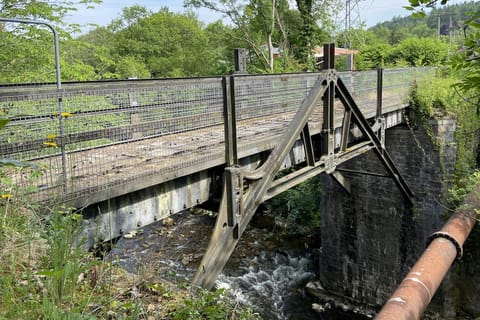
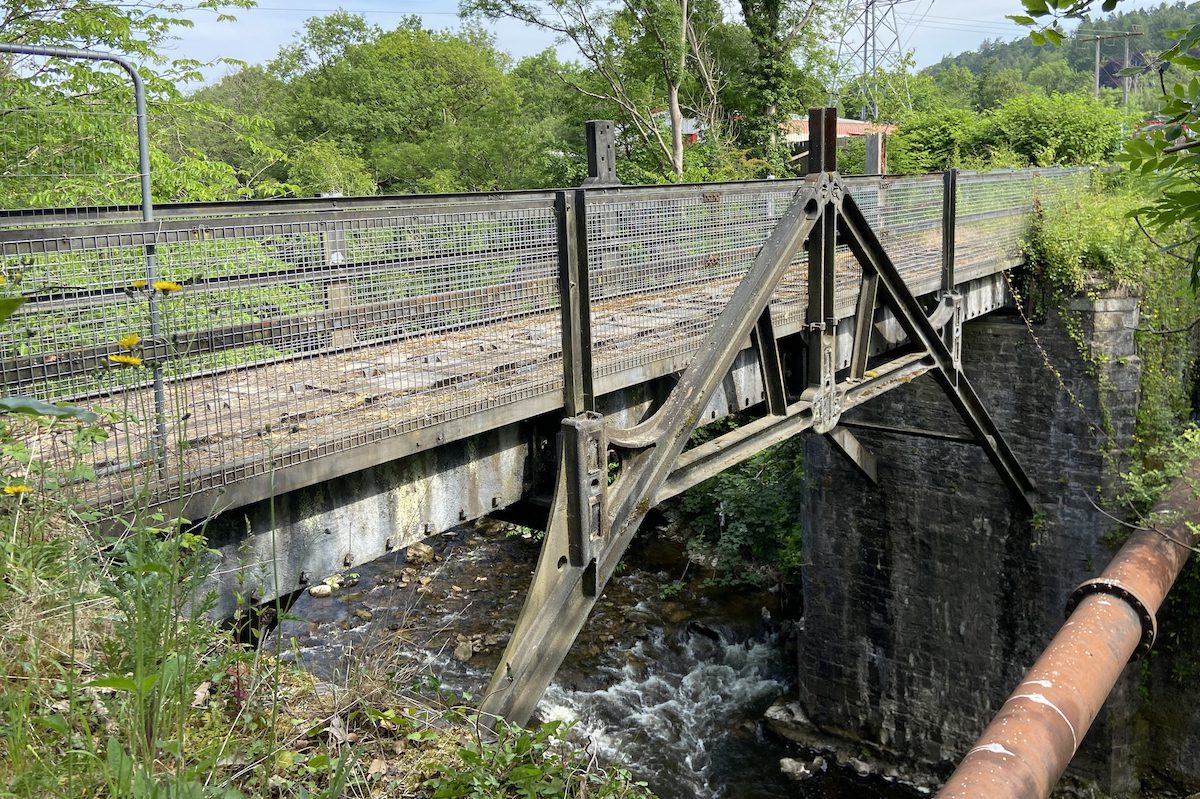
A wooden structure had stood at the site before, and it was replaced by the iron bridge, built between January and June 1793. George's background shows in the detail. Iron was a new material for engineers, so he joined it in the way he knew best. The members of the trusses are fixed with dovetail joints and mortise and tenon joints, techniques borrowed from timber framing rather than from metalworking.
How the bridge is built
The structure is just over 14 metres (47 feet) long and is made of cast iron. It has two A-frame trusses, which support a rectangular iron trough measuring 2 feet by 6 feet 2 inches. That trough did two jobs. It carried water, and it also acted as a girder beneath the plates that served as sleepers for the tramway. The rail chairs were cast as part of those plates, which avoided the need to fix them separately.
Three Levels over the River
What makes Pont y Cafnau unusual is that it was never only a railway bridge. It was a crossing for three separate flows, stacked one above another.
- Top level: an elevated aqueduct bringing water from the Taff Fawr. It crossed the Taff Fechan, then the Taff, and fed a 50-foot cast-iron water wheel known as Aeolus.
- Middle level: the tramway carrying limestone from the Gurnos Quarry into the works.
- Lower level: a trough carrying water from the Taff Fechan to the Cyfarthfa brick works.
Wooden uprights, attached to iron risers passing through the apex of each A-frame, held up the highest trough. Weirs had been built on each river upstream of the works, and leats led the water from them to the site. The bridge was the point where those channels and the tramway all met the same obstacle at once.
Change and Survival
Industrial sites are rarely static, and the water supply was reorganised over time. By 1850 the elevated trough that carried the Taff Fawr water had been removed, replaced by a leat running along the south bank of that river. The bridge lost its top tier, but the iron trusses, the lower trough and the tramway deck remained.
The great furnaces and wheels of Cyfarthfa later fell silent, and much of the infrastructure around them disappeared. Pont y Cafnau survived, perhaps because it was solidly made and still useful as a crossing.
Pont y Cafnau Today
The bridge is now a Grade II* listed building, listed on 22 August 1975, and a Scheduled Ancient Monument with the reference GM424. It has been refurbished by the local authority and is used as a footbridge, so visitors can still walk across it and see the joints up close.
It is generally described as the world's earliest surviving iron railway bridge. That claim rests on its date of 1793, which predates the better-known railway ironwork of the 19th century. Its setting, between the river and the remains of the ironworks, is a quiet spot to reflect on the scale of what once happened here.
A Lasting Legacy
Pont y Cafnau is modest in size and was built for purely practical reasons. Its lasting value lies in what it records: an early moment when cast iron was trusted to carry both rails and water, and when a carpenter's skills were translated into a new material. In Merthyr Tydfil, a town defined by iron, it remains one of the most direct links to the first years of that story.