
Stone Across the Floodwater: Pont Fawr, Llanrwst
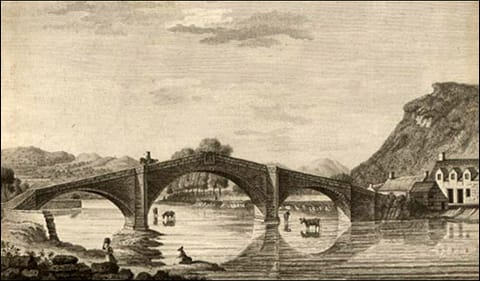
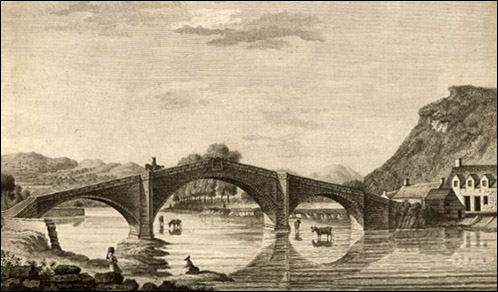
Approach Llanrwst from the Gwydir side on a still morning and the bridge appears all at once: a steep, humped crossing of dark stone, its arches reflected in the River Conwy and a whitewashed old building crouched at its foot. Pont Fawr, the Great Bridge, has linked two banks of the Conwy Valley for nearly four hundred years. It has been rebuilt in part, battered by floods and scraped by lorries, and it still does its job.
This is the story of how it came to be built, who may have designed it, and why it remains so loved.
A Crossing Lost to the River
The Conwy is a powerful river, and it was the reason a new bridge was needed. Pont Fawr replaced an earlier crossing at Llanrwst that had been destroyed by flooding. Surviving estate papers show that the decay of the old bridge was a matter of official concern by the summer of 1633, and permission to rebuild was granted in 1634.
The town had good reason to want a dependable crossing. Llanrwst grew up as a market town in the valley, and a reliable link across the water mattered to traders, travellers and the great household across the river.
A Commission from Gwydir
That household was the Wynn family of Gwydir, whose Tudor manor house stands just across the river from the town. The bridge is associated with Sir Richard Wynn (1588–1649), who held the post of Treasurer to Queen Henrietta Maria, the wife of King Charles I. The bridge helped connect the Gwydir estate with scattered parts of its land, as well as with the town itself.
Work was completed in 1636. That date is carved on stones set into both sides of the bridge, so the year is easy to confirm for anyone who walks across.
Did Inigo Jones Draw It?
For generations the bridge has been credited to Inigo Jones, the celebrated architect who served as Surveyor of the King's Works. The tradition is understandable. Wynn moved in court circles and had links to Jones, who designed a memorial plaque for Wynn that was placed in Llanrwst church.
No document, however, ties Jones directly to the bridge. Architectural historians have treated the idea with care. Edward Hubbard judged it far less improbable than many other Jones attributions in Wales, and John B. Hilling has pointed out that the rebuilding was ordered by the King's Privy Council while Jones held his royal post. The honest summary is that the attribution is plausible, popular and unproven.
Reading the Stonework
The bridge is about 51 metres (167 feet) long. It has three arches and two piers standing in the water, and it is built of roughly coursed rubble, a mixture of local gritstone and Welsh slate. The cutwaters, the pointed stones that face the current, are carried upwards to form small triangular refuges where pedestrians could step aside from passing carts.
Near the crown of the bridge, carved coats of arms sit above the datestones. One side bears the royal arms of the Stuarts with the initials CR, for Carolus Rex, meaning King Charles. The other carries the Prince of Wales's feathers with the initials for Carolus Princeps, a reference to the young Prince Charles. A bronze sundial on one parapet was added to mark three centuries of the bridge.
Floods, Repairs and Close Shaves
The river has never fully accepted the bridge. One of the arches was rebuilt in 1675 and again in 1703 after flood damage, and Hubbard later remarked on the poor quality of that repair work.
The modern threat is traffic. Pont Fawr was designed for horses and carts, yet it still carries cars, vans and the occasional coach on the road between Llanrwst and Trefriw. The steep camber hides oncoming vehicles until they reach the top, and drivers must often reverse or negotiate with strangers. Parapets have been struck many times, including three times in one ten-day spell in October 2013. In 2024 Conwy County Borough Council and the Welsh Government set up a joint study to look at ways of improving the crossing without spoiling it.
Pont Fawr Today
The bridge was listed Grade I on 25 January 1951 and is also a Scheduled Monument. Because it straddles the boundary between the communities of Llanrwst and Trefriw, it has more than one official entry.
Visitors usually come for the view. Beside the bridge stands Tu Hwnt i'r Bont, a 15th-century building now used as a tea room, which has appeared in countless photographs of the valley. Pont Fawr also forms part of local walking routes, and crossing it on foot allows you to appreciate its proportions properly.
What lasts here is the sense of continuity. A crossing commissioned in the reign of Charles I, perhaps with a famous architect's help, still lets people travel between town and estate, and the Conwy still runs beneath it. It is a working bridge as well as a listed one, and that is a large part of its appeal.