
Seven Arches Over the Alyn: Caergwrle Packhorse Bridge
Water runs brown and quick beneath the low arches at the edge of Caergwrle, and the bridge above it is barely wide enough for two people to pass. Its parapets are worn and its stones are crowded by trees. For more than three and a half centuries it has carried travellers over the River Alyn, first with their ponies and loads, and now with walkers and curious visitors.
Today we follow the path across Caergwrle Packhorse Bridge. We look at who built it, why it was made so narrow, and how it came close to being lost.
A Crossing Older Than the Stone
There has probably been a crossing here for as long as there has been a village. Caergwrle grew in the shadow of its castle, begun in 1277 by Dafydd ap Gruffudd after Edward I granted him the lordship of Hope. The village suffered badly in the centuries that followed. Owain Glyndŵr's forces laid waste to the area in 1403, and by the time John Leland toured Wales between 1536 and 1539 he described the place as decayed.
A bridge linking Caergwrle with the parish church at Hope is thought to have existed since medieval times. It was presumably built of timber, and it was in a poor state by 1654. Wood does not last long in a river that rises fast after rain, and the people of both settlements needed something better.
Squire Yonge's Seven Arches
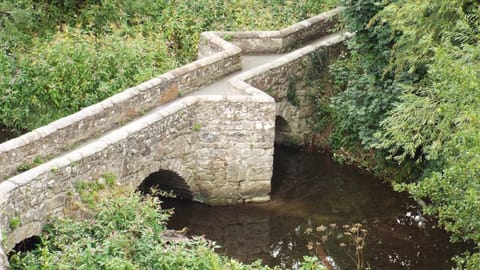
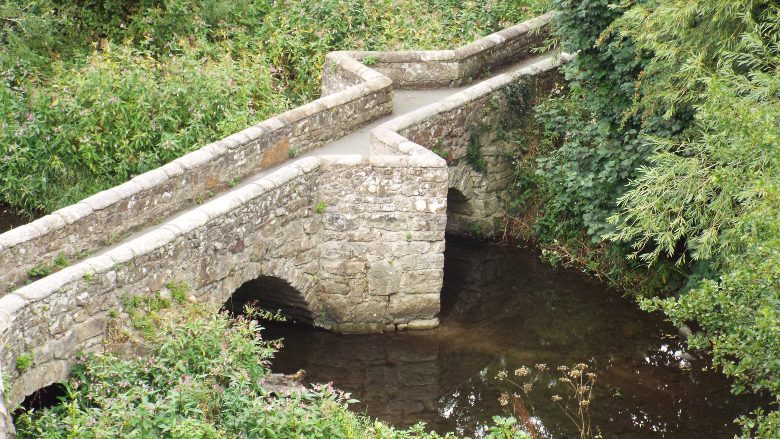
The stone bridge dates from the middle of the 17th century. It is associated with Squire Ellis Yonge of Bryn Iorcyn, the manor house on the hillside above the crossing, who is remembered as the man behind it. Seven arches carry the bridge over the Alyn and its flood channels, with the low, rounded spans typical of the period.
The date matters because the Alyn has few crossings of this age. The bridge is generally regarded as probably the oldest over the river, and it is often described as one of the finest packhorse bridges in Wales. Its builders were working in an age before turnpike roads and wheeled freight were common. Goods still moved across country on the backs of animals.
Built for Ponies and Passers-By
The shape of a packhorse bridge
A packhorse bridge is narrow because it never had to take a cart. Trains of ponies or mules, sometimes as many as thirty animals led by a few men, carried wool, grain, salt, coal and other goods along established routes. The animals carried their loads in panniers slung at their sides, so they needed only a path that was firm and dry, with low parapets that would not catch the baskets.
Refuges in the parapet
The most telling detail at Caergwrle is a pair of triangular recesses set into the parapet walls. A pedestrian who met a string of laden ponies halfway across had nowhere else to go. These small refuges let people step out of the way until the train had passed.
A route through the hills
The bridge sat on a recognised route linking Chester with the uplands towards Bala. The same path can be followed past Bryn Iorcyn and along the southern foot of Hope Mountain to the smaller packhorse bridge at Ffrith, which crosses the River Cegidog. John Ogilby's road atlas of 1675 shows Caergwrle on the main road between Wrexham and Mold, so the village stood at a busy junction of old ways.
Flood, Weeds and Vandals
In November 2000 severe flooding came close to destroying the bridge. Its arches had silted up and trees had taken root in the masonry, which weakened the structure. When the water rose, the bridge gave way. Repairs cost about £100,000, shared between the Welsh Assembly and Flintshire County Council, and the rebuilt crossing is a credit to the people who pushed for it.
The story did not end there. In later years the bridge was damaged by vandals, who broke off coping stones and threw them into the river. Saplings began to root in the walls once more. Flintshire's Streetscene team cleared the trees, removed weed and silt from the blocked arches, uncovered one that had almost disappeared and opened another channel to carry floodwater. The work rested on a simple lesson: a bridge that cannot pass water cannot stand for long.
Caergwrle Packhorse Bridge Today
The bridge stands in Flintshire, in north-east Wales, and is a listed structure protected for its architectural and historic interest. It lies within a short walk of the village centre, near Fellows Lane, with Hope Mountain rising behind. Visitors can still cross it on foot and look for the two recesses in the parapets.
Like many old crossings, it has gathered stories. Local people say it is haunted, and ghost hunters have reported a photograph taken during an overnight vigil, which some believe shows Squire Yonge himself. There is also a local saying, "live in Hope, die in Caergwrle", which recalls the days when Hope lacked a burial ground. Whatever one makes of the ghosts, they show how much affection the bridge attracts.
A Small Bridge with a Long Memory
Caergwrle Packhorse Bridge was never grand. It was built to serve a farming district that depended on animals and footpaths, and it has outlasted the trade that justified it. Its seven arches and tiny refuges are a reminder of how goods once travelled across Wales. It survived the flood of 2000 and the harm done by vandals, and it still stands over the Alyn.