
Ivy on the Parapet: The Short Bridge, Llanidloes
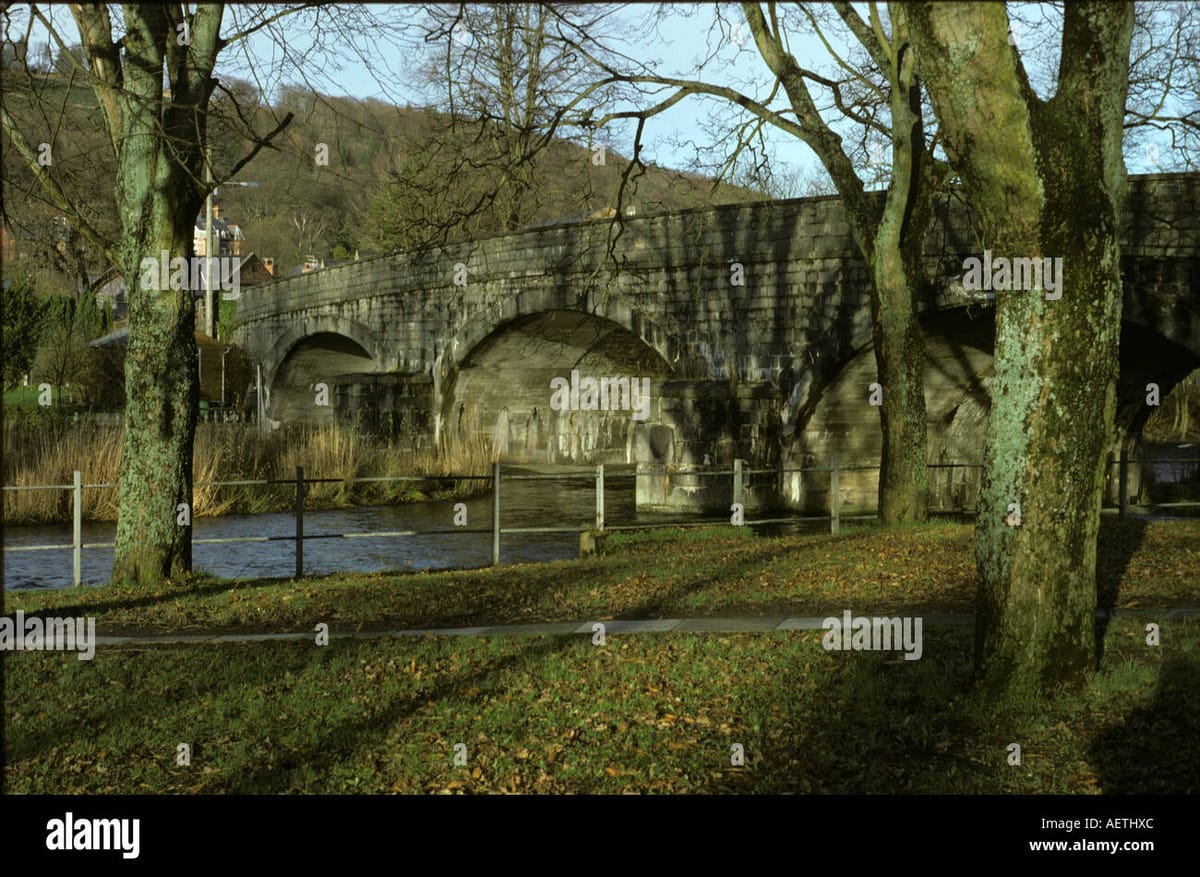
At the western end of Short Bridge Street, the pavement runs out of town and onto a single stone arch. Below it the River Severn, still young and quick this far from the sea, slides over its stony bed. Ivy clings to the masonry, and beside the bridge stands the tall, plain shape of an old flannel mill. This is the Short Bridge at Llanidloes, a modest structure with a good deal of history behind it.
Here is how it came to be built, what it carried, and why people still tell stories about what lies beneath it.
A Town Between Two Crossings
Llanidloes grew where the Severn is joined by the Afon Clywedog and the Afon Dulas, on a broad terrace of the upper valley. Its name recalls Idloes, the Celtic saint who is said to have founded a church beside the river in the 7th century. The town prides itself on being the first on the River Severn, and its street plan reflects that. Long Bridge Street leads to the Long Bridge, and Short Bridge Street leads, as you might expect, to the Short Bridge.
The Long Bridge, completed in 1826, crosses the river close to where the Clywedog joins it. The Short Bridge came a generation later and serves the western side of town, where the road leads out towards the hills.
Penson's Single Arch
Both bridges are the work of Thomas Penson, the County Surveyor, who designed a number of stone bridges across Montgomeryshire in the first half of the 19th century. The Short Bridge was begun in 1849. A plaque names Penson as surveyor and Edward Jones as builder, and the bridge is often dated to 1849 or 1850. It replaced an older timber bridge that had become unsafe.
Cadw describes it as a single segmental arch of heavily tooled, coursed rubble, wide enough for two lines of traffic. A segmental arch is a shallow curve, less than a full semicircle, and it suited a river that could rise quickly after rain in the Welsh hills. The bridge was listed at Grade II on 10 April 1989, recognising it as a well-preserved piece of mid-Victorian engineering.
The Mill at the Bridgend
The bridge's immediate neighbour tells you why a town of this size needed a second crossing. Llanidloes made its living from Welsh flannel, and by the later 18th century the industry had pushed it into the ranks of the larger towns in Wales. The Bridgend Factory, built in 1834 beside the Severn, used water power. It housed a carding engine on the ground floor, with spinning mules and looms on the floors above.
The arrival of railways in the 1860s did not rescue the trade. Better transport let the mass-produced cloth of the northern mill towns reach Welsh markets, and the local mills struggled. The Bridgend Factory was the last of the Llanidloes flannel mills to close. The tall building now stands as one of the few reminders of how large the industry once was.
Hard Times and Chartism
The town's textile workers also made their mark on national politics. In April 1839, during a period of hardship, Chartist feeling in Llanidloes boiled over into rioting. The authorities lost control of the town for a time and soldiers were needed to restore order. Several men were later sentenced, three of them to transportation. The bridge was not yet built, but the mill stood in the same streets where those events unfolded.
The Ghost Under the Arch
The Short Bridge is best known today for a piece of folklore. According to the story, a bottle hidden beneath the bridge holds the restless spirit of Lady Jeffries, who could not lie quietly in her grave because of her misdeeds. She is said to be freed only when the ivy growing on either side of the bridge meets in the middle and reaches the parapet. Nobody can say how old the tale is, but it has kept the ivy a subject of local interest. It is worth looking for on a visit.
Visiting the Short Bridge Today
The bridge is easy to find. Walk down Short Bridge Street from the market hall at the centre of the town, past the Royal Head, a pub formed from the merger of two older inns. The road ends at the river, the old mill and the arch. You can cross on foot, look upstream and downstream along the Severn, and see how close the water runs to the stonework.
The rest of the town rewards a longer stay. Llanidloes has a famous timber-framed market hall, a medieval church with a hammer-beam roof and a museum in the Town Hall. Walkers can follow the river upstream towards its source on Pumlumon.
A Small Bridge with a Long Memory
The Short Bridge is no grand monument. Its significance lies in the way it ties together the story of Llanidloes: a county surveyor's practical design, a mill that outlasted its rivals, and a town that has held on to its stories. Though it has long since stopped being the busiest road in town, it still takes people across the first river crossing of the Severn's long journey to the sea, and the ivy is still growing.