
Embers on Carmarthen Road: The Story of Libanus Chapel
In the dark before dawn on Saturday 21 January 2012, firefighters were called to a chapel beside a busy roundabout in Cwmbwrla, on the northern side of Swansea. By the time the flames were out, a building that had served its community for generations was beyond saving. Its front wall had been a familiar sight to drivers on Carmarthen Road for well over a century.
Come with us to Cwmbwrla to trace the history of Libanus Chapel, from its eighteenth-century beginnings to the night it was lost.
A Congregation Takes Root
Cwmbwrla sits on rising ground roughly a mile north of Swansea city centre. It takes its name from the valley of a small stream, the Burlais Brook, which now runs underground. In the nineteenth century the district filled with workers' housing as Swansea's copper and other metal industries expanded, and chapels sprang up to serve the new population.
The roots of Libanus go back to the middle of the eighteenth century, when a modest chapel stood on the site. For a time it was a daughter church of Mynyddbach Chapel, one of the older nonconformist meeting places in the area. Around 1826, in the wake of a religious revival, the congregation became independent and began to manage its own affairs. The name Libanus, the Welsh form of Lebanon, is a typically biblical choice for a Welsh chapel.
A Larger Chapel for a Growing Flock
By the 1860s the old building was too small. A new chapel opened in 1867, at a time when the congregation numbered more than 600 people. The land for it was donated by the industrialist Sir John Morris, 1st Baronet, a leading figure in Swansea's industrial life and a benefactor to several local causes.
A Sunday school followed in 1873. For many Welsh families the Sunday school was the centre of weekly life: a place to learn to read, to memorise scripture and to sing. Its date shows how firmly Libanus was established by the 1870s.
The Classical Front of 1906
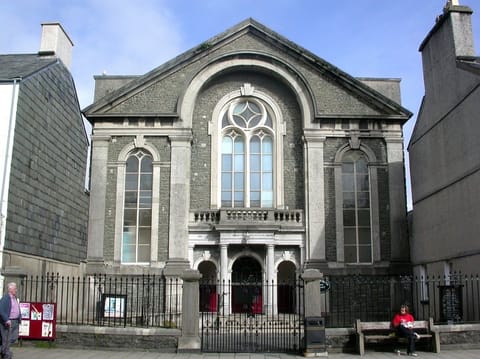
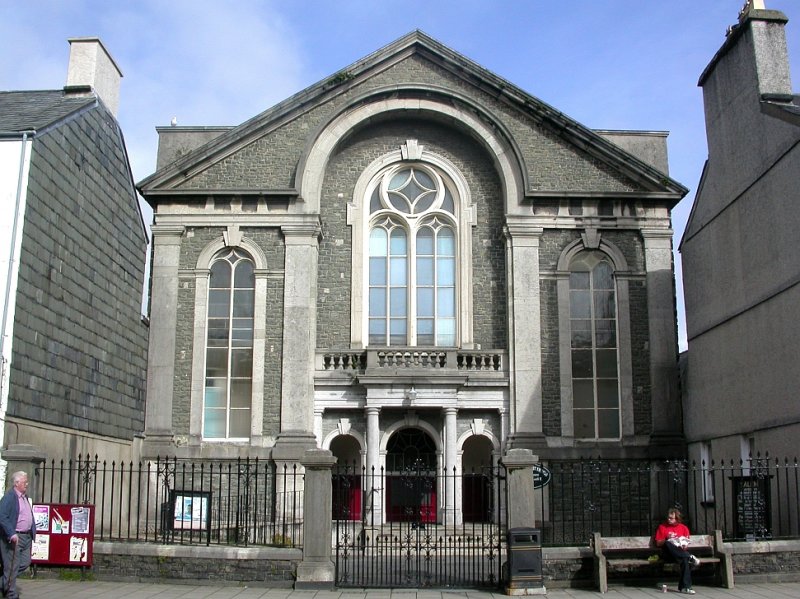
The chapel that most people remembered dates from the early twentieth century. Records describe work completed in 1905–06, and accounts differ on whether this was an extension of the 1867 building or a new chapel built next to it. The Royal Commission's record notes that the earlier 1867 building was still standing beside the later one.
The later chapel was built in a classical style. Its two-storey frontage was faced in pale Bath stone, with darker rubble on the ground floor. It had pilasters, a pedimented centrepiece, a large arched feature in the facade and scrolled ornament above. Balustraded side bays carried urns at the corners. Grand fronts of this kind were meant to show that a nonconformist congregation could build as confidently as the established church.
Cadw listed the chapel at Grade II on 30 March 1987, recognising its architectural interest. Listing records place it facing the modern roundabout at Cae Bricks. They name it Libanus Baptist Chapel, though other published accounts place it in the Congregational tradition, a reminder that the labels of Welsh nonconformity were not always applied consistently.
Decline and Closure
Libanus followed a path common across Wales. Through the twentieth century, congregations shrank as habits changed, younger families moved away and Welsh-language chapel life lost its central place in community affairs. A building made for hundreds could no longer be kept up by a handful of members. Libanus closed in 2000.
Closure did not bring a new use. Empty chapels are costly to heat, insure and repair, and few attract buyers. Even a listed building can drift into neglect, and Libanus stood quietly beside the traffic for the next twelve years.
The Fire of 2012
The blaze was discovered at 4.20am on 21 January 2012. At its height about 50 firefighters were at the scene. Media reports at the time suggested the fire had been started deliberately.
The damage was severe. Because of the risk to the public, it was announced that what remained would be pulled down for safety reasons, and the demolition went ahead quickly. Some local people felt the decision was too hasty and that the facade might have been saved, a view reported in the local press a few days later. The loss of a listed building so soon after a fire is a familiar and painful debate in heritage circles, and it left a gap on the roundabout that is still noticed.
Libanus Chapel Today
The chapel is gone, though it has not been forgotten. It is recorded in the national inventory of Welsh historic sites, and it is remembered in local histories of Cwmbwrla and in studies of Swansea's industrial landscape, where it stands for the chapel-going culture that grew up alongside the copper works.
Libanus is also a lesson in how fragile unused historic buildings can be. For over 250 years, from a small eighteenth-century chapel to a classical landmark, it gave a working neighbourhood a place to worship, learn and sing together. Anyone passing the Cae Bricks roundabout today is passing the site of one of Swansea's most characteristic Victorian and Edwardian institutions.