
Deepest Shafts in the Coalfield: Nantgarw Colliery
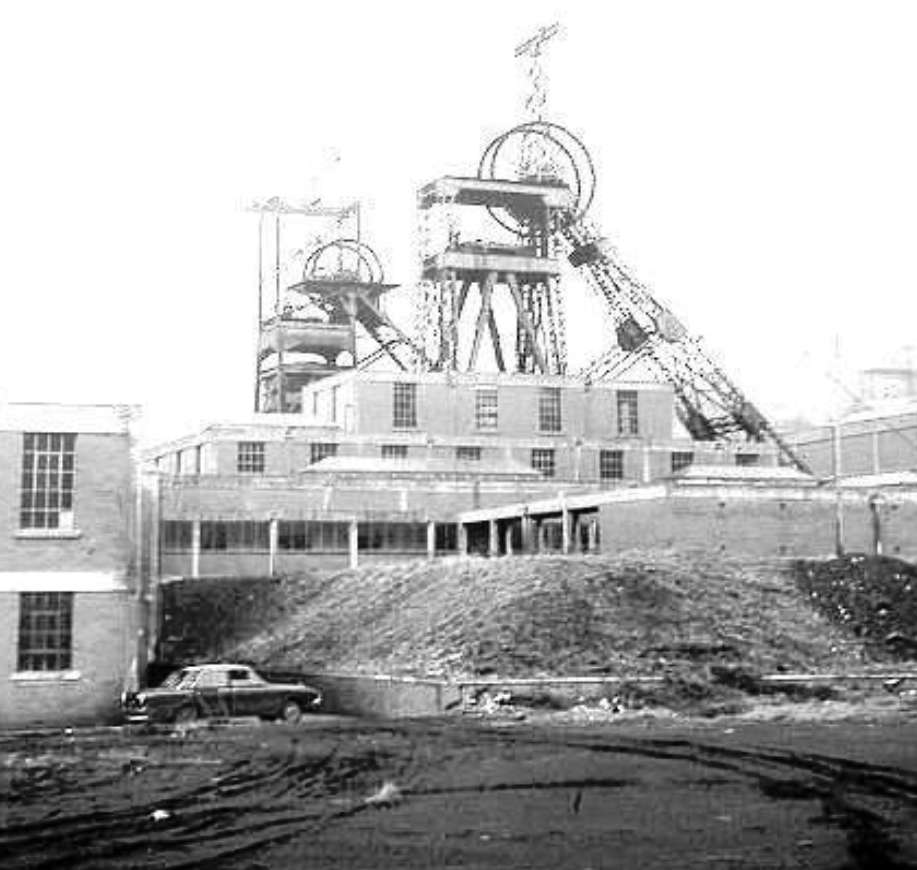
Drive along the Taff Vale today and you will pass the tidy units and car parks of Parc Nantgarw, with little to suggest what lay beneath them. For most of the 20th century this ground belonged to a colliery whose shafts plunged deeper than any then sunk in the South Wales Coalfield. It was a pit of great ambition and awkward geology, and it took more than forty years to reach steady production.
This article follows Nantgarw Colliery from its first sinking to its closure in 1986.
A Valley Floor Prone to Flooding
Coal had been worked here before. Craig yr Allt Colliery stood close to Nantgarw village, but the River Taff repeatedly flooded its workings, and it was abandoned in 1878. The lesson, that the low ground beside the river was a difficult place to mine, would resurface in the story of its successor.
Nantgarw lay near the edge of the Caerphilly Syncline, where the coal measures dipped away to considerable depths. Reaching them would demand deep shafts and a good deal of capital.
Sinking to Record Depths
Thomas Taylor of Pontypridd began developing the colliery in May 1910. Twin shafts were sunk from 1911, and in 1915 they reached the coal at a depth of more than 850 yards (about 780 metres). That made Nantgarw the deepest pit sunk in the South Wales Coalfield up to that time, a notable achievement in a region famous for its deep mines.
The colliery was linked to the Rhymney Railway by the Coryton Line, giving it a route to market. Yet depth brought no easy fortune. The coal lay in steeply tilted, disturbed strata, and the mine proved hard to work profitably.
False Starts Between the Wars
In 1924 the colliery was sold to the Taff Rhondda Navigation Steam Coal Company. Three years later, after serious geological difficulties, the pit was abandoned and its 850 men were redeployed elsewhere. Poor industrial relations were part of the reasoning behind that closure.
Powell Duffryn Steam Coal Company then bought the site. Further attempts at development followed, but the colliery was placed on care and maintenance. In 1937 Powell Duffryn drew up a new development scheme, though work was suspended in 1939 when the Second World War began.
A Model Colliery for a Nationalised Industry
Plans to revive Nantgarw were approved by the Ministry of Fuel and Power in 1946. After nationalisation in 1947, the National Coal Board invested £5 million in the site. The old workings were cleared and replaced by a purpose-designed colliery with modern surface buildings and equipment intended to reduce smoke and fumes.
Coal production began in 1952. By 1954 around 200 men worked on the surface and 820 underground.
Horizon Mining
To cope with the difficult geology, new landings were cut in both shafts at 280 and 380 yards. The mine was then worked by a method known as horizon mining. The main heading was driven through seams that dipped sharply, at about 36 degrees, including the No. 1 Rhondda, Bute, Brass and Hard seams.
Waste was tipped back into the shafts, to a level 60 feet below the new landings. This kept the surface free of the spoil heaps that scarred so many valley communities.
Coke, Steel and Phurnacite
Alongside the colliery, the National Coal Board opened coke ovens and a by-product plant in 1951. The works produced furnace and foundry coke for the steel industry, supplying Welsh plants at Ebbw Vale, Llanwern and Port Talbot, as well as customers abroad, including Romania.
Nantgarw also stored Phurnacite, a smokeless fuel for the domestic market. It was made at Abercwmboi in the Cynon Valley and held at Nantgarw until sold.
The Final Decades
Labour relations remained unsettled. In 1958 the pit recorded 65 stoppages, go-slows and walk-outs. It survived the wave of closures in the 1960s, but geological trouble persisted, and in 1974 the colliery's own workings came to an end. From 1975 it was combined with Windsor Colliery at Abertridwr, near Caerphilly.
The merged unit did well for a time. By 1979 it employed around 650 men and produced more than 4,000 tons of coal a week, making a profit of over £0.5 million. The tide turned in the early 1980s. The combined coal and coking operation lost £7 million in 1981, and output fell steeply in 1982 when a major seam at Windsor became unworkable. An overtime ban in 1984 helped to spread the miners' strike of 1984–85 to South Wales.
Although the unit was profitable after the strike, it was not saved. Both sites closed on 6 November 1986 as part of a National Coal Board regional review.
Nantgarw Today
The colliery buildings were demolished soon after closure, and the land was redeveloped as the Parc Nantgarw industrial estate. Few visible traces of the pit remain.
Nantgarw's legacy lies in its engineering and in the people who worked it. Its twin shafts were the deepest of their day, and the model colliery rebuilt after the war was among the National Coal Board's most ambitious projects. For the men who spent their working lives on its landings and at its coking ovens, it was a long-running and often difficult workplace, and it remains an important part of the industrial history of the Taff Vale.