
Bonnets in the Moonlight: The Story of the Rebecca Riots
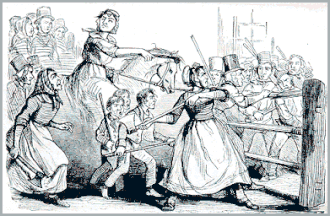
On a dark night in the early 1840s, a crowd gathers on a lane in Carmarthenshire. Horns sound across the fields. Men stride out in long gowns, shawls and bonnets, their faces blackened, with a tall figure at their head who is addressed as 'mother'. Within minutes a toll-gate is in splinters and the crowd has melted back into the hills. Rebecca has called again.
Today we look at the Rebecca Riots, a rural protest that unsettled West and Mid Wales for four years and left a lasting mark on Welsh memory.
Hard Times in the Hills
The late 1830s and early 1840s were punishing for the farming communities of West Wales. Poor harvests in 1837 and 1838 pushed up the price of corn, and farmers had to buy grain to feed their families and animals. The south-west of the country was hit hardest, and what little savings people had were eaten away.
Things did not improve when the weather did. The harvest of 1842 was among the best in years, but corn prices slumped, and cattle prices fell sharply as well. Many blamed Robert Peel's tariff changes, which made it easier to import foreign livestock and meat. Demand from the Glamorgan ironworks also contracted. Farmers' incomes fell, but rents, tithes, poor rates and tolls did not fall with them, and some actually rose.
The Trouble with Toll-gates
Roads in Wales were largely run by turnpike trusts, which were meant to repair them using the money collected at the gates. In practice, some trusts charged heavily and spent the money elsewhere. Even well-run ones laid a further burden on poor communities.
Resentment sharpened when a group of toll-renters bought the right to collect tolls across several trusts and set about recovering their investment. The group was led by Thomas Bullin, who became a hated name. Particular anger fell on the side-bars, small gates placed on minor roads to catch travellers trying to avoid the main toll-houses. For farmers hauling lime to sweeten their fields, the charges were ruinous. One account claims that carting lime from the Cardiff docks to an upland farm cost ten times the price of the lime itself.
A Mother Named Rebecca
The first Rebecca appeared in 1839. At Efail Wen, near the Pembrokeshire–Carmarthenshire border, a crowd destroyed a new gate erected by the Narberth Turnpike Trust, and returned to finish the job when it was rebuilt. Local tradition names Thomas Rees, known as Twm Carnabwth, as the first to play the part.
The name is usually traced to the Book of Genesis, where Rebekah is blessed and told that her descendants will possess the gate of those who hate them. Followers called themselves Merched Beca, 'Rebecca's Daughters'. Their raids had a theatre of their own. The leader would pretend that something blocked the old mother's way, and the crowd would offer to clear it. Once the gate was identified as the obstacle, they destroyed it.
These early outbursts were sporadic. The true wave of rioting did not begin until the winter of 1842.
The Summer of 1843
As prices fell, the raids multiplied and spread across Carmarthenshire and neighbouring counties, and reached Mid Wales. Gates, toll-houses and sometimes the property of unpopular landowners were attacked, usually at night and often in large numbers. On 19 June 1843, a crowd several thousand strong marched on the workhouse at Carmarthen, a striking show of strength.
The authorities responded with more troops and police, and the national press, including The Times, sent reporters to the region. Meanwhile, the movement began to lose its focus. Some protesters wished to avoid violence, while criminals started to borrow the Rebecca disguise to settle private scores. On 6 September 1843, a Rebecca party attacking the gate at Pontarddulais was ambushed by police. Several men were arrested, and some of those convicted, including David Davies, known as Dai'r Cantwr, were transported to Australia.
Rebecca's Legacy
The riots had faded by 1844, but they had been heard. A government inquiry into the Welsh roads followed, and in 1844 Parliament passed an act to consolidate and amend the laws governing Welsh turnpike trusts. It brought order to a tangled system and answered some of the grievances that had sent men out in bonnets.
The Rebecca Riots are remembered as one of the most distinctive episodes of 19th-century protest in Britain. They show how a rural community, short of money and political voice, found a way to be heard through ritual, disguise and collective action. The story survives in books, songs and local memory across West Wales, and in the lanes where the gates once stood.