
Above the Floodline: St Mary Magdalene's Church, Goldcliff
An avenue of pollarded lime trees leads towards a low stone church, so close to the village pub that it is easy to walk past without noticing it. The land around is flat, drained by straight ditches and open to the weather coming off the Severn Estuary. St Mary Magdalene's Church at Goldcliff looks modest from the lane. Its walls, though, record a medieval priory, a ruinous storm and one of the worst floods in British history.
A Priory on the Shore
The church's story begins with a monastery rather than a parish. Shortly before 1113 the Norman lord Robert de Chandos founded a Benedictine priory at Goldcliff and endowed it with land on the coastal levels. It was dedicated, like the church that survives today, to St Mary Magdalene. It stood roughly a kilometre from the present church, nearer the sea, and in time it became one of the larger Benedictine houses in South Wales. By the 13th century about 25 monks lived there, and its estates were worth a considerable sum each year.
The foundation charter also mentions a church at Goldcliff, so worship for local people was already tied to the priory's fortunes. That link explains much of what followed.
Storm, Salvage and Rebuilding
In 1424 floodwater and storms badly damaged the priory. It was re-formed in 1442, but its position was never secure again. In the middle of the 15th century the Crown granted the priory to the newly founded Eton College, and by 1467 the monastic community had been formally abandoned. Eton remained connected with the parish for centuries. Its archives still hold the priory and parish records, and into the early 20th century the college was patron of the living.
The parish church was reworked in the years after the storm. Cadw dates the building to the 12th century, and the nave may well be that old. Much of what visitors see, however, belongs to a rebuilding in the 14th century and later. One theory is that an existing building, possibly a barn belonging to the priory, was converted into the church. Stonework above some of the south windows may have been taken from the damaged priory buildings.
The Water Mark of 1607
The church's most famous object is a brass plaque on the north wall of the nave, put up by the churchwardens in 1609. It remembers the flood that struck the Severn Estuary on 30 January 1607, when sea defences on both shores were overwhelmed. Hundreds of people died across the Gwent, Somerset and Gloucestershire Levels.
The plaque records the losses in this one parish. Twenty-two people drowned, and the damage was valued at more than £5,000, a vast sum for a small farming community. The metal is set at roughly the height the water reached, about three feet above today's floor. The plaque gives the year as 1606 because the calendar then in use began the new year on 25 March. It is a sobering thing to stand beside, and a reminder of why the levels are crossed by so many sea walls and drainage channels.
Victorian Hands and Later Additions
Tower and bell
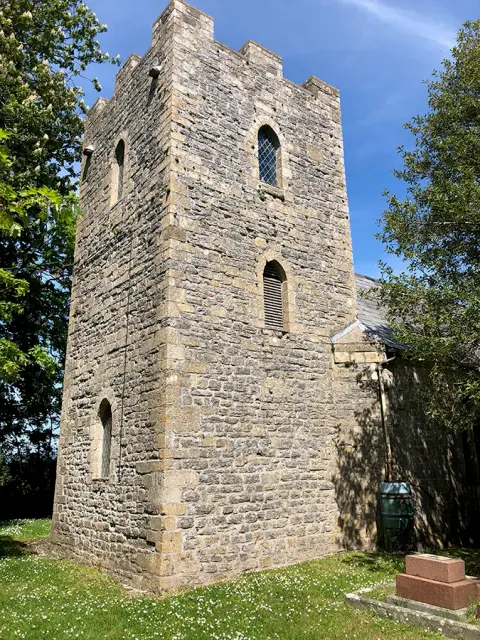
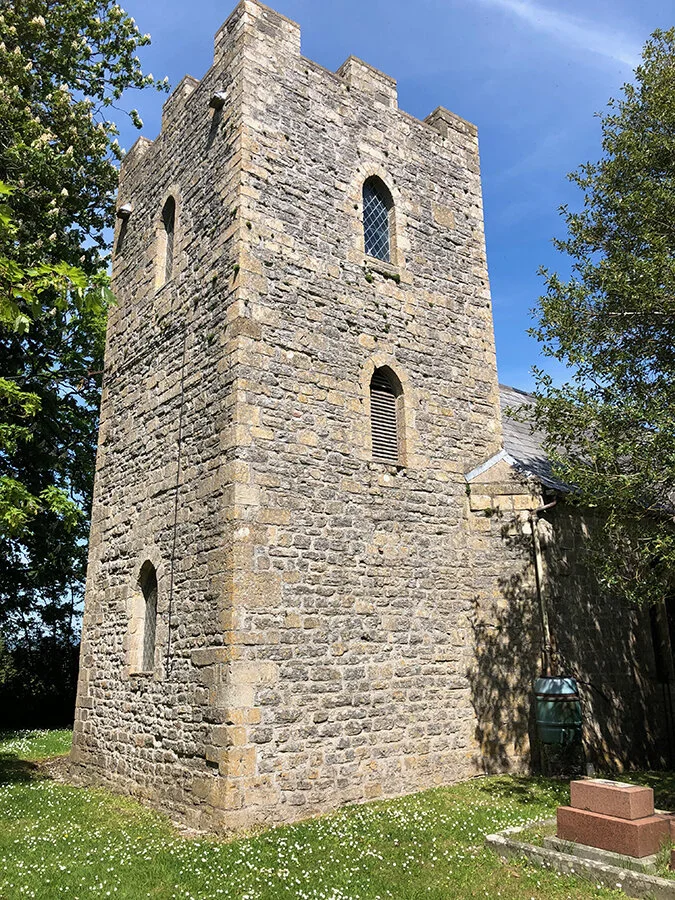
The battlemented west tower has three storeys and is probably an addition of the 18th or 19th century. It holds a single bell, recast by Taylors of Loughborough in 1969.
A Victorian rebuilding
In the 19th century the church was substantially reconstructed. Cadw and the Royal Commission on the Ancient and Historical Monuments of Wales both describe the work as austere, a restrained example of Decorated Gothic Revival. The result is a simple building of stone under a slate roof, with a south porch and a plain interior.
Smaller details
A medieval font survives, topped by an 18th-century cover. Above the porch is a sundial inscribed with the initials C.W. and the date 1729. A modest memorial remembers the three Goldcliff men who died in the First World War. The local historian Fred Hando wrote about the church in his 1958 book Out and About in Monmouthshire, and sketched it beneath its lime trees.
The Church Today
St Mary Magdalene was listed at Grade II on 1 March 1963. Its churchyard cross, a weathered medieval survival, is a scheduled monument. Drainage ditches still mark the edge of the roughly square churchyard, a small piece of the wider levels landscape.
It remains an active parish church of the Church in Wales and belongs to the Netherwent Ministry Area. That area stretches between Newport and Chepstow, from Nash on the Gwent Levels to Portskewett and Sudbrook on the Severn Estuary. Services are held fortnightly, so visitors should check times before travelling. The churchyard is a pleasant place to pause whenever the church is closed.
A Small Church with Long Memories
Goldcliff's church never grew into a grand building. Its value lies in what it has kept: a thread back to a Norman priory, the traces of a 15th-century storm and a brass plate that fixes a national disaster at the level of a single parish. Few churches on the levels show so plainly how closely life here has always depended on the tide.