
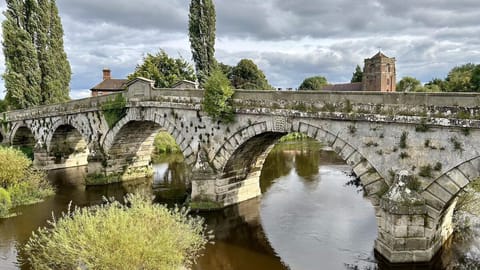
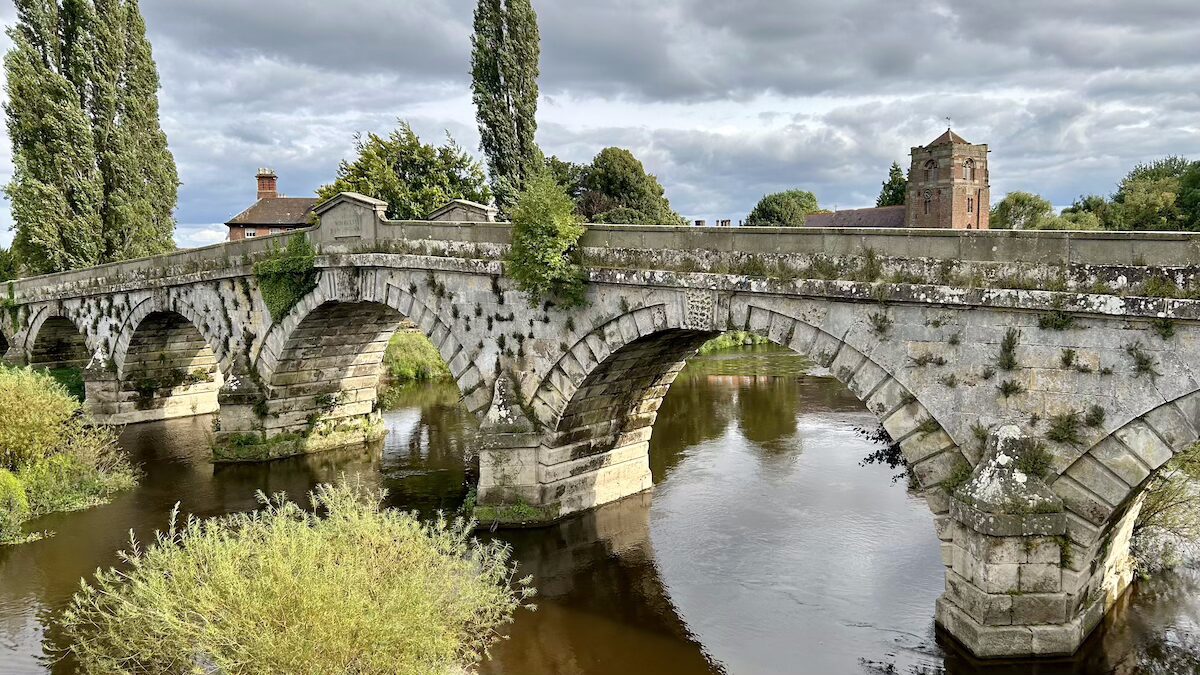
A Single Arch Over the Severn: Felindre Bridge
Follow the lane out of Llanidloes towards Llangurig and the road soon drops to the water. Here the River Severn is still young, quick and clear, running between wooded banks and open farmland. A single arch of grey stone carries the lane over it, its parapets sweeping outwards at either end as if to welcome travellers on to the span. This is Felindre Bridge, and although few visitors stop to look at it, it has served the people of this valley for well over a century and a half.
Today, we look at how a timber crossing became a stone arch in 1848, who designed it, and why it is protected as a listed building.
A Crossing Above Llanidloes
The Severn is the longest river in Britain, and it begins its journey on the slopes of Plynlimon, not far from here. By the time it reaches the hamlet of Felindre, close to Mount Severn, it is already a river that needs a proper bridge, particularly in winter, when rain on the Welsh uplands can turn it swiftly into a torrent.
The road between Llangurig and Llanidloes was a practical link for farmers, drovers and carriers moving between the upland parishes and the market town. Before 1848 the river was crossed here by a timber bridge, made up of three bays resting on two stone abutments. Timber was a common choice for rural crossings of the period. It was cheap and quick to build, but it needed regular repair and could suffer badly in floods.
Rebuilt in Stone, 1848
In 1848 the old timber structure was replaced with a masonry bridge. The reconstruction is recorded as costing about £600, a considerable sum for a lane crossing at the time, but one that bought a structure meant to last without constant maintenance.
The date places the work in a decade of great change for mid Wales. Railways were beginning to reshape the region's transport, yet the everyday business of moving people, livestock and goods still depended on roads and bridges maintained under county supervision. In Montgomeryshire, that meant the county surveyor.
The Surveyor Behind the Arch
Felindre Bridge is attributed to Thomas Penson, who held the post of county surveyor for Montgomeryshire from 1817 until his death in 1859. Born around 1790, Penson was the son of an architect and surveyor of the same name, and he trained under the Chester architect and bridge designer Thomas Harrison. His early career was shaped by a dramatic episode: after the bridge at Overton-on-Dee collapsed, his father was dismissed, and the younger Penson was involved in completing its replacement.
Based in Oswestry, where he later served as Mayor in 1840, Penson became one of the most prolific bridge designers in the region. One study of his work lists 62 bridges built to his designs in Montgomeryshire alone. Many cross the Severn, among them Caersws Bridge of 1821, the Long Bridge at Llanidloes of 1826 and Caerhowel Bridge of 1858. The town's Short Bridge, dating from 1850, is also his, and its plaque names him as county surveyor. Felindre Bridge belongs to this family of Severn crossings, and sits at the quieter, upstream end of the series.
Why masonry arches?
Penson is remembered chiefly for his masonry arch bridges. Stone was available locally, the skills to work it were widespread, and a well-built arch could withstand floods that damaged lighter structures. For a county with limited funds and many rivers, durability made good economic sense.
Reading the Structure
The official description of the bridge is brief and precise. It is a single segmental arch, meaning the curve forms a section of a circle rather than a full semicircle, built of coursed rubble. Coursed rubble is stone that is roughly shaped and laid in fairly level rows, a practical and handsome finish for a rural bridge. The parapets curve outwards at the ends and finish in piers, giving the approach a gentle flare.
The listing dates the bridge to the mid 19th century, in keeping with the 1848 rebuilding. It is a Grade II listed building, the category given to buildings of special interest. The structure straddles an administrative boundary, so it appears in the records as lying partly in the community of Llanidloes and partly in Llangurig, and it was historically part of Montgomeryshire, now within Powys.
Felindre Bridge Today
The bridge still does the job it was built for, carrying a lane between Llangurig and Llanidloes. It is not a showpiece. There is no visitor centre and no grand viewpoint, just the sound of the Severn running beneath the arch and the green slopes of the valley rising on either side. Walkers following the river upstream from Llanidloes may find it a pleasant landmark, and it rewards a slow look at the stonework and the curve of the parapets.
Its significance lies in its ordinariness. Felindre Bridge reminds us that Wales's heritage is made not only of castles and cathedrals but of everyday structures, designed with care by officials such as Thomas Penson and built to keep communities connected. Nearly two centuries after the timber bays were swept away, that single stone arch is still doing its quiet work.