
A Doorway on St James Square: The Dispensary, Monmouth
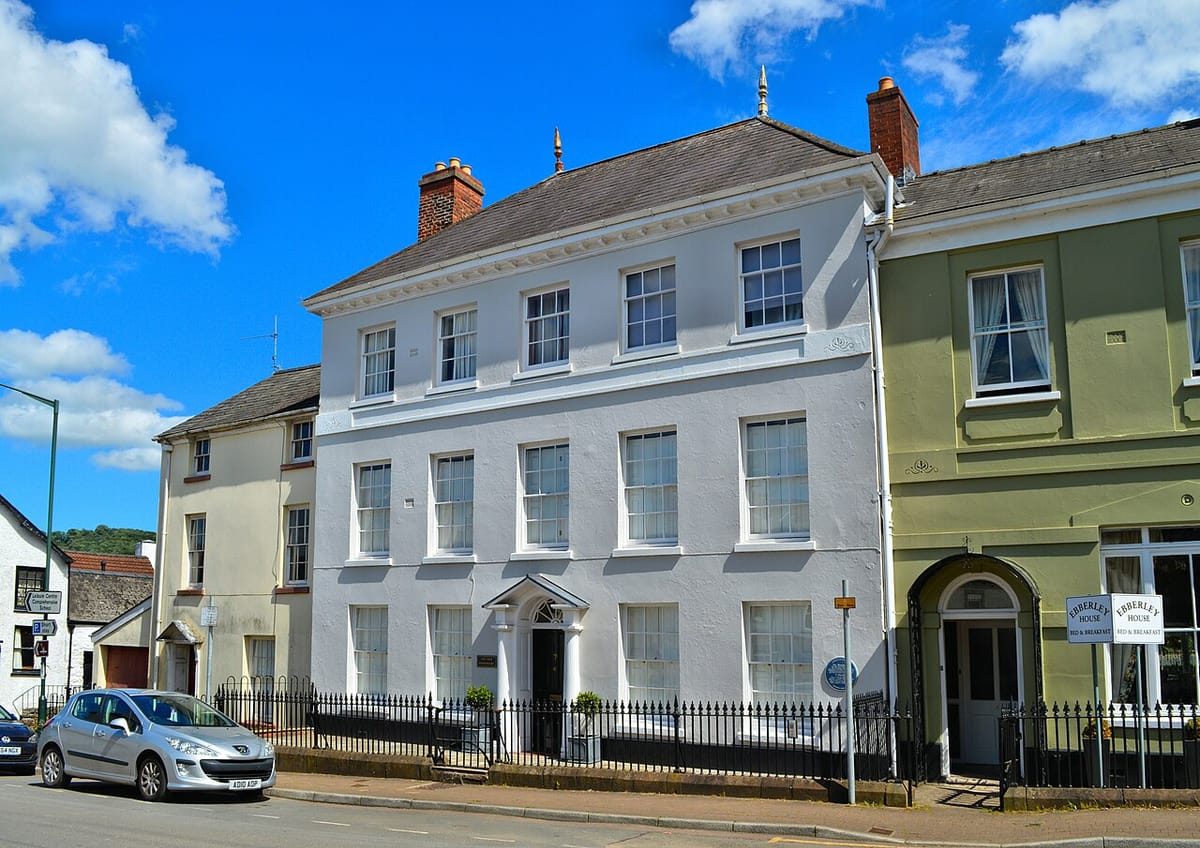
On the eastern side of Monmouth, a few minutes' walk from the town square, a painted house stands with a doorway topped by a broken pediment. Beside it, a ceramic blue plaque tells passers-by that this was once the town's hospital. The building is known simply as The Dispensary, and for much of the 19th century it was where Monmouth's poorer residents went when they were ill.
Here is how a Georgian family house came to be a place of medicine, and what became of it afterwards.
A Georgian House on St James Square
The building began as an ordinary town house. Cadw, the Welsh historic environment service, dates it to the middle of the 18th century, with alterations made in the early 19th century. Externally it has changed little since.
It is three storeys high and five windows wide, with a stucco front and a Welsh slate roof. The central doorcase has fluted Doric columns, a six-panel door and a fanlight with radiating bars. Many of the sash windows still hold old glass. Cadw lists it at Grade II, noting that it is a mid-18th-century building of real character close to the town centre. The listing dates from 27 June 1952 and was amended in 2005.
A Dispensary for the Town
Monmouth had offered medical help to the poor before this house took on the role. An earlier dispensary operated near the castle, in what is now called Little Castle House. It gave free advice and medicine and encouraged vaccination, and it relied on donations and fundraising events.
The house on St James Square took over the work in 1857, when it became the Monmouth Dispensary. The model was a common one in Victorian Britain. Subscribers and donors paid for medicines and medical attendance, and patients from low-income families received treatment without charge.
Nine Beds, 1868 to 1903
In 1868 the dispensary grew into the Monmouth Hospital and Dispensary, with nine beds. Running it depended on charity. The yearly cost of keeping one bed was about £40, and the money came from gifts handed in at the town's banks or at the Dispensary itself.
The hospital's reach went well beyond the town. Its catchment area extended about eight miles around Monmouth and included part of the Forest of Dean. Nine beds were few, but for farm workers, tradespeople and families across that area, they were often the nearest hospital care available.
Outgrowing the house
A converted private house had obvious limits. Its rooms had been laid out for a household, not for nursing, and the town eventually decided that it needed a purpose-built hospital. The new Cottage Hospital went up on Hereford Road, on land that had once held the county gaol. The land was bought from the Duke of Beaufort for £250. The architect was Richard Creed, and the building has been described as one of the most successful building projects in Monmouth in its period.
The hospital left St James Square in 1903, and the house ceased to be a place of medicine.
Convent School and Private House
The building soon found new uses. By 1907 the French Sisters were running a private school there. It took boarders and day pupils and taught French, music, painting, drawing and needlework alongside general subjects.
Later it returned to domestic use. Like many of Monmouth's historic buildings, it has been kept going by new owners finding new uses for it, and that is one reason its Georgian front survives so well.
The Dispensary Today
The Dispensary is one of 24 buildings on the Monmouth Heritage Trail, and its blue plaque was placed by Monmouth Civic Society. The plaque records the hospital years from 1868 to 1903. The house is not a museum and is best seen from the pavement, so a visit takes only a few minutes.
It makes sense to pair it with a longer walk. The trail takes in the Priory, the Market Hall and the old streets around Agincourt Square, and the Dispensary sits among them as a reminder of an everyday side of town life.
A Modest Building with a Lasting Place
Monmouth has grander landmarks, but The Dispensary shows how Victorian communities looked after their own. Donors, doctors and a converted house provided care when public provision hardly existed. Behind its Georgian doorway, patients from the town and the surrounding countryside were treated for more than four decades.