
Pineapple Kingdom: The Story of Lānaʻi
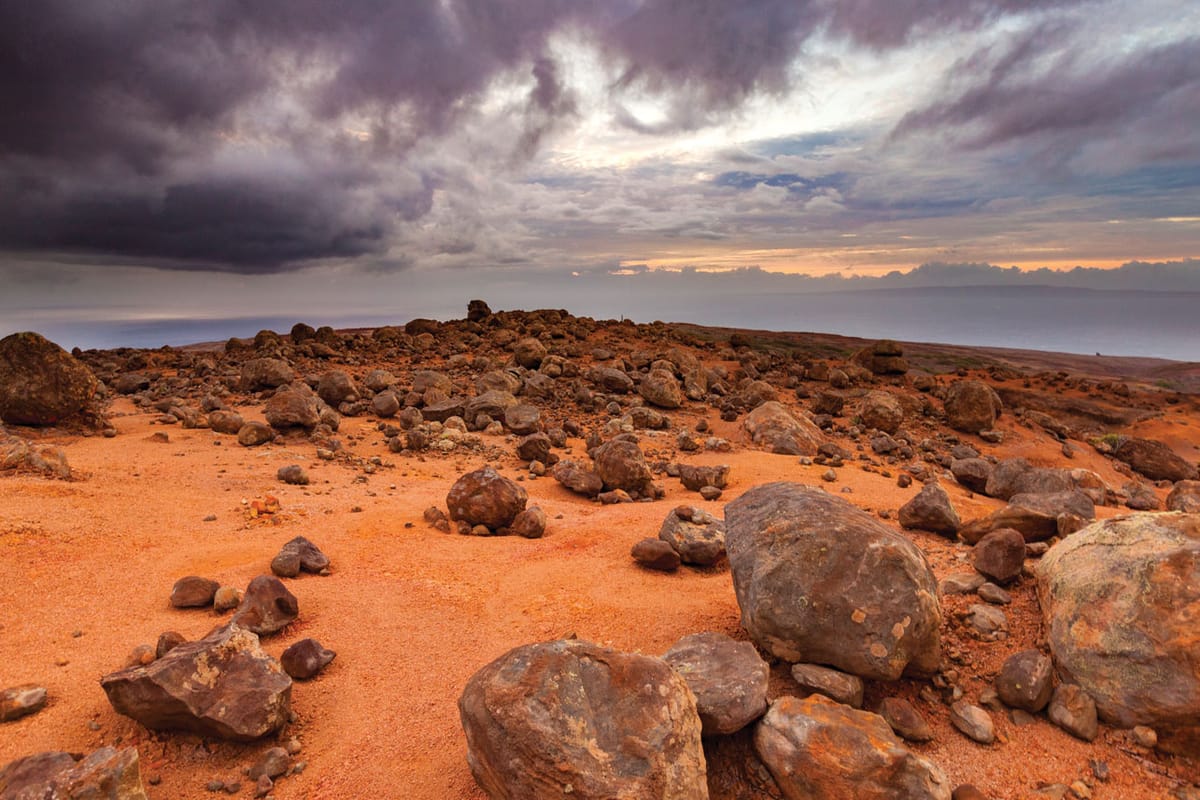
Drive up from the harbour on Lānaʻi and the road climbs through red earth and rows of Cook pines towards a small town with no traffic lights. Lānaʻi City sits on a cool upland plain, its tidy plantation cottages laid out around a central green. There are few places in the Hawaiian Islands where the past is so close to the surface, or so recently changed.
Join us as we trace the story of the sixth-largest of the Hawaiian Islands, from legends of ghosts and exiled princes to pineapple fields and private ownership.
An Isle of Spirits
Lānaʻi covers about 140.5 square miles (364 square kilometres) and lies in the lee of Maui, across the Auʻau Channel. To the north, the Kalohi Channel separates it from Molokaʻi. Its highest point, Lānaʻihale, reaches 3,366 feet (1,026 metres).
The island's earliest settlers probably came from Maui and Molokaʻi, possibly as late as the 15th century. They built fishing villages along the shore and later moved inland to grow taro in the volcanic soil. The origin of the name is uncertain, but an old epithet, Lānaʻi o Kauluāʻau, recalls a legend. A Maui prince, banished for his pranks at his father's court in Lāhainā, is said to have driven off the ghosts and goblins that haunted the isle, and so won back his father's favour.
Chiefs, Missionaries and Failed Ventures
Lānaʻi was long under the sway of neighbouring Maui, and its population stayed small. One of its best-known ancient sites is Kaunolū, on the south coast, where Kamehameha I is said to have kept a royal retreat. Visitors can still see the foundations of houses, the remains of a heiau (temple) and petroglyphs. The village was abandoned in the 1880s, and the site was recognised as a National Historic Landmark in 1962. Nearby, a sheer drop known as Kahekili's Leap was a place where warriors proved their courage.
The 19th century brought hard times. Introduced diseases reduced the population, and outsiders tried one scheme after another. In 1854 a group of Mormon elders founded a colony that did not last. Cattle ranching followed, along with experiments in sugar and beet farming, and none of them brought lasting prosperity. By the early 1920s the island's population had fallen to only a few hundred people.
Dole's Pineapple Kingdom
In 1922 James Dole, president of the Hawaiian Pineapple Company, bought the island and set about turning it into a vast plantation. Roughly 20,000 acres were eventually planted with pineapple, and Lānaʻi earned the nickname the Pineapple Isle. Dole built Lānaʻi City to house his workers, whose numbers were swelled by migrants from the Philippines, Japan, China, Portugal, Korea and Puerto Rico.
For decades the company ran Lānaʻi almost as a private estate, and in some years it supplied a large share of the world's pineapples. The cottages, shops and community buildings of Lānaʻi City date largely from this period. After Hawaiian statehood in 1959 the island became part of Maui County.
From Fields to Resorts
Rising labour and land costs undermined Hawaiian pineapple growing in the 1980s, when cheaper fruit from elsewhere took over the market. In 1985 David Murdock took control of Lānaʻi when he bought Castle & Cooke, then owner of Dole. He moved the economy towards tourism, and luxury hotels and golf courses opened in the following years. The last pineapple harvest came in the early 1990s, and the resort at Mānele Bay opened in 1991. It has traded as a Four Seasons resort since 2005.
In June 2012 Larry Ellison, co-founder of Oracle, bought Castle & Cooke's 98 per cent share. The state and individual homeowners own the remaining 2 per cent. A new management company, Pūlama Lānaʻi, was created to look after the land and its resources, and the former Lodge at Koele has since reopened as a wellness retreat.
Lānaʻi Today
At the 2020 census Lānaʻi had 3,367 residents, up from 3,131 a decade earlier. Almost all of them live in Lānaʻi City. The whole island is served by a single school, Lānaʻi High and Elementary School, and one 24-bed hospital. Many of the best-known places lie at the end of dirt tracks that need a four-wheel-drive vehicle. They include the boulder-strewn red landscape of Keahiakawelo, often called the Garden of the Gods, and the wrecked ship on the northern shore. Ferries from Maui are the usual way to arrive.
The Lānaʻi Culture and Heritage Center works to keep local stories and traditions alive. Its founders are among those who know the island's "storied places", the trails, stones and legends that long predate the plantation.
A Legacy of Change
Few places have been reshaped as completely as Lānaʻi. It has been an exiled prince's refuge, a ranch, a plantation and a resort. Each owner has left a mark, from the terraces and temple walls of Kaunolū to the plantation streets of Lānaʻi City. What has stayed constant is the sense of a small, quiet place, set apart from the busier Hawaiian Islands around it.