
Light on the Granite: The Life of Ansel Adams
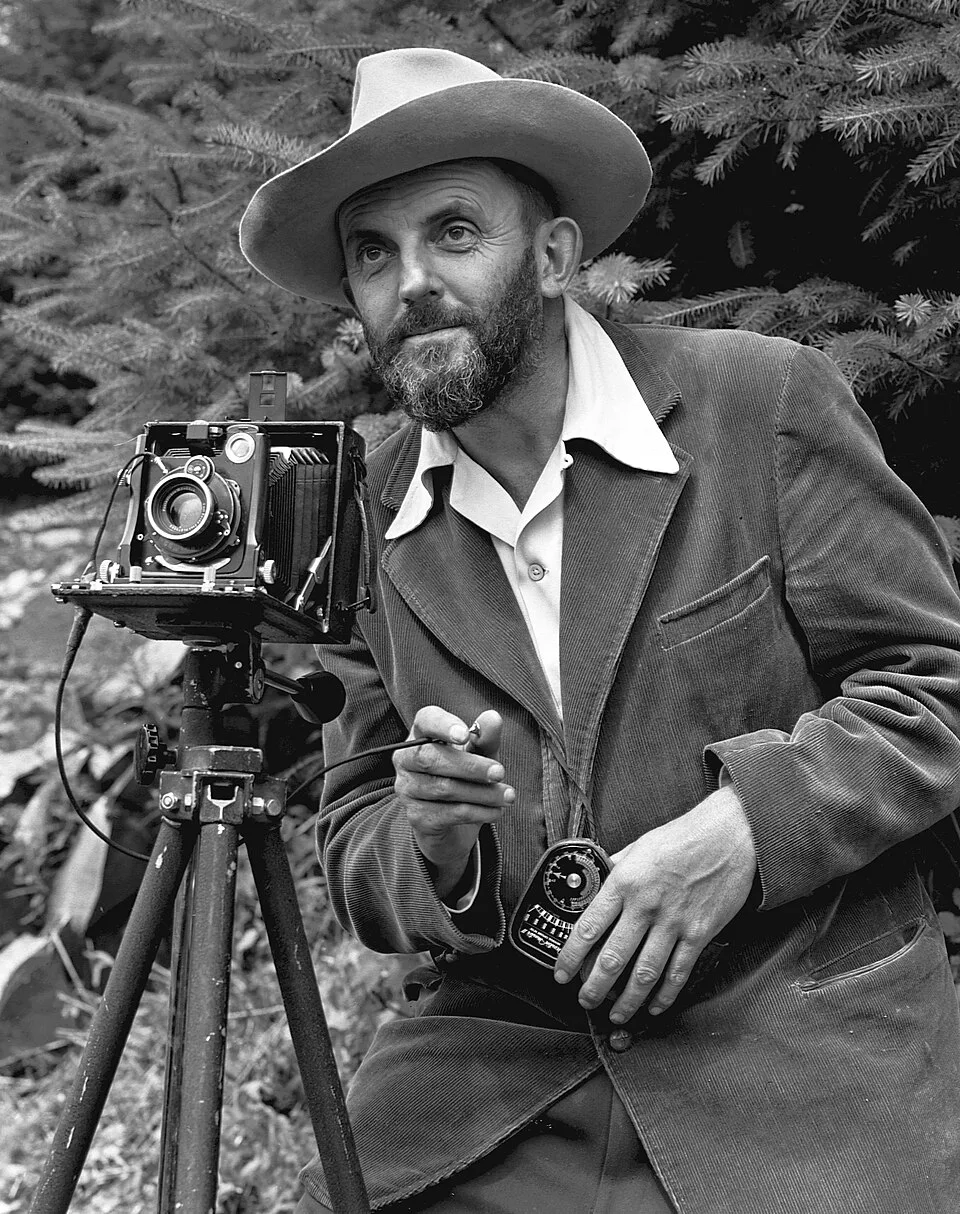
In the spring of 1927, a young man climbed through the cold shadows of Yosemite Valley with a heavy wooden camera, a tripod and a handful of glass plates. He was looking for one picture: the sheer face of Half Dome, rendered as he felt it rather than as the eye saw it. When he pressed the shutter he had only a few plates left, and he knew at once that this exposure mattered. The photographer was Ansel Adams, and the landscape he was learning to read would occupy him for the next six decades.
Here we trace his path from a bruised San Francisco childhood to the darkroom, the mountains and the campaign trail.
A Boy in San Francisco
Ansel Easton Adams was born in San Francisco on 20 February 1902, the only child of a well-off family. In 1906, when he was four, an aftershock of the great earthquake threw him against a garden wall and broke his nose, which stayed crooked for the rest of his life. He was a restless pupil and did badly in conventional schooling, but he found discipline in the piano and for several years expected to become a concert musician.
That changed in 1916. His family took him to Yosemite, and he was given a simple Kodak Box Brownie to record the trip. He returned to the valley again and again, and soon he was learning the practical side of photography, including darkroom work, whilst earning a little money as a photo finisher.
Learning the Valley
In 1919 Adams joined the Sierra Club, the mountaineering and conservation society that would shape his adult life. He spent summers in Yosemite, hiked and climbed in the High Sierra, and for a time looked after the club's LeConte Memorial Lodge in the valley. Photography slowly replaced music as his chosen craft.
The 1927 image of Half Dome, titled Monolith, the Face of Half Dome, was a turning point. Adams used a red filter to darken the sky and deepen the granite, an early example of what he called visualisation: deciding in advance how the finished print should look. That same year he published his first portfolio of High Sierra prints. In 1928 he married Virginia Best, the daughter of a Yosemite painter and studio owner, and the couple went on to raise two children, Michael and Anne.
Sharp Focus and the Zone System
In 1932 Adams helped to found Group f/64, a loose circle of West Coast photographers that included Edward Weston and Imogen Cunningham. Named after a very small lens aperture that gives great depth of field, the group favoured crisp, detailed images over the soft, painterly effects then popular. Adams became its most famous member.
A meeting with the New York dealer and photographer Alfred Stieglitz in 1933 gave him further confidence, and a solo exhibition in New York followed in 1936. Around 1940, working with the teacher Fred Archer in Los Angeles, he helped to formalise the Zone System. It divides a scene into a scale of tones from black to white, so that a photographer can choose exposure and development to place each tone precisely. It remains a staple of photographic teaching.
Moonrise and Manzanar
In autumn 1941, driving near Hernandez, New Mexico, Adams saw a moon rising above a small village and its white crosses. He stopped, set up in a hurry and made a single exposure that became Moonrise, Hernandez, New Mexico. It is probably his most reproduced image, and he returned to the negative many times over the years, printing it with ever stronger contrast.
His work was not limited to scenery. In 1943 he visited Manzanar, a camp in California's Owens Valley where Japanese Americans were held during the Second World War. His photographs of the inmates, published in 1944 as Born Free and Equal, were a quiet protest against their treatment. In the same year he made Mount Williamson, Clearing Storm, showing that his landscapes had lost none of their drama.
Campaigner and Teacher
Adams saw his pictures as tools for protecting wild places. His 1938 book Sierra Nevada: The John Muir Trail was part of the lobbying that preceded the creation of Kings Canyon National Park in 1940. He served on the Sierra Club's board of directors for decades and spoke repeatedly for wilderness protection.
He was also a devoted teacher. In 1946 he set up a photography department at the California School of Fine Arts in San Francisco, he ran workshops in Yosemite, and he wrote influential technical manuals. After moving to Carmel in the early 1960s, he helped found the Friends of Photography in 1967. In 1980 President Jimmy Carter awarded him the Presidential Medal of Freedom.
Ansel Adams Today
Adams died on 22 April 1984 in Monterey, California, at the age of 82. Later that year Congress named the Ansel Adams Wilderness in the Sierra Nevada, and a peak near Yosemite also carries his name. The Ansel Adams Gallery, descended from the studio once run by his father-in-law, still operates in Yosemite Valley.
His legacy is partly artistic and partly practical. Adams showed that photography could be a serious art, and he demonstrated that a well-made picture can persuade people to protect a place they may never see. Visitors who stand beneath Half Dome today are often looking at a view he taught the world to recognise.