
AEC Routemaster
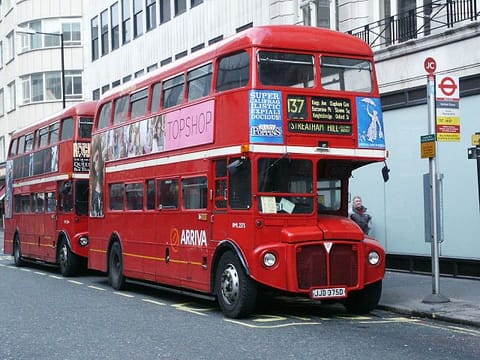
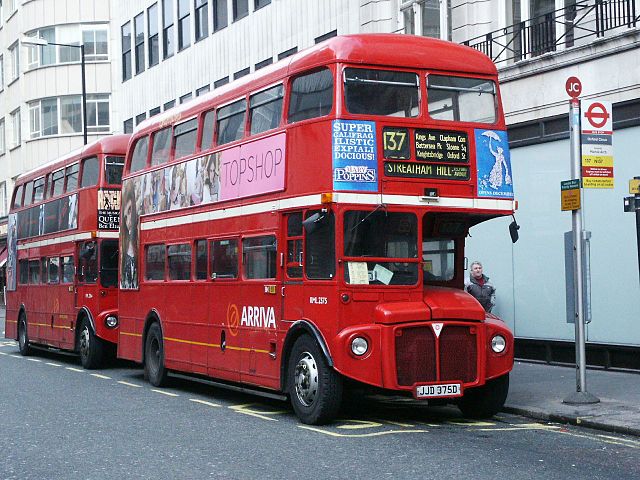
The AEC Routemaster is a model of double-decker bus that was introduced by Associated Equipment Company (AEC) in 1954 and produced until 1968. Primarily front-engined, rear open platform buses, a small number of variants were produced with doors and/or front entrances. Introduced in 1956, the Routemaster saw continuous service in London until 2005, and currently remains on two heritage routes in central London.
Having been developed in partnership with London Transport, the customer of nearly all new Routemasters was to be that organisation, in both traditional red and green "country" colours, although small numbers were also delivered new to British European Airways and The Northern General Transport Company. In all, 2,876 Routemasters were built, with approximately 1,000 still in existence.
A pioneering design, the Routemaster outlasted several of its replacement types in London, survived the privatisation of the former London Transport bus operators, and saw proliferation to other operators around the UK. Latterly in modern UK public transport bus operation, the unique features of the standard Routemaster attracted both praise and criticism alike. Notably the open platform, while open to the elements, allowed boarding/alighting away from stops; and the presence of a conductor allowed minimal boarding time and security, although conductors perpetuated higher labour costs and increased the effect of labour shortages.
The image of the traditional red Routemaster has become one of the famous icons of London, with much tourist paraphernalia continuing to bear Routemaster imagery, and examples still in existence around the world. Despite its iconic status, the previous London bus classes the Routemaster replaced (the RT-type AEC Regent and Leyland Titan RTL and RTW counterparts) are often mistaken for Routemasters by the public and by the media.
The Routemaster bus was developed during the years of 1947–1956 by a team led by Douglas Scott, A. A. Durant and Colin Curtis, the brief being to replace London''s trolleybuses, which had themselves replaced trams, in London. The Routemaster was primarily intended for London use, being designed by London Transport and constructed at the AEC works in Southall, London with assembly at body builder Park Royal Vehicles, a subsidiary company of AEC.
It was a revolutionary design over previous buses, and used lightweight aluminium and techniques developed in aircraft production during World War II. As well as a novel weight-saving integral design, the Routemaster also introduced (for the first time on a bus) independent front suspension, power steering, a fully automatic gearbox and power-hydraulic braking. This surprised some early drivers who found the chassis unexpectedly light and nimble compared to older designs, especially as depicted on film on tests at the Chiswick Works "skid pan".
The Routemaster design was a departure from the traditional chassis/body construction method. With London Transport being the primary customer, the option to use different bodybuilders was less important. The design was one of the first "integral" buses, with the bus being a combination of an "A" steel sub-frame (including engine, steering, front suspension), a rear "B" steel sub-frame (carrying rear axle and suspension), connected by the aluminium body.
Prototypes
London Transport received four prototype Routemasters; these were placed in service between 1956 and 1958. The first two were built at the London Transport works at Chiswick, the third at Addlestone by Weymann, and the fourth, an experimental Green Line coach, at Eastern Coach Works at Lowestoft. The third and fourth had Leyland engines. The Routemaster was first exhibited at the Commercial Motor Show at Earl''s Court in 1954. In 1961 a small batch of longer RMLs were built as a test, before eventually being produced from 1965. In 1962 the front entrance RMF concept was trailed, with a single bus RMF1254 produced based on the trial RMLs. This was exhibited and toured, leading to a small number of orders as the RMF and RMA class. In 1964, just before mainstream production of the RML, the final front-engined Routemaster model, AEC started work on a front-entrance, rear-engined Routemaster, the FRM class. Completed in 1966, it was not produced beyond an initial prototype, FRM1. This saw regular London service, then on tour operations, before being withdrawn in 1983.Production
Production of mechanical components was undertaken chiefly at AEC's Southall site throughout the life of the Routemaster, with body construction and final assembly at Park Royal. AEC itself was taken over by Leyland Motors in 1962, Routemaster production ceased in 1968. The majority of production examples were 27 feet 6 inches (8.4 metres) long to meet the then maximum length regulations. This was later relaxed, and reflected in later 30 feet (9.1 metres) "long" types, although this was delayed with union resistance at the extra work for conductors.Heyday of the Routemaster
The heyday of Routemaster operation was its first 25 years of operation, until 1981, when the type started to be withdrawn and transferred to training fleets. The RM class was placed in service from 1959 to replace trolleybuses, completed in May 1962. Subsequent Routemasters, the last 500 of which were the RML types, began replacing the previous generation of buses, the RT-type AEC Regent and Leyland Titan RTL and RTW. RMLs also displaced RMs on central routes to cope with higher loadings. The last Routemaster, RML 2760, entered service in March 1968. The original London Transport concept for the Routemaster included the intentional routine overhaul and refurbishment of the Routemaster fleet at London Transport''s Aldenham Works, usually every 7 years. Here the buses were completely stripped down and rebuilt, leaving practically as new. As the number of Routemasters in London reduced, however, and newer bus designs were intended to have longer service lives, the overhaul routine was abandoned and Aldenham Works closed in the mid-1980s. The "green Routemasters" originally worked for LT's "country division", which took coach type RMC and RCL buses, for Green Line services, and later standard bus RMLs. The RMC class were initially used on Green Line routes in outlying towns. Similarly, the RCL entered service in areas where the RMC was not introduced. These vehicles passed to the nationalised National Bus Company''s subsidiary London Country Bus Services (known simply as London Country) in 1969, which took over outlying areas of LT bus operation resulting from the 1968 Transport Act. The transfer comprised 69 RMCs, 43 RCLs and 97 RMLs. By the latter half of the 1970s, most of these vehicles were re-acquired by London Transport, as London Country modernised and standardised its fleet, and increased car usage and improved commuter railways reduced suburban bus demand. Most of the RMLs found use on red London bus routes, and the RMC and RCL class were cascaded into the training fleet. As the RCL class was relatively new (in Routemaster terms), and LT was suffering from lack of parts, between 1980 and 1984 several of the RCLs were converted to standard bus use.Withdrawl from London
In his first election campaign to become Mayor of London, Ken Livingstone made a commitment that he would not be withdrawing the Routemaster from service, stating: "Only a de-humanised moron would get rid of the Routemaster". During the new millennium, debates surrounded the issue of whether to replace or retain the Routemaster in London service. Supporters citing its continued mechanical fitness, speed of boarding and tourist potential, while opponents pointed to the economics of running increasingly elderly buses when newer, larger and more modern designs were now on the market following a resurgence in the bus manufacturing industry after recession in the 1990s. Opponents also pointed specifically to the lack of accessibility of the Routemaster in light of impending relevant legislation, which meant all new buses now entering service in London were of a low-floor design. The emergence of off-bus ticketing technology also reduced the argument for better dwell times, whereby the Oyster card and off-bus ticket machines would reduce the time it took to board the bus. In 2004, following his second election campaign, Livingstone announced the phasing out of the type in order to provide a bus service in the capital fully accessible to wheelchair users. Government legislation requires full accessibility by 2017 under the Disability Discrimination Act. As a consequence the Routemaster was officially withdrawn from general service on 9 December 2005, although it remains in regular service on two "heritage" routes. The Routemaster was gradually phased out of service by the end of 2005. By December 2005 only one route was left, the 159 (Marble Arch — Streatham). Friday 9 December 2005 would be the last official running day. On Thursday 8th, 24 special buses, including preserved RMs and RMLs, plus a number of their predecessors from the "RT" bus family, made guest appearances on the 159 route. On Friday, instead of doing a normal shift, with crews ending normally at around 11pm, on police advice,[28] the day was split into two duty shifts,[28] a Routemaster shift, and a VLA class shift (Volvo B7TL/Alexander ALX400), the replacement bus for route 159, with the Routemasters due to be replaced in the middle of the day. Towards the last runs to the garage, crowds blocked the four-lane road, bringing all traffic to a standstill. RM2217 was set to be the last official running bus, as per the timetable. Heavily delayed, RM2217 even took 10 minutes to turn the final corner into Brixton Garage. The bus left the public highway at 14:07, accompanied by duplicates provided by preserved buses RM5 and RM6. Due to the delays, it is possible that RM54 was actually the last in service, running into Streatham Station stand a few minutes later, before running dead to Norwood Garage. Later, RM5 and RM6, followed by RM2217 were moved to the old LCC Tramways depot at Brixton for press photographs in the quieter surroundings of the old tramways depot, complete with still visible tramlines.Routemaster in use today
Two heritage routes were immediately introduced in London, recognising the nostalgia for the type among ordinary Londoners, and their appeal to tourists. Although these buses are operated under contract to TfL, and accept standard Travelcards, Oystercards or cash fares, they are not considered part of the regular Tfl bus network, and only operate for a limited time during the day duplicating short sections of two regular London bus routes. The Heritage routes operate around 10 buses each, with 5 each in reserve.- Heritage route 9: Royal Albert Hall — Hyde Park Corner — Piccadilly Circus — Trafalgar Square — Strand — Aldwych.
- Heritage route 15: Trafalgar Square — Strand — Aldwych — Fleet Street — Cannon Street — Monument — Tower Hill.