
Guarding the Narrows: The Story of Brimstone Hill Fortress
From the road along the Western coast of St Kitts, the hill appears first as a dark shoulder of volcanic rock above the cane fields and the sea. Then the walls come into view, grey and angular, climbing the slope in tiers until they seem to grow out of the mountain itself. Rising to nearly 240 metres, Brimstone Hill Fortress once commanded the surrounding waters like a stone sentry.
Come with us up the slope as we trace how a single battery of cannon became the largest colonial fortress of its kind in the Eastern Caribbean, and why it now stands on the UNESCO World Heritage list.
A Hill Worth Fighting For
St Kitts was one of the earliest footholds of European settlement in the region. English and French colonists arrived in 1624 and 1625 and, from 1627, divided the island between them, an uneasy partnership that lasted until the early 18th century. Sugar made the colony valuable, and valuable colonies were worth defending.
The hill took its name from the sulphurous smell once noted around its slopes, since brimstone is an old word for sulphur. Its military story begins in 1690, when British forces hauled cannon to the summit and used them to retake Fort Charles from the French. The French had assumed that no one could drag heavy guns up such steep, wooded ground. They were wrong, and the lesson was not lost on British planners.
Building a Fortress in Volcanic Stone
What began as a gun position grew, in stages, into a full fortress. Work continued on and off for roughly a century, reaching into the 1790s. British military engineers drew up the designs, but the labour of quarrying, hauling and building was carried out by enslaved Africans, whose skill and endurance are written into every wall.
The builders worked with what the hill provided. Hard volcanic rock was cut from the slopes for the walls, while limestone found lower down was burned to make mortar. The result is a fortress that looks like an extension of the landscape.
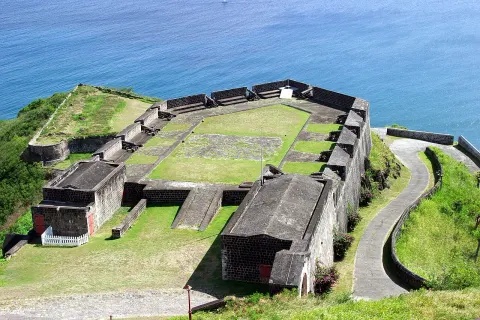
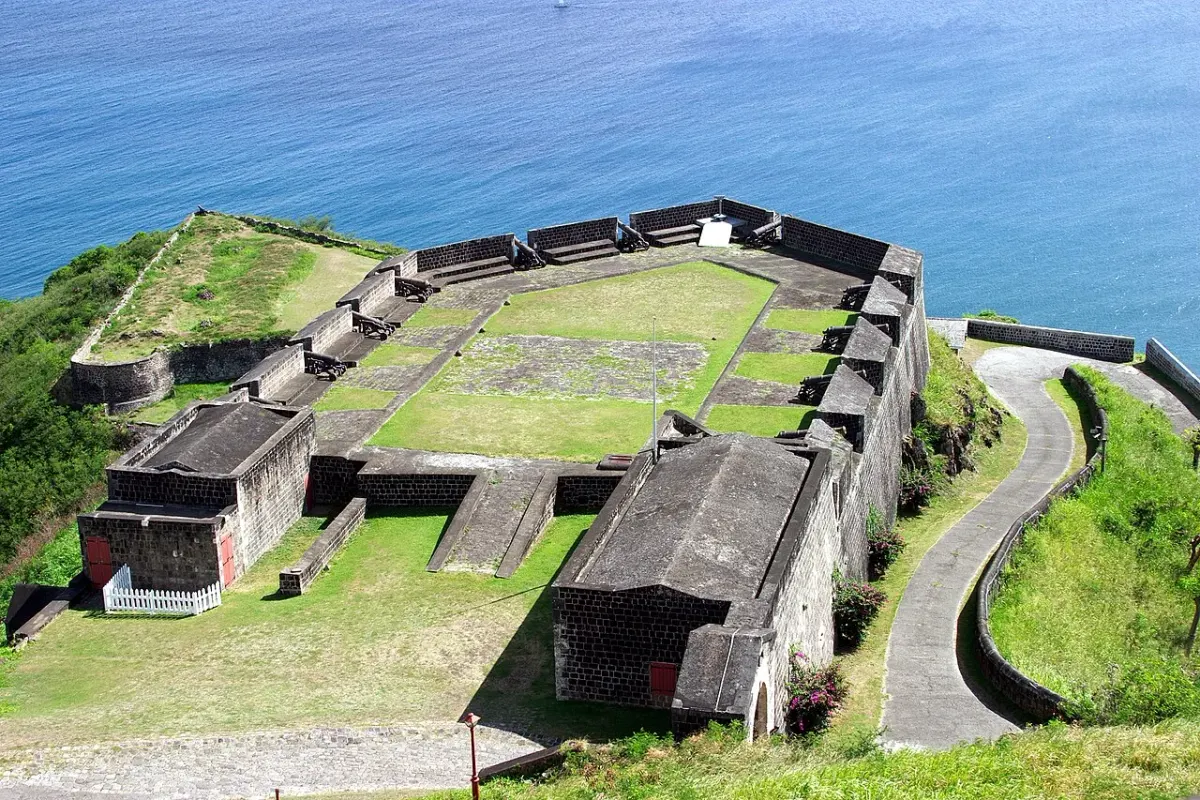
The complex rose in tiers, with outlying bastions and batteries below and a stout citadel, named Fort George, at the top. Barracks, magazines, cisterns and a hospital turned the hilltop into a self-contained community. In its prime, the fortress earned the nickname the Gibraltar of the West Indies.
The Siege of 1782
The fortress faced its sternest test during the American War of Independence, when Britain and France were contesting the Caribbean as fiercely as they were North America. In January 1782 a French force under the Marquis de Bouillé, supported by a fleet commanded by Admiral de Grasse, landed on St Kitts and moved against the hill.
A British naval squadron under Admiral Hood tried to relieve the island but could not break the French hold. The garrison, heavily outnumbered, endured bombardment for more than a month before surrendering in February. The reputation for invulnerability had been dented, though the defenders earned respect for their resistance.
The French victory was short-lived. The Treaty of Paris of 1783 returned St Kitts to Britain, and the fortress went back with it.
Abandonment and Revival
The age of sail and sugar gradually gave way to different priorities. Slavery was abolished across the British Empire in the 1830s, and the strategic calculations of the Caribbean changed. The British garrison left in 1853, and the buildings were left to the weather, the vegetation and, in places, to those who wanted stone.
Stabilisation work began in the early 20th century, but it was in the 1960s that revival gathered pace. A restoration society was formed in 1965, and in 1973 Prince Charles reopened the first fully restored area, the Prince of Wales Bastion. In 1987 the site was designated a national park, bringing it under dedicated protection.
Brimstone Hill Fortress Today
In 1999 the fortress was inscribed as a UNESCO World Heritage Site, recognised as an outstanding example of 17th- and 18th-century military architecture in the Caribbean. The listing also acknowledges something less visible: the exchange of ideas, labour and cultures that shaped the region.
Visitors can walk the ramparts, step into the restored citadel and see cannon still pointing out to sea. Some of the old chambers now house displays on the fortress and its wider setting. On a clear day the view takes in neighbouring islands, a reminder of why this hill was chosen in the first place.
A Monument with Many Stories
Brimstone Hill is often described as a triumph of military engineering, and it is. Yet its fuller legacy is more complicated. It records imperial rivalry, the fortunes of sugar and the unpaid work of enslaved people who built it. For anyone interested in Caribbean history, it remains one of the clearest places to see how those themes fit together, set in stone on a hillside above the sea.