
Carved from the Mountain: The Rock Churches of Lalibela
At dawn in the Ethiopian highlands, white-robed worshippers move along narrow trenches cut into red volcanic rock. Below them, the roofs of churches sit level with the ground, and the buildings themselves lie sunk within the earth. This is Lalibela, where around eleven rock-hewn churches were carved out of the mountain rather than built upon it.
This article looks at how the churches came to be, who ordered them and why they still matter, both to the people who pray in them and to anyone interested in medieval history.
A Capital Called Roha
Lalibela lies in the Amhara region of northern Ethiopia, at an altitude of roughly 2,500 metres. The town was once known as Roha. It rose to prominence under the Zagwe dynasty, which ruled much of the Ethiopian highlands before the Solomonic line took power in the 13th century.
Tradition names King Gebre Mesqel Lalibela, who reigned around the turn of the 13th century, as the man behind the churches. After his death the town took his name. Ethiopian Christianity was already ancient by his day, since the kingdom of Aksum had adopted the faith in the 4th century.
A New Jerusalem in the Highlands
Local tradition holds that Lalibela, as a young man, visited the Holy Land and resolved to create a second Jerusalem at home. The timing is often linked to the loss of Jerusalem to Saladin in 1187, which made the journey harder for Christian pilgrims. Historians treat the story with caution, but the layout of the site supports the idea. A stream running through the complex is called the Jordan, and several chapels carry names such as Golgotha and the Tomb of Adam.
Ethiopian accounts add that angels worked alongside the human labourers, doubling the pace by night. Whatever the truth, the project shows the ambition of a court that wanted to express its faith in stone.
How the Churches Were Made
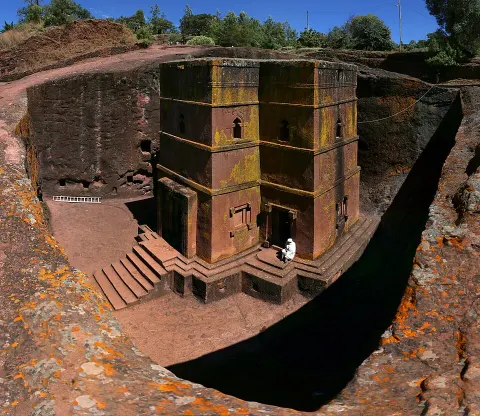
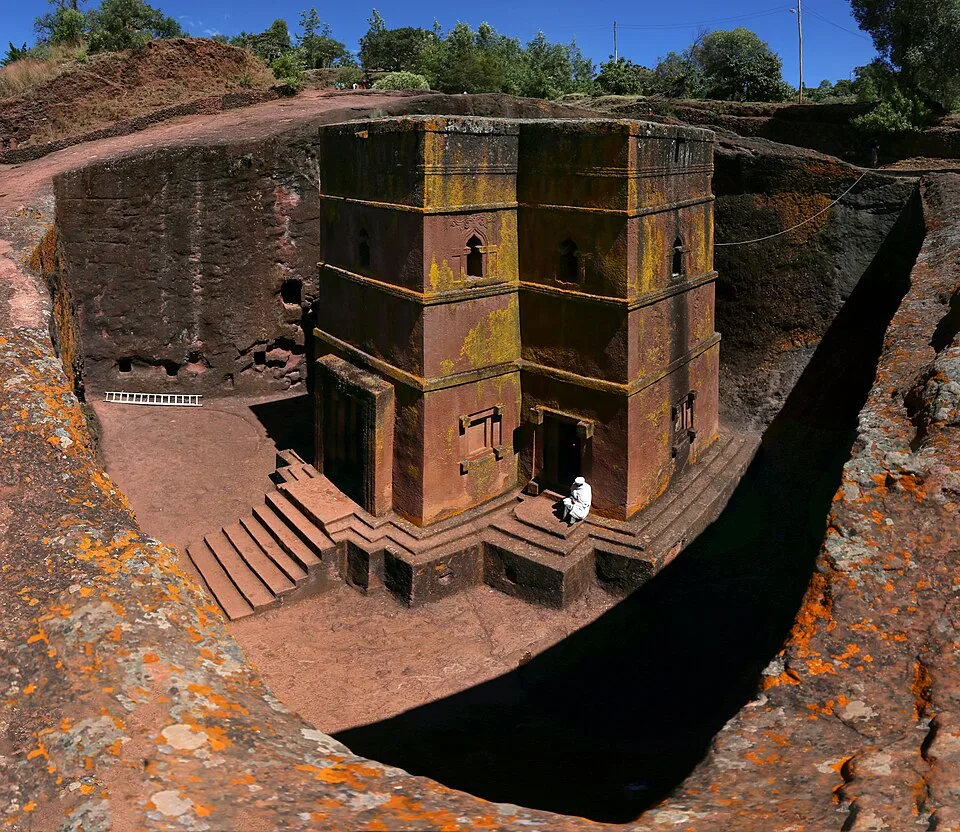
The method was as remarkable as the result. Instead of stacking blocks, the builders began at the top of a rock mass. They cut trenches around the future church, then worked inwards and downwards. They shaped the roof, walls, windows and columns from a single piece of stone and hollowed out the interior last.
The Two Main Groups
The churches fall into a northern and a southern cluster, divided by the seasonal Jordan River. The northern group includes:
- Bete Medhane Alem, widely described as the largest monolithic rock-cut church in the world, ringed by a colonnade of square pillars.
- Bete Maryam, dedicated to the Virgin and often said to be among the oldest, with painted ceilings and carved interior panels.
- Bete Golgotha and Bete Mikael, which are associated with sacred relics and are of particular importance to pilgrims.
The southern group includes Bete Gabriel-Rufael, Bete Merkorios, Bete Abba Libanos and Bete Emmanuel.
Bete Giyorgis
Set apart to the southwest is Bete Giyorgis, the church of St George. It is cut in the shape of a Greek cross and sits within a deep, square pit. Seen from above, its three-tiered cross roof looks like a stone jewel at the bottom of a well, and many visitors consider it the finest of the group.
A Living Pilgrimage
Lalibela was never a museum. The churches belong to the Ethiopian Orthodox Tewahedo Church, and priests still conduct services in them. The town fills with pilgrims at major festivals, above all Genna, the Ethiopian Christmas, which falls in early January. Many travellers arrive on foot after journeys of days. They gather in white shawls, chanting and praying in the courtyards and passages between the churches.
For visitors, this means that the site works best when approached as a place of worship. Shoes are removed before entering, and quiet is expected in the interiors.
Protecting a Fragile Wonder
In 1978 Lalibela was among the first places in the world to be inscribed on the UNESCO World Heritage List. Its greatest enemy is water. The soft volcanic rock, known as scoria, is vulnerable to seepage and erosion, and the open-air churches face the rainy season each year. In the 21st century, large protective canopies were erected over several of the churches. They have been debated, with some critics saying they alter the look of the site. Conservation work continues, including drainage improvements and repairs to the stonework.
Lalibela Today
Reaching Lalibela usually means a flight into the town's small airport or a long road journey through the highlands. The best months for a visit are generally the drier ones, from October to March, and a guide helps visitors to understand the tunnels, the symbolism and the church customs. Visitors should allow at least two days to see both groups of churches without hurrying.
A Lasting Legacy
Lalibela endures because it joins two things that rarely sit together: an extraordinary feat of medieval engineering and an unbroken tradition of faith. Eight centuries on, the stone is still being used for the purpose it was cut for. As a monument to medieval history, to the Ethiopian Church and to the human will to build something sacred from raw rock, Lalibela has few equals.