
Refuge on the Reef: The Story of Douglas's Tower of Refuge
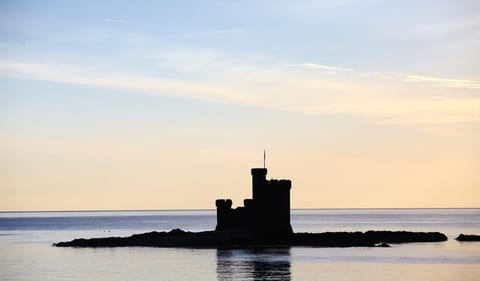
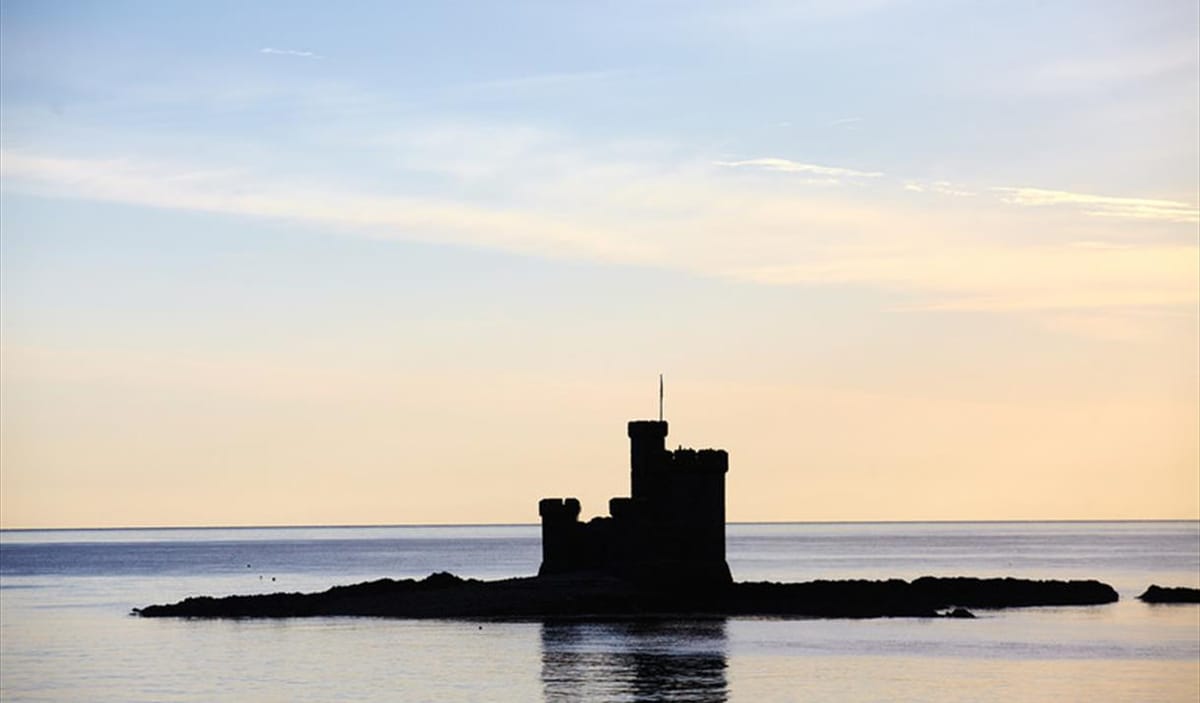
At high tide in Douglas Bay, a miniature castle seems to float on the water, with battlements and a little turret and the waves slapping at its base. As the sea drains away, a rough reef of dark rock appears beneath it, and the Tower of Refuge is joined, for a short while, to the shore. Locals walk past it every day. Few stop to think that the odd little fortress was built as a lifesaving device.
This is the story of how one man's experience of a terrible night on the water put a tower on a reef.
A Reef at the Harbour Mouth
The rock is known as Conister Rock, or St Mary's Isle. The name Conister is generally explained as a corruption of a Manx phrase meaning the head of the reef. It lies towards the southern end of Douglas Bay, a few hundred metres from the promenade. At low water it is a stony outcrop. At high water, and especially in spring tides, it is almost entirely covered and very hard for a sailor to see.
That made it a menace to vessels approaching the harbour, particularly in poor visibility or an easterly gale. Before the tower was built, the reef had claimed many ships, and it features heavily in the long list of Isle of Man shipwrecks.
The Man from Fort Anne
Sir William Hillary moved to the Isle of Man in 1808 and made his home at Fort Anne, a house overlooking the bay. He had a deep interest in the sea and its dangers. In 1824 he helped to found the Royal National Institution for the Preservation of Life from Shipwreck, the body that became the Royal National Lifeboat Institution, now known as the RNLI.
Hillary's work was not only administrative. He took part in rescues himself, from the Douglas lifeboat, and he knew how quickly a calm anchorage could turn deadly.
The Wreck of the St George
The turning point came in November 1830. The steam packet St George, commanded by Lieutenant John Tudor, had landed her passengers and mail at Douglas and anchored close to Conister Rock for the night. A storm blew up, and the vessel was driven onto the reef and began to fill with water. Her captain sent out distress signals.
Hillary saw the emergency from his windows. A lifeboat put out into the storm and, despite the conditions, the people aboard were brought off the wreck. Hillary was among those in the boat, and he was injured in the attempt.
The rescue was a success, but it showed how close the reef was to the harbour and how little there was to help anyone stranded on it. Hillary concluded that a permanent refuge was needed, something to warn shipping and to give survivors a place of safety until a boat could reach them.
Building the Tower
The rock had belonged to the Quane family. John Quane, the Attorney General of the Isle of Man, gave it to Hillary for the project. The design was entrusted to John Welch, a respected local architect who worked on several island landmarks, and the foundation stone was laid on Easter Monday, 23 April 1832.
Welch chose a castle for the design, in a 13th-century style, with a main tower, curtain walls, and corner turrets on corbels. The look is often compared with Peel Castle and Castle Rushen, the island's great medieval fortresses. The building was made of local stone and was intended to be seen from a distance.
It was also remarkably cheap. The total cost came to £254, raised from a modest group of subscribers. Hillary was one of the larger contributors, and the Commissioners of Isle of Man Harbours also gave a substantial sum. Most other donors gave small amounts.
The tower originally held a bell and a store of provisions, so that anyone washed onto the reef would have something to eat and a way to attract attention.
Poets, Postcards and Persistent Hazards
The tower was an immediate success as a landmark. Wordsworth visited the island in 1833 and wrote a poem about it, and Victorian guidebooks and engravings soon made it one of the best-known views of Douglas.
It did not make the bay entirely safe. Two vessels were lost in Douglas Bay in the last weeks of 1832, although not on Conister Rock itself, and the reef has continued to be a hazard for harbour traffic ever since. Hillary himself lived until 1847, and the tower stands as one of the clearest reminders of his life's work.
The Tower of Refuge Today
The Tower of Refuge is still a prominent feature of the Douglas skyline, easily seen from the promenade. At low spring tides the reef can be reached on foot from the shore, though visitors need to watch the tide carefully, as the way back can disappear. Community walks to the tower are organised from time to time to raise money for the RNLI, which gives the building a link to the cause it was built to serve.
It is a small structure, with no great architectural pretension, but it reflects a simple idea: that a community can do something practical about danger at its own doorstep. The RNLI that Hillary helped to found now saves lives around the coasts of Britain and Ireland, and on a calm evening in Douglas Bay the little castle on the reef is a lasting reminder of how that story began.