
Narrow Gauge to the South: The Isle of Man Steam Railway
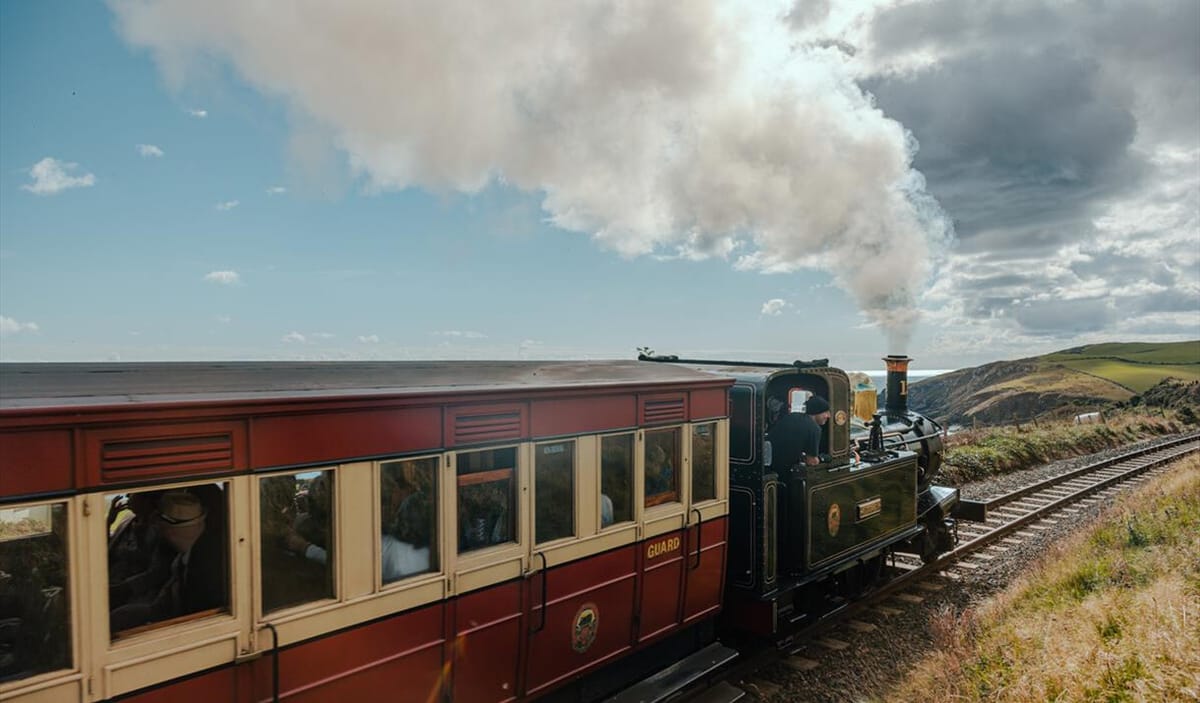
On a summer morning at Douglas, a small green locomotive simmers beside the platform, its brass catching the light off the harbour. Behind it stand wooden carriages in deep red and cream, their compartment doors opening straight onto the platform. A whistle sounds and the train pulls away, heading for the quiet farmland and coves of the southern Isle of Man.
This is the Isle of Man Steam Railway, a 3 ft gauge line that has outlived almost every neighbour it once had. Come aboard and we will trace how it began, why most of it disappeared and how the surviving stretch earned its place as a treasured heritage Railway.
Rails for a Holiday Island
The Isle of Man Railway Company was formed in 1870, at a time when steamers from Liverpool were bringing growing numbers of visitors to Douglas. Douglas had become the capital in 1869, taking the role from Castletown, and the new Company chose a narrow gauge of three feet. Narrow track was cheaper to build and could follow the contours of the land more closely than a standard gauge line.
The first route, from Douglas to Peel, opened on 1 July 1873. The Company bought the Douglas station site in 1872 and diverted the Douglas River to make room for its platforms. The southern line to Port Erin followed on 1 August 1874, giving the Island two arms of track from the capital.
Engines from Manchester
The locomotives came from Beyer, Peacock & Company of Manchester, a firm that supplied engines to railways around the globe. The first of them, No. 1 Sutherland, arrived in 1873 and remains in the story today. Their compact design suited the sharp curves and short trains of an Island line, and they proved sturdy enough to work for well over a century.
The carriages tell their own tale. Many of the wooden coaches date from the Victorian and Edwardian years, and the line still runs with its original steam locomotives and coaches, some of them more than 150 years old. First-class compartments remain part of the experience, with their upholstered seats and period fittings.
Growth, Strain and Closure
For decades the railway was the Island's principal means of moving people and goods. Branches and rival companies widened the network until it linked Douglas with Peel, Ramsey, Foxdale and Port Erin. Holidaymakers filled the summer trains, and farmers, miners and shopkeepers relied on the goods wagons throughout the year.
Road transport eventually eroded that business. The Foxdale branch closed in 1940, and the Peel and northern lines had gone by 1968. The Douglas to Port Erin line came close to the same fate, and the railway shut entirely in 1965 to 1966. What followed was a series of rescues. From 1969 a new company operated it as a Victorian steam attraction, and from 1972 Lord Ailsa held an option to run the services. In 1975 trains ran only between Port Erin and Castletown, and in 1976 between Ballasalla and Port Erin, after local campaigning kept the southern end alive. Seasonal operation of the full line has continued since 1977, and the Isle of Man Government now owns the railway.
The Line Today
The route measures about 15½ miles and takes a little over an hour to complete. Leaving the terminus at Douglas, trains climb out of the town and run through the valley and fields of the south-east. They call at Castletown, whose large station reflects its long status as the Island's former capital, before heading on to Port St Mary and the terminus at Port Erin. Several smaller halts operate as request stops, and the whole line has around eleven stations, stops and halts.
Castletown
Many visitors break their journey here to see Castle Rushen, a short walk from the platform, and then take a later train on to the coast.
Port Erin
The line ends beside a sheltered bay. The station houses the Port Erin Railway Museum, which tells the story of the Island's steam railways, and the waiting room café has kept much of its old character. From the platform it is a short stroll to the beach and the headland at Bradda Head.
A Living Piece of Victorian Engineering
The Isle of Man Steam Railway survives because people kept choosing it, from the supporters who volunteered their weekends to the local residents who tend station flower beds and the Government that now maintains it. It is not a museum piece behind a fence but a working railway, carrying passengers through the same countryside that its Victorian builders surveyed.
Few narrow gauge lines in Britain offer such an unbroken link to the age of steam holidays. A single journey from Douglas to Port Erin takes in the engineering, the landscape and the stubborn affection of a small Island for its railway.