
Hooves on the Promenade: The Douglas Bay Horse Tramway
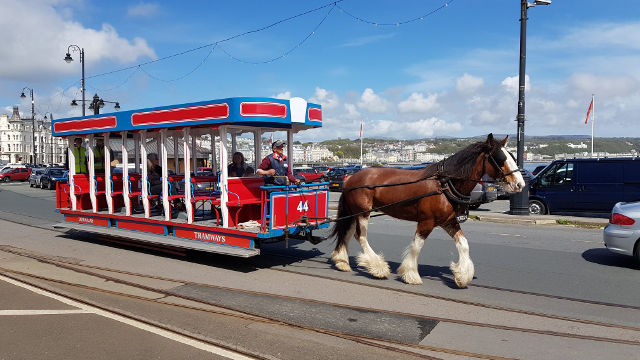
On a summer morning at Derby Castle, at the northern end of Douglas promenade, a large horse leans into its collar and a wooden tramcar begins to roll. The only sounds are hooves, iron wheels and the gulls over the bay. The scene would have looked much the same to a holidaymaker in the 1870s, and that is what makes it unusual. This is the Douglas Bay Horse Tramway, and it is still carrying passengers after nearly a century and a half.
Walk the seafront with us to see how a retired engineer's idea became one of the best-loved pieces of Isle of Man heritage.
A Retired Engineer's Idea
The tramway owes its existence to Thomas Lightfoot, a Yorkshire-born civil engineer who had settled in Douglas after his working life. He had helped build the first Woodhead Railway Tunnel. He saw that steamers were landing ever larger crowds at the harbour, and that visitors needed a way along the sweep of the bay to the boarding houses and entertainments.
The scheme needed an Act of Tynwald, and the rules attached to it were strict. Services had to run at least six double journeys on weekdays. The top fare was fixed at 3d, and only animal power could be used. The investment was reported at around £7,000 to £8,000, a large sum for a seaside venture at the time.
Opening Summer, 1876
The line opened quietly on 7 August 1876, with no ceremony. The first track was a single line of 3 ft gauge, running from Burnt Mill Hill, now called Summer Hill, to the Iron Pier. In January 1877 it was extended to Victoria Pier, the landing place for the steamers. The tramway's stables, which date from 1877, are listed today and still house the horses.
Demand was strong from the start. By late summer 1876 the cars were reported to be carrying hundreds of passengers during a long working day. Even so, the economics were hard, and Lightfoot sold the business in 1882 to Isle of Man Tramways Ltd.
New Owners, New Rails
The new owners doubled the track and pushed the route north to Derby Castle, where a depot was built in the mid-1880s. In 1894 the tramway passed to the company that ran the coastal electric line, soon known as the Isle of Man Tramways & Electric Power Company. That company also owned the Manx Electric Railway, and for a while there was talk of electrifying the seafront too. Douglas Corporation resisted, and the horses stayed.
The electric company ran into financial trouble around 1900, and the horse tramway was sold to Douglas Corporation early in the twentieth century. Since 1927 it has run in summer only. Service was suspended during the Second World War, but otherwise the trams ran every year until recent times.
Horses and Toastracks
The tramway is as much about its animals as its vehicles. Shires and Clydesdales provide the power, and they spend the season at the Summer Hill stables, close to the Derby Castle terminus. Each horse works only short spells and has regular rest days. In winter the horses are turned out to graze.
The cars come in several types, from enclosed saloons to open cross-bench cars, along with a double-decker kept for special occasions. The open cars, known as toastracks, are the best known. Their rows of bench seats gave them the nickname, and the novelist Hall Caine used the same comparison. Fifty-one cars have run on the line since 1876, and a good number of the survivors are still in service.
Closure Scares and a Rebuilt Seafront
The tramway has been threatened more than once. In January 2016 Douglas Corporation announced that the service had been closed because it was not financially viable. Public feeling ran high, and responsibility for the line moved to the Isle of Man government, which now runs it as part of its heritage railway operation.
The service was suspended again in 2018 while Douglas promenade was rebuilt in a redevelopment costing about £26 million. It returned in 2022 on a shortened route between Derby Castle and Broadway. Reinstating the section to the Sea Terminal is still under discussion, and local supporters hope it will eventually be restored.
The Tramway Today
The tramway's 150th anniversary fell on 7 August 2026, a milestone few pieces of Victorian seaside transport can claim. Trams now run from spring until the start of November, linking Derby Castle with the central promenade. At Derby Castle passengers can change to the Manx Electric Railway for the journey north.
A ride takes only a few minutes, but it explains a good deal about how Victorian holidaymakers saw the coast. The line's lasting value is that it is still a working transport service, not a museum piece. Few Isle of Man trams can match it for sheer continuity, and few seafronts still have the sound of horses on the road.