
Fell Rail to the Summit: The Story of the Snaefell Mountain Railway
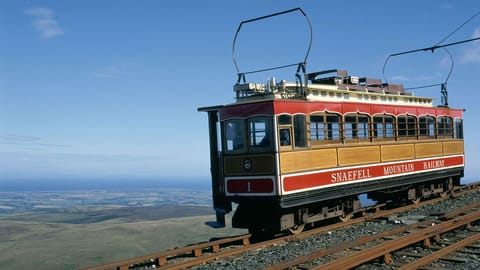
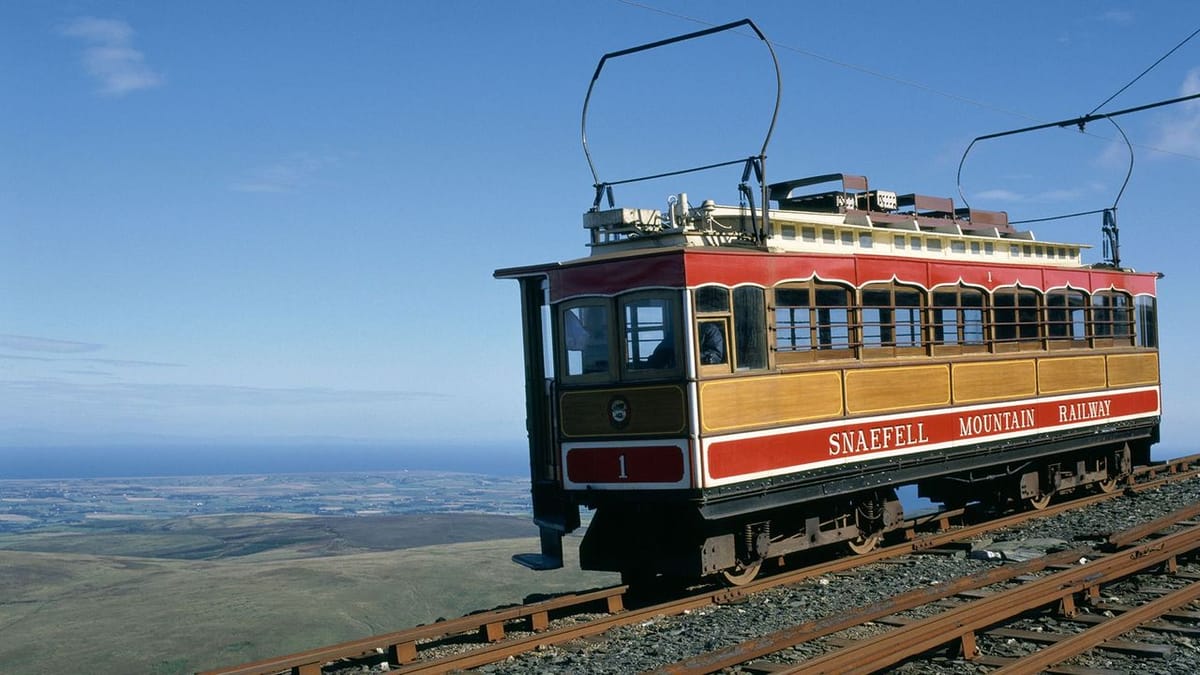
On a clear day at the top of Snaefell, the Isle of Man lies spread out beneath you like a relief map, with green glens, a ring of sea and, on the best days, distant coastlines. Behind you, a small wooden-panelled tramcar waits at the end of the line, its pantograph raised to the overhead wire. It is a scene that has changed remarkably little since the summer of 1895.
This is the story of the Snaefell Mountain Railway, a line built at speed in the Victorian age that still carries passengers to the Island's highest point.
A Mountain Waiting for a Railway
Snaefell rises to 2,036 feet (621 metres), and by the late 19th century the Isle of Man was a thriving holiday destination. Visitors who arrived by steamer from Liverpool wanted views, and the summit offered the best on the Island. A railway to the top was first proposed in the 1880s. It was to be a steam line using the Fell system, and Tynwald approved the scheme in 1888, but nothing was built.
The idea returned in 1895, when the Snaefell Mountain Railway Association revived the plans and chose the route of the earlier survey. By then the Manx Electric Railway already ran north from Douglas to Laxey, and electric traction had proved itself on the Island. The new line would run from Laxey and draw its power from the same new technology.
Built in Seven Months
Construction began in January 1895. The line was finished about seven months later, despite a month lost to bad weather in February. The route runs for just under five miles, and some stretches climb at 1 in 12, which is steep for any railway.
The official opening took place on 20 August 1895, and public services began the next day. The Association did not keep the line for long. In December 1895 it sold the undertaking to the Isle of Man Tramways and Electric Power Company. That company went into liquidation in 1900, and the mountain line passed, together with the Manx Electric Railway, to a newly formed Manx Electric Railway Company.
The Fell Rail Explained
The railway's most distinctive feature lies between the running rails. The Fell system takes its name from John Barraclough Fell, who devised a centre rail gripped by horizontal wheels or brake blocks. It was first used for both traction and braking on mountain lines in the 19th century.
On Snaefell the original steam plan was replaced by an electric one. The cars climb by ordinary adhesion, with their wheels gripping the running rails. The Fell rail is used only for braking on the way down. To make room for it, the line was laid to a gauge of 3 feet 6 inches, six inches wider than the 3 foot gauge of the Island's other lines. The Fell rail is there for emergencies, since the cars now rely on rheostatic braking for normal use. It is still the only place in the British Isles where a Fell rail can be seen in daily use on a heritage railway.
The Cars
Six identical tramcars were built for the opening by G. F. Milnes of Birkenhead. Five of them still work the line today, which gives passengers an unusually direct link with the 1890s. Their wooden bodies, open end platforms and slatted seats have been maintained and restored over the decades rather than replaced.
Up the Mountain, Season by Season
The journey begins at Laxey, where passengers change from the Manx Electric Railway to the mountain line. The only intermediate stop is the Bungalow, where the track crosses the Mountain Road. That road forms part of the Snaefell Mountain Course used for the TT races, and on race days the railway carries large numbers of motorcycle fans.
At the summit, the station has always included a café. The view is traditionally said to take in seven kingdoms: Mann, England, Scotland, Wales and Ireland, together with the kingdom of the sea and the kingdom of heaven. That claim featured in the railway's advertising for many years.
Not every change has been a gentle one. For the centenary in 1995, a third rail was added between the Bungalow and the summit so that a steam locomotive from the Isle of Man's 3 foot gauge network, Caledonia, could run on the line for a festival. The centenary also brought a rebuilt depot above Laxey. More recently, the railway has offered special evening excursions to the summit café.
The Snaefell Mountain Railway Today
The railway is owned and run by Isle of Man Heritage Railways, a department of the Manx Government, and it operates seasonally, usually from spring to autumn. Maintaining a line this old is demanding. When parts of the central Fell rail needed replacing, the type of section required had not been rolled for decades, and a steel mill had to prepare new rollers to make it.
The effort says something about how the Island values the line. Britain's only electric mountain railway has carried visitors for well over a century, and it still climbs from Laxey in the same way, with the same cars and the same central rail. A ride on it remains a straightforward pleasure: a slow climb, an exposed summit and a long view across the Irish Sea.