
Castle in the Surf: The Tower of Refuge, Douglas Bay
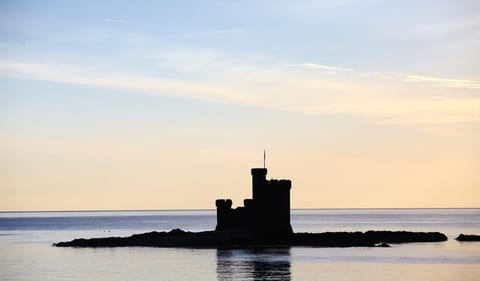
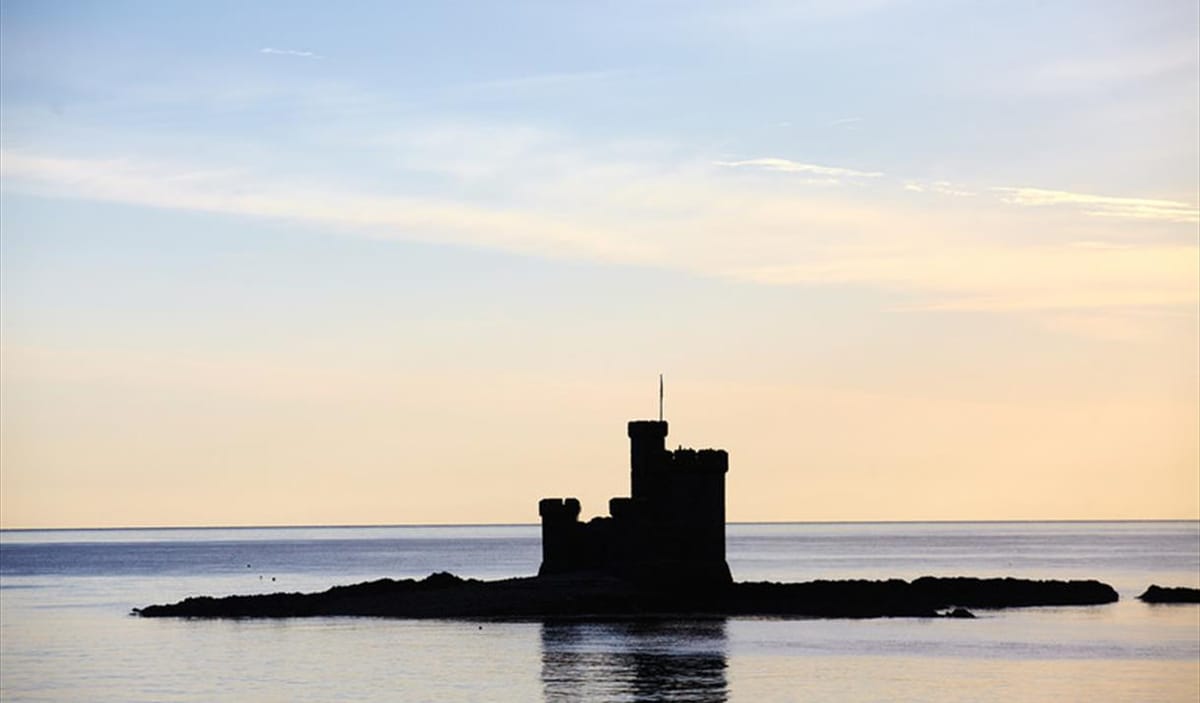
At high tide the little fortress seems to float. Its grey battlements rise straight from the water at the southern end of Douglas Bay, a few hundred metres off the promenade, with gulls on the parapet and ferries sliding past. Within hours the sea can drop away to leave a sandy, weed-slick causeway running out to the door. The Tower of Refuge looks like a toy castle, but it was built for a serious purpose: to give drowning people something to hold on to.
A Reef with a Grim Reputation
The rock beneath the tower is Conister Rock, also called St Mary's Isle. The name Conister is generally explained as a worn-down form of the Manx for the head of the reef, which describes it well. For most of the tide it lies just under or just above the surface, close to the line ships take into Douglas harbour. Vessels caught by an easterly gale could be driven onto it within minutes, and survivors who reached it could be stranded, cold and exposed, with the shore too far to swim.
This was a familiar sight to Sir William Hillary. He settled on the Island in 1808 and made his home at Fort Anne, a house with a clear view across the bay. From there he watched the sea take its toll for more than twenty years. His name belongs to wider Isle of Man history, but his best-known cause was lifesaving.
The Man Behind the Idea
Hillary was not a local fisherman or harbour official. He was an English-born gentleman with a baronetcy, a taste for campaigning and a conviction that shipwreck deaths could be prevented. In 1824 he helped to found the body now known as the RNLI, then styled the Royal National Institution for the Preservation of Life from Shipwreck. The Douglas lifeboat was among the first stations the new society supported, and Hillary took a place in its crew despite being well past youth.
The wreck of the St George
The turning point came in November 1830. The steam packet St George was caught in a violent gale in Douglas Bay and was driven onto Conister Rock. Hillary, then aged 60, joined the lifeboat crew that went out to her. The lifeboat itself was thrown on the reef and nearly lost, and Hillary was badly injured. Even so, everyone aboard the packet was brought off alive. The episode left him certain that the rock needed a permanent place of safety.
Building the Refuge, 1832
The rock was in private hands. It belonged to the Quane family, and John Quane, Attorney General of the Island, handed it over to Hillary in his capacity as president of the Isle of Man district of the lifeboat society. The design was entrusted to the Douglas architect John Welch, who gave the tower a castellated outline, with battlements and corbelled turrets, in the manner of a medieval stronghold.
The cost was modest, about £254. Roughly half came from Hillary's own pocket and the remainder from public subscription. The tower was completed in 1832. It was stocked with bread and fresh water, and a bell hung there so that anyone sheltering inside could call for help. A day mark in stone also did a second job, warning mariners that the reef lay beneath them when the tide was high.
Poetry and Persistent Danger
In 1833 the poet William Wordsworth visited Douglas and wrote verses on entering the bay, praising the tower and Hillary himself. The poem has often been credited with giving the building its name, though the name was already in use before he arrived.
The tower did not make the bay safe. Late in 1832, within weeks of its completion, two vessels were lost with all hands in Douglas Bay, although not on Conister Rock. The real remedy was a better harbour. Hillary campaigned for a great breakwater to shelter the anchorage, and work on it finally began in 1862, fifteen years after his death at Fort Anne in 1847.
The Tower of Refuge Today
Nobody now needs to shelter in the building, but it remains a working landmark and a fixture of every postcard of Douglas Bay. It is looked after by the local authority, and the rock itself passed long ago into the care of the lifesaving charity's island branch. A centenary celebration was held in May 1932, and a plaque on the tower honours Hillary.
The rock can be reached on foot from the shore only at low water, and the walk is not one to attempt without checking the tides. At the lowest spring tides, community walks across the sands are organised to raise money for the RNLI, and hundreds of people take part. Visitors are better placed to admire it from the promenade, or from the deck of an arriving ferry.
A Small Building with a Long Reach
The Tower of Refuge never saved the number of lives its founder hoped, but it stands for something larger. It records a moment when one resident of a small island looked at the sea and decided that rescue should be organised, funded and open to all. The charity he helped to found now covers the coasts of the British Isles. Its first, tiny symbol still stands in Douglas Bay, battlements and all, catching the light at dusk.