
Along the Promenade Rail: The Story of Ramsey's Queen's Pier
On a summer Sunday afternoon, a small crowd gathers at the landward end of Ramsey's Queen's Pier. Gulls wheel over the harbour mouth, the tide slides in and out beneath the iron legs, and a short stretch of freshly restored decking leads out above the water. It is only a fraction of what once existed, but for a town that watched its pier fall silent for decades, it is a sight worth coming for.
This is the story of a Victorian steamer landing that became a symbol of Manx heritage, and of the volunteers who have spent the last decade putting it back together.
A Landing Stage for the Steamers
The Queen's Pier was born of a practical problem. Ramsey's harbour dries out at low water, which made it awkward for steamers to land passengers at all states of the tide. The answer was a long iron pier reaching into deeper water, where ships of the Isle of Man Steam Packet Company could call whenever they needed to.
The design is credited to the engineer Sir John Coode, and the ironwork was supplied by the firm of Head Wrightson. Construction began in 1882. The builders laid a temporary 3 ft (914 mm) gauge tramway along the structure to carry materials out to the pier head, and it was meant to be lifted once the work was done.
Opening and the Seaside Years
The pier was formally opened on 22 July 1886 by Rowley Hill, Bishop of Sodor and Man, although it had already been in use for some time while the finishing touches were made. With the consent of Queen Victoria, Lord of Man, it was given the name Queen's Pier. Accounts of the cost vary, with figures between about £45,000 and £70,000 quoted depending on what is counted.
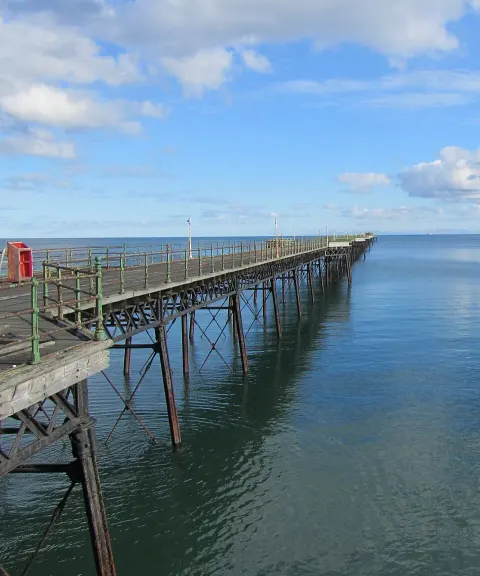
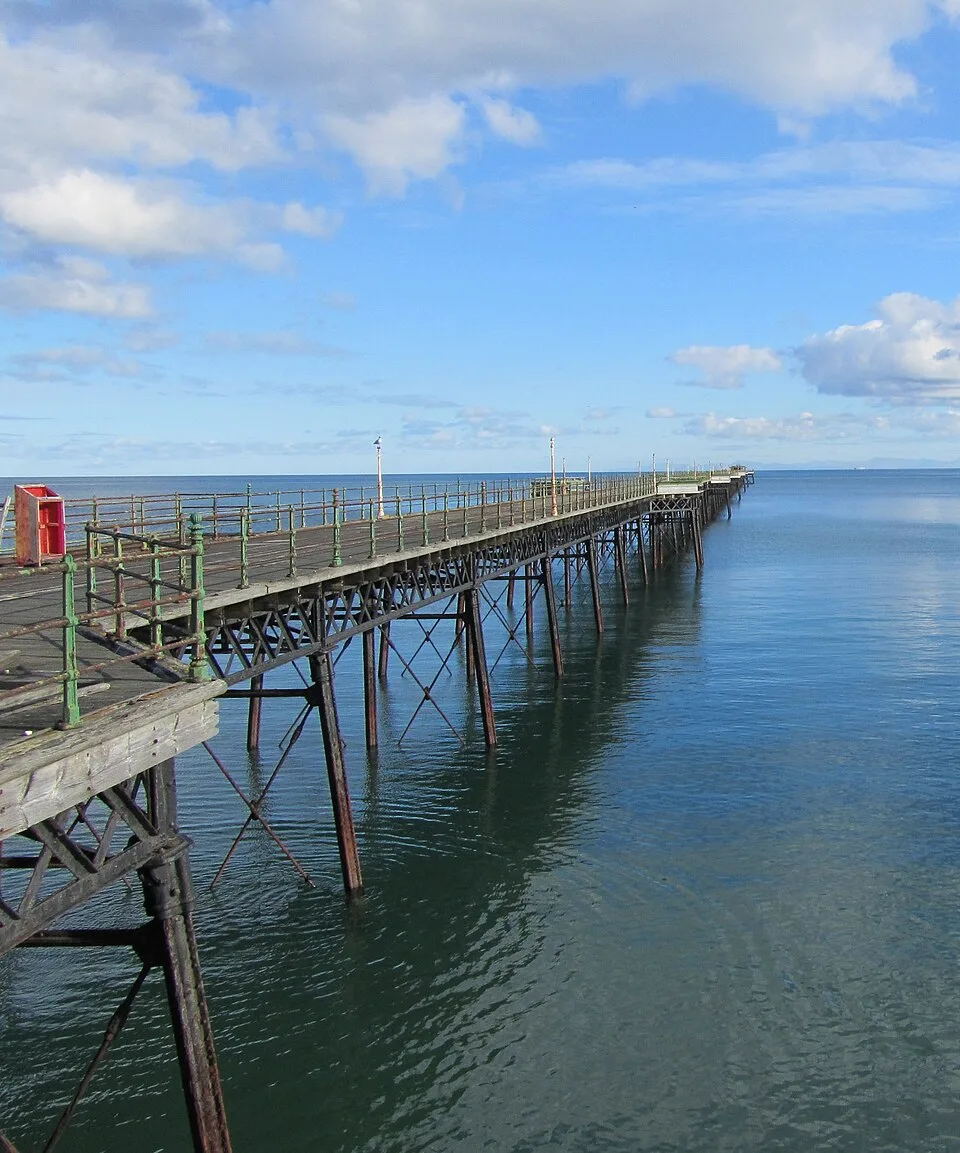
At roughly 2,200 feet, or around 680 metres, it was a substantial piece of engineering. The pier head measured about 120 feet by 50 feet, enough room for passengers to gather as steamers came alongside. Like many a Victorian seaside pier, it also served as a promenade, where visitors could stroll out over the water for the sea air.
The Pier Tram
The tramway that had been laid for the builders proved too useful to remove. It stayed in place to carry passengers and luggage along the long walk to the pier head, at first moved by hand-pushed trucks. A locomotive was added in 1930. The line gave the pier a character that few others in the British Isles could match.
Decline and Closure
The pier's fortunes followed those of the steamers it was built to serve. The last steamer called at the pier head in 1970, and with the working purpose gone, maintenance became harder to justify. The tram made its last regular runs in 1981.
Neglect and repeated vandalism took their toll. The pier was closed to the public in the early 1990s over safety concerns, and the gates remained locked for roughly three decades. Public concern grew, and a campaign group, the Friends of Queen's Pier, was formed in 1994 to press for the structure's survival. A working group and public survey followed in 2007, as islanders were asked whether they wanted the pier repaired or removed.
A Volunteer Restoration
The turning point came with the formation of the Queen's Pier Restoration Trust, which began working with the Isle of Man Government in 2015 on a lease. Access for survey work followed in 2016, and in July 2017 the trust signed a five-year lease, allowing repairs to begin. Early estimates suggested that a full restoration could run to around £1.5 million, and the project has relied heavily on donations, grants and the sale of commemorative plaques.
The first restored sections reopened to the public in July 2021, close to the 135th anniversary of the original opening. In August 2024, the pier tram carried passengers for the first time in more than 40 years, a moment that drew many locals back to the waterfront.
Progress is measured in bays, the repeating structural sections that make up the pier, of which there are 60 in total. Bays nine and ten were completed in the summer of 2026, and on 4 October 2026 the Lieutenant Governor, Sir John Lorimer, formally opened the next phase of the project. Volunteers now have their sights on bays 11 to 13 next year and a further three in 2028, with the next wider stabilising bay, bay 18, as the larger goal.
The Pier Today
Visitors can walk the restored section on summer Sunday afternoons, when the trust opens the pier free of charge and welcomes donations. Cast iron seating has been reinstated on the newest bays, offering a glimpse of the decorative quality the original designers intended. The restored length is still short, and the project will take years more, but each completed bay is a visible gain.
Not everything runs smoothly. The pier train has had periods out of action while a replacement is sought, and steel prices have added to the cost of the work. Yet the project keeps moving forward.
A Lasting Legacy
The Queen's Pier has outlived the steamers that justified it, the holidaymakers who strolled it and the years of closure that nearly ended it. Its survival owes much to the people of Ramsey, who decided that a Victorian iron landmark was worth the effort. Whatever length is eventually reopened, the Queen's Pier already stands as an example of how a community can reclaim a piece of its past, bay by bay.