
Summit in the Clouds: The Story of the Kehlsteinhaus
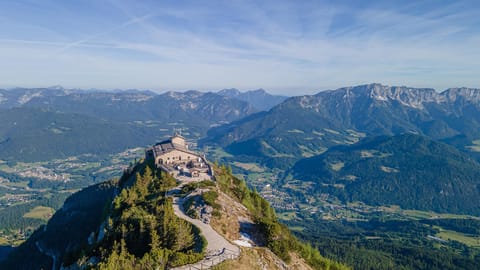
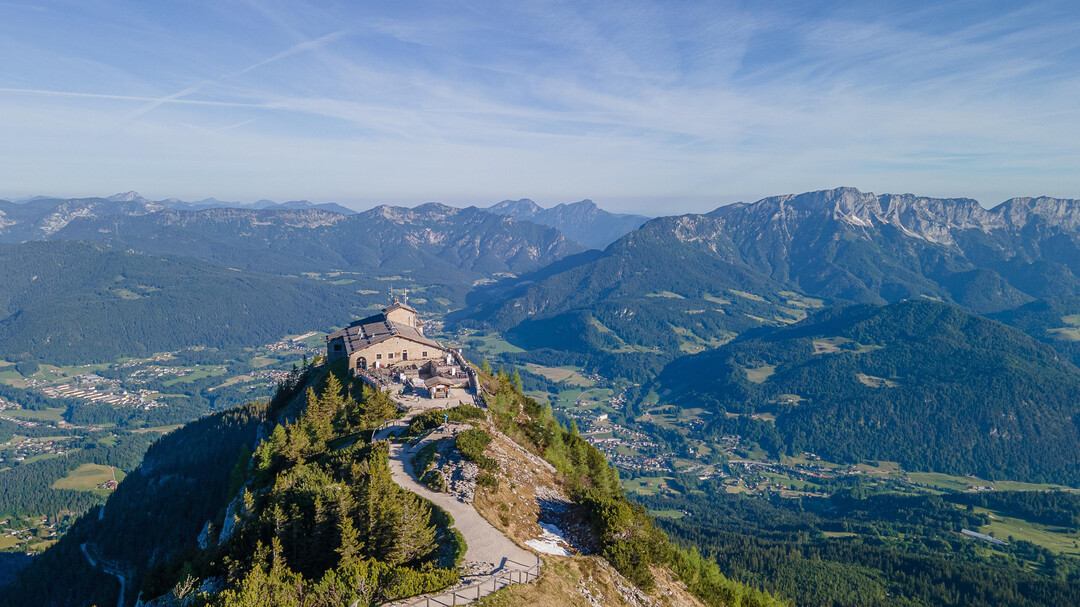
On a clear morning the stone house on the Kehlstein seemed to float, a squat grey shape on a ridge with the Bavarian Alps falling away on every side. Cloud often filled the valley below, and the building rose out of it as though it had been set there on purpose. It was, and the reasons say a good deal about the era that produced it.
Today, we climb the mountain road to look at the Kehlsteinhaus, often called the Eagle's Nest, and at the fire on 23–24 October 2026 that destroyed almost all of it.
A Summit Above Berchtesgaden
The Kehlstein is a rocky summit of about 1,834 metres on the edge of the Berchtesgaden Alps, above the hamlet of Obersalzberg in southern Bavaria. Before the 1930s it was known mainly to walkers and local farmers. That changed when Adolf Hitler, who had stayed in the area in the 1920s, bought a house at Obersalzberg and turned the slope into a private compound for the Nazi leadership.
The Kehlsteinhaus was planned as a high-altitude addition to that compound. It stood well above the main residence, the Berghof, and was meant for receiving guests rather than for living in.
Road, Tunnel and Lift
Construction began in 1937 under Martin Bormann, head of the Nazi Party Chancellery, and the work was carried out by the Organisation Todt, with Roderich Fick usually named as architect. The engineering was the real feat. A narrow road of roughly 6.5 kilometres was blasted and built up the mountainside in about a year, climbing to a car park just below the summit.
From there, visitors walked through a tunnel of about 120 metres into the rock, then rode a lift up a vertical shaft of similar height to the house itself. The lift cabin, lined with polished brass, was one of the building's best-known features.
- Altitude: about 1,834 metres
- Built: 1937–1938
- Approach: mountain road, tunnel and lift
- Style: stone-built, with a large terrace and a main hall
A Gift, Rarely Used
The house was presented to Hitler on 20 April 1939, his fiftieth birthday, as a gift from the Party. Accounts agree that he visited only a handful of times, and he is said to have been uneasy at such heights. Its main role was as a showpiece for dignitaries.
The nickname "Eagle's Nest" is generally credited to the French ambassador André François-Poncet, who visited in 1938. Contemporary German usage was simply Kehlsteinhaus, and many local historians still prefer it.
1945 and After
On 25 April 1945, Allied aircraft heavily bombed the Obersalzberg complex. The Berghof and other buildings were badly damaged, but the Kehlsteinhaus, small and high on its ridge, escaped. American troops reached the area in early May, and the house passed into the hands of the Bavarian state, which owns the site today. The ruins of the Berghof were cleared in the early 1950s.
The Kehlsteinhaus was later opened to the public as a mountain restaurant, and income from it is understood to have gone to charitable purposes. The nearby Obersalzberg Documentation Centre helps put the site in historical context.
Fire on the Mountain
On 23–24 October 2026 a fire swept through the house. Police said the building burned down almost completely. Nobody was hurt, but the damage runs to millions of euros.
Prosecutors in Traunstein say there are clear indications that a detained 33-year-old motorcyclist set the fire. They describe him as likely mentally ill. Investigators suspect arson, and the case remains a matter for the authorities and the courts.
The episode is a reminder of how remote the house was. Reached only by a single steep road, everything from firefighting equipment to building materials had to travel the same winding route that was cut in 1937.
The Kehlsteinhaus Today
The restaurant and tourist attraction is destroyed and cannot be visited. Before the fire, the house opened from late spring to autumn, weather permitting, and visitors went up by special bus from Obersalzberg rather than by private car. The reward was the view, which takes in the Watzmann massif, the Königssee area and, on good days, parts of Austria.
Bavaria's interior minister wants the building rebuilt, and the state, as owner, plans to restore it. What form that will take is yet to be seen.
The Kehlsteinhaus was both a handsome piece of mountain engineering and a difficult piece of history. It was built to flatter a regime, yet it outlasted that regime and served as a place where visitors could look at the landscape and consider how such a house came to be here. Whatever shape a rebuilt house takes, its lasting legacy is that tension between beauty and memory.