
Concrete Over the Polcevera: The Story of Ponte Morandi
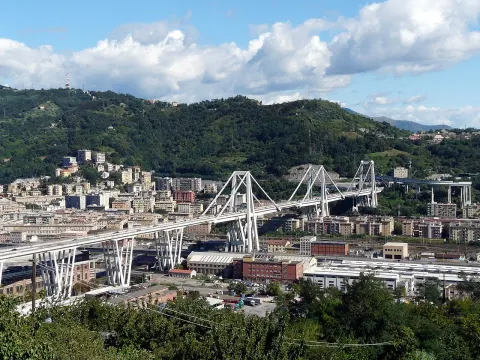
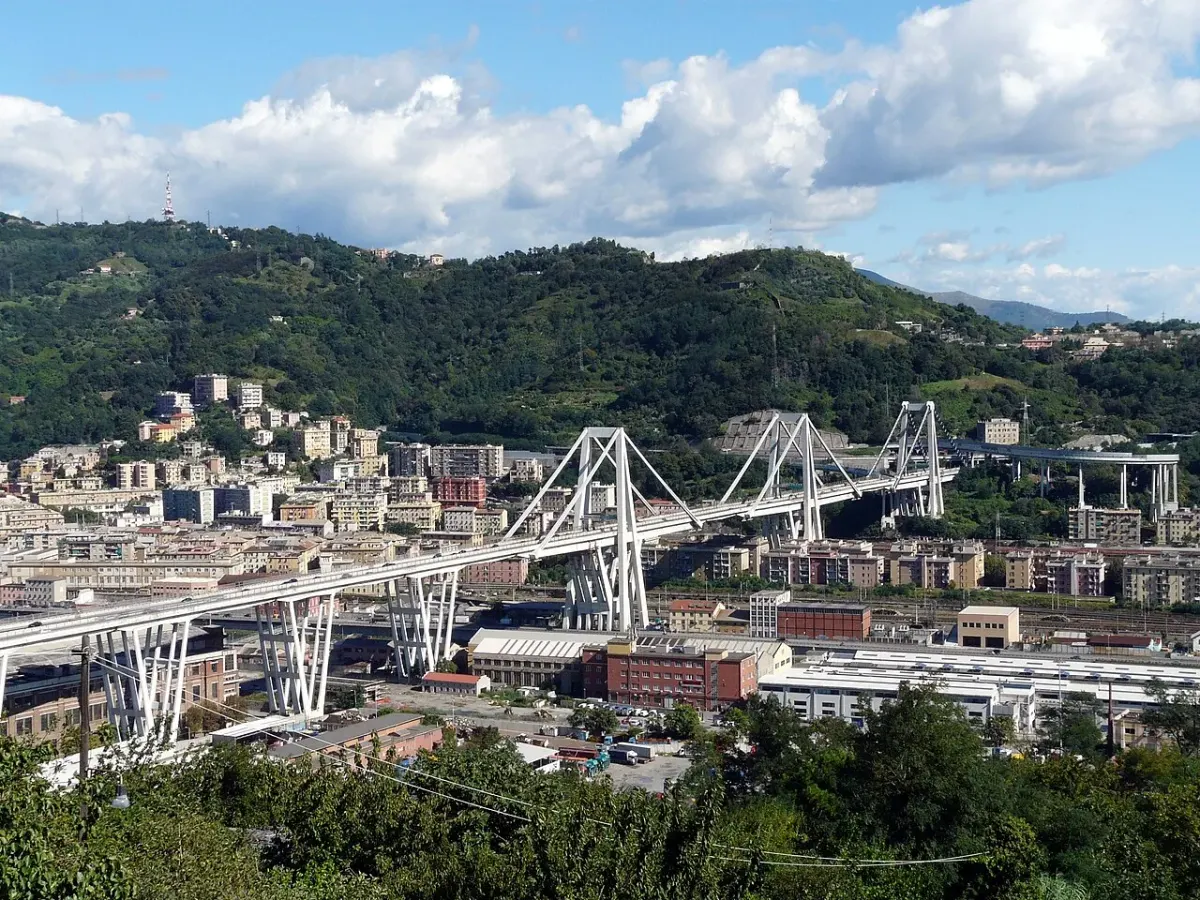
On a summer morning in 2018, traffic was moving along a high motorway viaduct on the western edge of Genoa. Below it lay railway lines, warehouses, apartment blocks and the bed of the Polcevera, a river that is often little more than a trickle. For half a century the Ponte Morandi had been part of daily life in this corner of Liguria. It was admired as a feat of engineering, and in its later years it was a source of repeated worry.
This article follows the bridge from its construction to its collapse, and then through the demolition, the replacement and the legal case that followed.
A Valley Built for Traffic
Genoa is squeezed between the Ligurian Sea and steep hills, and its port needed fast road links to the industrial north of Italy. The Polcevera Valley, home to the districts of Sampierdarena and Cornigliano, was crowded with factories and railway lines, so engineers chose to carry the A10 motorway above it rather than through it.
The structure was officially called the Viadotto Polcevera, after the river it crossed. Almost everyone knew it by the name of its designer, the engineer Riccardo Morandi. Construction ran from 1963 to 1967 and was carried out by the Società Italiana per Condotte d'Acqua at a cost of 3.8 billion lire. President Giuseppe Saragat attended the opening on 4 September 1967.
Morandi's Unusual Design
The viaduct was 1,182 metres long, with its roadway about 45 metres above the valley floor. Three concrete pylons rose roughly 90 metres, and the longest span measured 210 metres. It was a cable-stayed bridge, but not a conventional one. Morandi used very few stays, as few as two per span, and he encased the steel cables in prestressed concrete.
The approach had worked on an earlier Morandi bridge in Venezuela, the General Rafael Urdaneta Bridge of 1957, where the stays were left uncovered. In Genoa the concrete casing was meant to protect the steel. Critics later argued that it also hid the cables from inspection and left the structure prone to cracking, water entering the concrete and corrosion of the steel inside. The bridge was nicknamed Italy's Brooklyn Bridge, a sign of the pride it inspired.
Decades of Repair and Warning
Trouble began early. From the 1970s the bridge needed continual work because the long-term creep of the concrete had been underestimated. The deck sagged and undulated, and only after repeated measurement and structural intervention was it brought close to level by the mid-1980s.
In a report of 1979, Morandi himself suggested that the concrete would eventually need major treatment. He proposed removing rust from the exposed reinforcement, filling the patches with resins and sealing the whole surface with a highly resistant coating. Strengthening work did follow in later decades, but experts continued to voice concern about the deterioration of the structure into the new century.
14 August 2018
The collapse came at 11:36 on 14 August 2018, during a violent rainstorm, at the height of the Italian holiday season. A section of roughly 200 metres fell into the valley, including the tall pylon known as number nine, and vehicles fell with it. Forty-three people died.
The disaster shocked Italy and became a national symbol of neglected infrastructure. A state of emergency was declared in Liguria and lasted a year. Hundreds of residents who lived beneath the viaduct were moved from their homes, and the city's road and rail connections were severely disrupted.
Demolition and a New Bridge
The remains of the old viaduct were taken down in stages, ending with a controlled demolition of the surviving towers on 28 June 2019. The replacement, the Genoa-Saint George Bridge, was designed by the Genoese architect Renzo Piano and opened in August 2020, a little over two years after the disaster. Its slender steel deck and widely spaced piers look nothing like Morandi's heavy concrete forms.
The Search for Responsibility
The question of who was to blame took far longer to settle. The bridge was operated by the motorway company Autostrade per l'Italia under a state concession. Prosecutors argued that years of poor maintenance, ignored warnings and postponed work led to the collapse. The defendants denied wrongdoing, and some argued that the fault lay in the original construction.
The criminal trial opened in 2022 and ran for more than 280 hearings. On 16 July 2026 the court in Genoa convicted 32 of the 57 defendants, including former Autostrade chief executive Giovanni Castellucci, who received a 12-year sentence. The other 25 were acquitted or cleared. Appeals were expected, so the legal story is not yet closed.
A Lasting Legacy
The Ponte Morandi is gone, but it still shapes how Italy thinks about its roads, bridges and viaducts. It prompted national debate on inspection, maintenance and the responsibilities of private operators and public authorities. In Genoa, the victims are remembered by their families and by a committee that works to keep the memory of the disaster alive. The new bridge now carries the traffic, and the people of Genoa continue to remember the one it replaced.