
Chambers of Rock Salt: The Story of Wieliczka Salt Mine
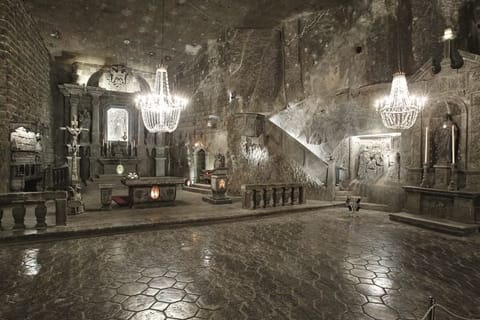
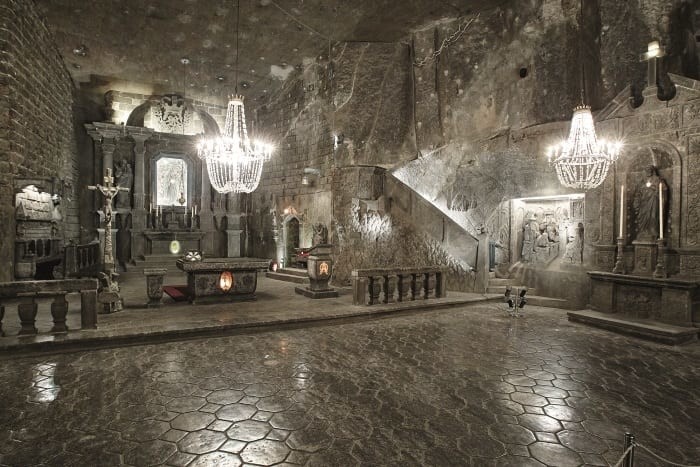
The wooden stairs seem to go on for ever. Level by level, the daylight fades and the air turns cool and faintly briny, until the walls on either side are no longer plaster or brick but rock salt, grey and glittering like unpolished granite. Then a passage opens into a chamber the size of a cathedral, lit by chandeliers made of salt crystals.
This is the Wieliczka Salt Mine, on the edge of the town of Wieliczka, just outside Kraków. For some seven centuries it supplied one of Europe's most valuable commodities. Today we go down to see how it was worked, who shaped it and why it is now one of Poland's most visited places.
Brine, Shafts and a Royal Privilege
Salt was being made at Wieliczka long before anyone dug a mine. From Neolithic times, people boiled the brine that welled up from the ground to leave behind sodium chloride. The earliest written trace of the operation comes from 1044, when Casimir I granted a privilege connected with it.
From the 13th century the work changed. Wells were sunk to reach the brine and the first shafts were dug to cut solid rock salt from the ground. A local legend gives the discovery a more romantic origin. It says that the Hungarian princess Kinga, betrothed to a Polish duke, threw her ring into a mine in her homeland and found it again inside a lump of salt at Wieliczka. She later became the patron saint of salt miners.
White Gold of the Crown
The mine was run for the Crown by the Kraków Salt Mines administration, known in Polish as Żupy Krakowskie. It provided a large share of the royal revenue. At the end of the 13th century and the start of the 14th, the Saltworks Castle was built to manage the business. It now forms part of the town's museum.
King Casimir III the Great was a notable patron. He granted the mine privileges, took its workers under his protection and, in 1363, founded a hospital near the site. Tradition says the demand for timber to prop the galleries helped to turn a Poland of wood into a Poland of stone, because forests around the mine were cleared for scaffolding and supports.
Life Below Ground
Working conditions were harsh. Early miners relied on muscle, horses and simple machines, among them the horse-driven treadmills of Hungarian and Saxon design that raised salt up the shafts. Machine drills and blasting only arrived in the late 1890s. A salt miner in 1915 earned the equivalent of about 20 cents a day.
By 1871 Wieliczka was regarded as one of the most productive mines in the world. Observers distinguished three qualities of salt. Green salt was clayey and opaque, spiza was sandy and crystalline, and szybik was the purest and clearest.
Out of this dangerous work came something unexpected: a tradition of art. Miners carved small chapels where they could pray before a shift. They also made statues from the rock around them.
The Chapel of St Kinga
The finest of these is the Chapel of St Kinga, about 101 metres below the surface. Work on it began in the 1890s and carried on, on and off, until 1963. Almost everything inside was shaped from salt, including the floor, the altar reliefs, the figures and the chandeliers. It is still a consecrated space, used for Mass, concerts and ceremonies. Older and smaller, the Baroque Chapel of St Anthony dates from the years around 1690 to 1710 and is the oldest chapel to survive.
Visitors, War and Closure
Tourists were walking the galleries as early as the 18th century. Some were taken across an underground brine lake by boat, and firework displays were once staged in the chambers.
The 20th century brought darker chapters. During World War II the occupying Germans used the mine as an underground facility for war-related manufacturing. Afterwards the mine returned to salt production, but the economics were against it. Falling salt prices and flooding led to the end of commercial mining in 1996, after a continuous run that made it one of the oldest working salt mines in the world.
Recognition had already arrived. The mine was listed as a monument under Polish law in 1976 and, in 1978, it was among the first sites on the UNESCO World Heritage List. It was placed on the danger list between 1989 and 1998 because of threats to its fabric. The listing was later extended to include Saltworks Castle and the neighbouring mine at Bochnia, in 2008 and 2013.
Wieliczka Today
The mine reaches a depth of 327 metres and its passages stretch for more than 287 kilometres. Visitors see only a small part of that. The tourist route runs for about 3.5 kilometres, less than 2 per cent of the total, and passes through chambers, historic mining equipment, the underground lake, four chapels and sculptures that range from old miners' work to modern commissions. Visitor numbers are among the highest of any heritage attraction in Poland, with several thousand people descending on busy days.
It is worth remembering the colour of the rock. The salt here is mostly grey rather than white, and the guides will happily tell you that tasting the walls is a tradition.
A Legacy Carved in Salt
Wieliczka began as a source of wealth and became a monument to the people who worked it. The mine's real significance lies in the combination of engineering, devotion and craftsmanship that built up across 700 years. Miners dug out a commodity that helped to fund a kingdom, and in their spare moments they left behind a gallery of art that outlived the industry itself.