
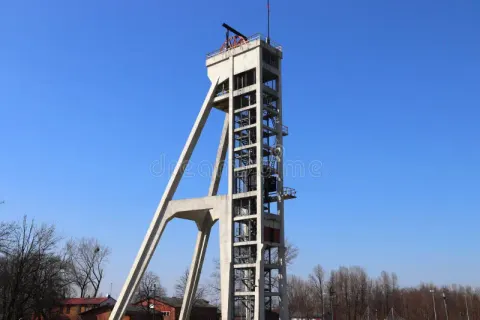
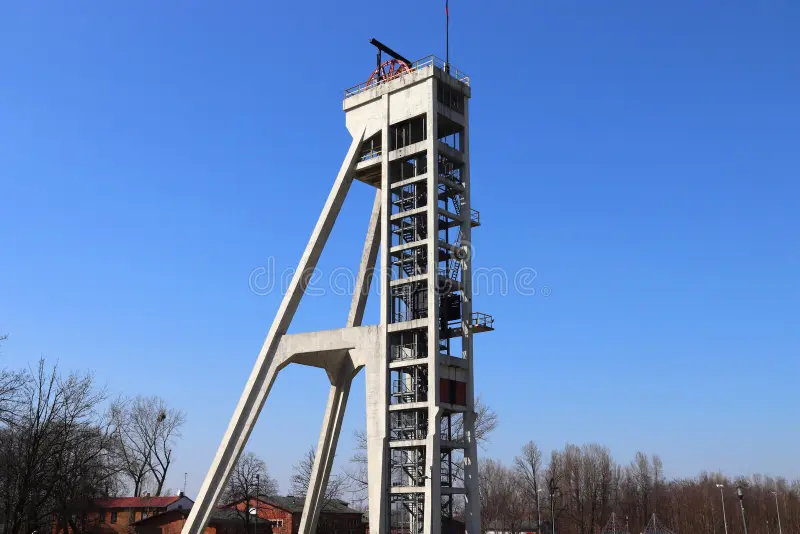
Beneath Lędziny: The Story of the Ziemowit Coal Mine
On 3 December 1952, with the miners' feast of St Barbara only a day away, the first coal from a new colliery in Lędziny was brought up to the surface. The mine was called Ziemowit. Within a generation it had become one of the biggest coal producers in Europe, and it shaped the life of the town around it.
This is a look at how Ziemowit grew from a post-war project into a giant of Polish industry, and what became of it.
Coal Under the Silesian Fields
Coal has been part of life around Lędziny for a long time. Local mining tradition reaches back to the first half of the 19th century, and the seams here belong to the Upper Silesian Coal Basin. Ziemowit itself lies in the south-eastern part of that basin, on the Silesian Upland.
The idea of a second large colliery in Lędziny is older than the mine. A plan was drawn up on 4 November 1911, but the approach of the First World War brought it to a halt. Surveys and boreholes resumed soon after the war. On 1 January 1947 the name Ziemowit was entered in the register of Polish mines as an independent works, though coal would not be raised for several more years.
Opening Day, 1952
Production began on 3 December 1952, the day before Barbórka, the traditional holiday of Polish miners. The date has stayed in the mine's story ever since. Barbórka is still marked in the houses around the pit.
Growth followed quickly. Output passed three million tonnes a year in 1971. On 1 July 1972 the older Piast mine in Lędziny was merged with Ziemowit to form a single enterprise. Daily output reached about 16,000 tonnes, which made it one of the largest mines in Europe.
The Record-Breaking Years
Deeper shafts were sunk in 1976, and in 1978 work began on a seam at the 650-metre level. By 1984 daily output had risen to about 27,000 tonnes. By 1986 Ziemowit was the leading mine in Poland, raising more than seven million tonnes of coal a year.
The mine's own chronicle records that a 1979 international ranking named it the largest hard-coal mine in the world. In the 1980s it brought up its 100 millionth tonne of coal. At its peak it employed around 11,000 people, and the workforce today is about a third of that.
Whole districts grew up around this work. Lędziny has an estate of Finnish-style timber houses dating from 1949, and many families there have worked at the mine for generations.
December 1981
The mine also has a place in Poland's political history. After the declaration of martial law in December 1981, miners at both Ziemowit and the neighbouring Piast mine staged strikes underground. The protest at Piast lasted 14 days. It is remembered as the longest underground strike of that period in the country.
A Merger and a New Name
The end of communism brought a long restructuring of Polish coal. Until early 2003 Ziemowit was part of the Nadwiślańska Coal Company, and on 1 February 2003 it joined Kompania Węglowa, then the largest mining group in Europe. Wikipedia's entry, based on figures from around 2010, gives estimated reserves of 133 million tonnes. It puts annual output at about 4.5 million tonnes.
On 1 July 2016 Ziemowit was joined with the Piast mine in nearby Bieruń to form a single mine, Piast-Ziemowit. It is now part of Polska Grupa Górnicza. Piast had begun production in 1975, only 41 months after construction started. The combined mine has ten shafts for production, ventilation, materials and the transport of crews. Most work takes place at levels of about 500 and 650 metres. The deepest workings reach roughly 800 metres below the surface.
Ziemowit Today
Ziemowit still works as one section of Piast-Ziemowit. Its mining area, known as Lędziny I, covers 63.58 square kilometres. Mining plans for the coming years run mostly beneath farmland and forest. This is not a visitor attraction in the usual sense, but the mine's history is kept in Lędziny. A museum of tradition, the Izba Tradycji, was set up in a former works canteen that was nearly demolished. It holds objects given by former miners and local residents.
Ziemowit's legacy is both industrial and human. It raised millions of tonnes of coal and made the town of Lędziny what it is. Its miners also took a stand in December 1981, when they stayed underground in protest.