
Wedding Cake in the Chilterns: The Story of Halton House
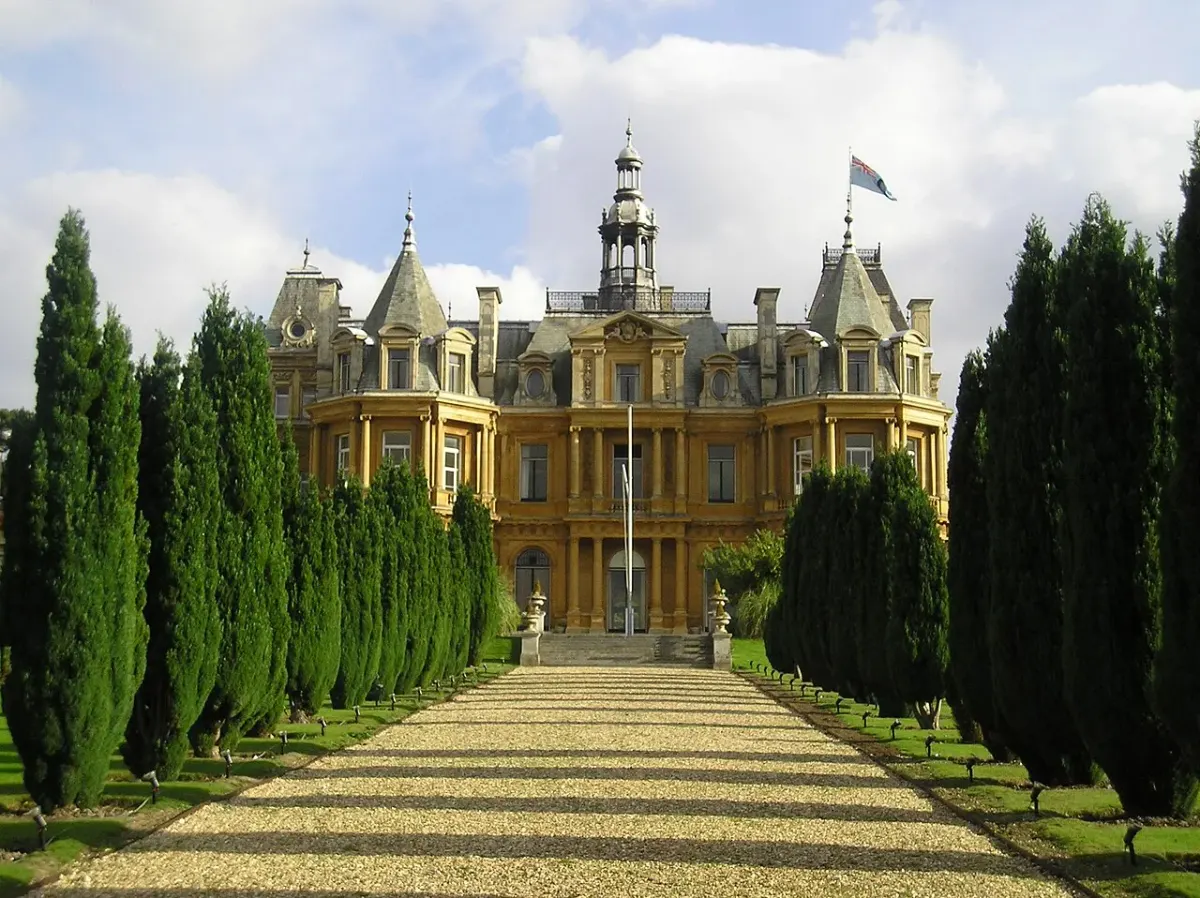
Seen from the Buckinghamshire lanes below, Halton House looks too elaborate to be real. Mansard roofs, pediments, spires and a cupola crowd the skyline above the Chiltern slopes, and a grand porte-cochère marks the entrance. For more than a century it has been one of the most recognisable country houses in the county, first as a banker's showpiece, then as the heart of a Royal Air Force station.
Today the house is shut and sealed. Here is how it came to be, and how it came to be quiet.
An Older House at Halton
The grand building on the hill is not the first Halton House. A manor has stood at Halton since the Norman Conquest, when it belonged to the Archbishop of Canterbury. In the middle of the 16th century Thomas Cranmer sold it to Henry Bradshaw, the Solicitor-General. After a long period with the Bradshaw family, it was bought in 1720 by Sir Francis Dashwood, and the Dashwoods held it for almost 150 years.
That earlier house stood west of the parish church in Halton village, in a large park that the Grand Union Canal later cut in two. In June 1849 Sir George Dashwood auctioned its contents, and in 1853 the estate passed to Lionel de Rothschild. In 1879 Lionel left it to his son, Alfred, by which time it covered roughly 1,500 acres (610 hectares) between Wendover, Aston Clinton and Weston Turville.
A Rothschild Builds on the Hill
Alfred de Rothschild commissioned a new house, and building began in 1880. The firm entrusted with the work was William Cubitt and Company. The design is thought to be the work of William R. Rodriguez, also known as Rogers, a member of the Cubitt design team. The house was complete in 1883, just three years later.
Not everyone approved. The architect Eustace Balfour called it a mixture of French chateau and gambling house, and one of Gladstone's private secretaries dismissed it as an exaggerated nightmare. A Rothschild cousin is said to have likened it to a giant wedding cake.
Le Style Rothschild
Alfred was probably influenced by Waddesdon Manor, the home of his brother-in-law Baron Ferdinand de Rothschild, which was nearing completion at the time. Halton is smaller, but the resemblance is there, mixed with other continental ideas. Classical pediments project from the mansard roofs, gables and spires compete for attention, and a cupola crowns the whole.
The interior matched the exterior. The central hall, which recalls the galleried hall at Mentmore Towers, was furnished as the grand salon. Two drawing rooms, east and west, followed in the same lavish spirit, and the dining and billiards rooms were fitted with 18th-century panelling. A plaster-panelled staircase led up to the bedrooms. Furnishings followed what became known as Le Style Rothschild: 18th-century French furniture, boulle work, ebony and ormolu, set alongside Old Masters and fine porcelain. A large domed conservatory, the winter garden, was attached to the house.
The Party Ends
Alfred entertained widely at Halton, but its glittering years lasted less than thirty. The last party was held in 1914, as the First World War broke out. Alfred was devastated by the slaughter, his health declined, and he died in 1918. He had no legitimate children, so the house passed to his nephew, Lionel Nathan de Rothschild. Lionel disliked the place and sold its contents at auction that same year.
The house and its much reduced estate were bought for the Royal Air Force by the Air Ministry for £115,000, a low price even then. Soon afterwards the house became the officers' mess for RAF Halton. On 1 January 1920 the station was raised to the status of a command, and its headquarters moved into the house. The headquarters role later ended, but the mess remained, and a new dining room was added behind the servants' wing in the 1960s.
A Star of Screen and Television
Its looks have also made Halton House popular with film and television makers. Its credits include:
- Jeeves and Wooster (1992)
- Evita (1996)
- The World Is Not Enough (1999)
- The King's Speech (2010)
- Downton Abbey, where its interiors became the fictional Haxby Park
- Agatha Christie's Poirot, in which it doubled as a Swiss Alpine hotel
- The Crown, as a French home of the Duke and Duchess of Windsor
More recently it has also appeared as the home of the Bridgertons in the Netflix series of that name.
Halton House Today
The house remained an officers' mess until 2025. A structural survey that January found a serious defect, and officers and staff were told to leave at very short notice. The building has been closed and fenced off since then. The Ministry of Defence has described it as surplus to operational requirements. It says it will stay closed until another occupier is found through the disposals process, and that repairs and security are being handled with the local authority and Historic England.
The future of the house is therefore undecided. It is a listed building with a long record in service life, and many who served there regret its closure. Its story runs from a Norman manor and a Rothschild fantasy to an air force mess and a film set. Whoever takes it on next will inherit a very distinctive piece of Buckinghamshire's history.