
Bournemouth Pier, Dorset
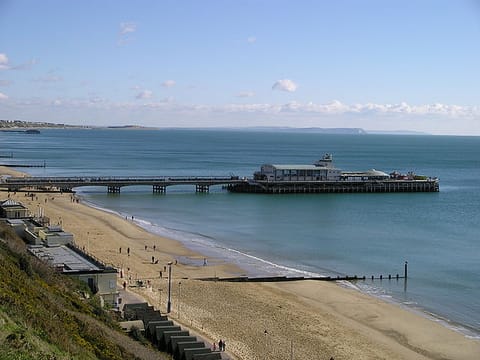
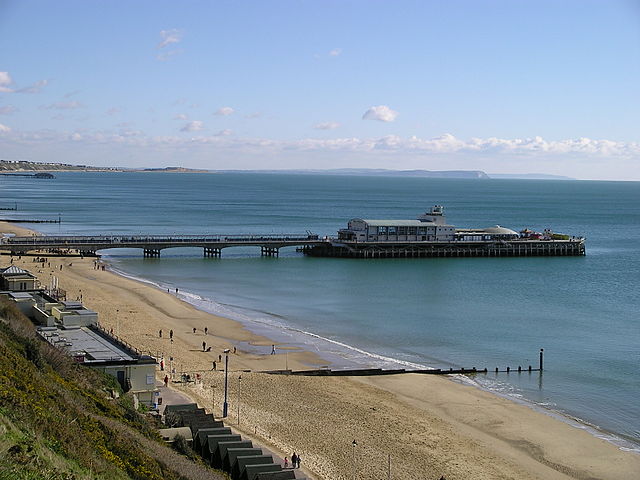
A concrete walkway, bridge-like in its sweep, carries visitors from the Bournemouth shoreline out over the waves, past an octagonal leisure complex and on towards the pier head. It looks like a single, settled structure, yet it is the product of more than a century and a half of rebuilding, repair and reinvention.
Today, we walk out along the pier's history, from a modest wooden jetty to the seaside landmark that stands off the Dorset coast now.
A Jetty and a First Pier
Bournemouth's first pier was a short wooden jetty, completed in 1856. It was soon outgrown. On 17 September 1861 a much longer wooden pier, designed by George Rennie, opened in its place.
Worm, Gale and Storm
The Rennie pier had a troubled life. Its wooden piles fell victim to the Teredo worm, and in 1866 they were removed in favour of cast iron replacements. The improvement did not last. Just over a year later, a gale swept away the T-shaped landing stage and left the pier unusable.
After repairs, it served for another ten years. Then, in November 1876, a second severe storm caused further collapse and left the pier too short for steamboat traffic. The Rennie pier was demolished and a temporary structure took its place in 1877. Over the next three years, a new pier designed by Eugenius Birch was completed.
Birch's Pier Opens
Bournemouth Pier was opened by the Lord Mayor of London on 11 August 1880, at a cost of £2,600 [check: confirm the cost figure]. It was an open promenade 838 ft (255.4 m) long. The neck was some 35 ft (10.6 m) wide, widening to 110 ft (33.3 m) at the head.
Music, Shelter and Extension
A bandstand was added in 1885, and military band concerts followed three times a day in summer and twice daily through the winter. Covered shelters arrived at around the same time. Two extensions, in 1894 and 1909, took the pier's overall length to more than 1000 ft (304.8 m).
War and Rebuilding
Like virtually every other pier in the south and east of the country, Bournemouth Pier was a casualty of the invasion threat. On 5 July 1940, soldiers of the 18th Field Park Company of the Royal Engineers substantially demolished it as a precaution against German landings.
It was repaired and re-opened in August 1946. The pier head was refurbished in 1950, and by 1960 the substructure had been rebuilt in concrete to take the weight of a new pier theatre.
Restoration and the Pier Today
A structural survey in 1976 found major areas of corrosion, and a £1.7m restoration programme began in 1979. The old shoreward buildings were demolished and replaced by a two-storey octagonal leisure complex. The pier neck was reconstructed in concrete, giving it the bridge-like appearance it keeps today. The work was completed in two years.
Each rebuilding, from Rennie's wooden piles to the concrete neck of the modern pier, has answered some new threat, whether storm, shipworm, war or rust. Bournemouth Pier still reaches out over the water, and its long history of survival is part of what it offers visitors.