
A Château on Lodge Hill: The Story of Waddesdon Manor
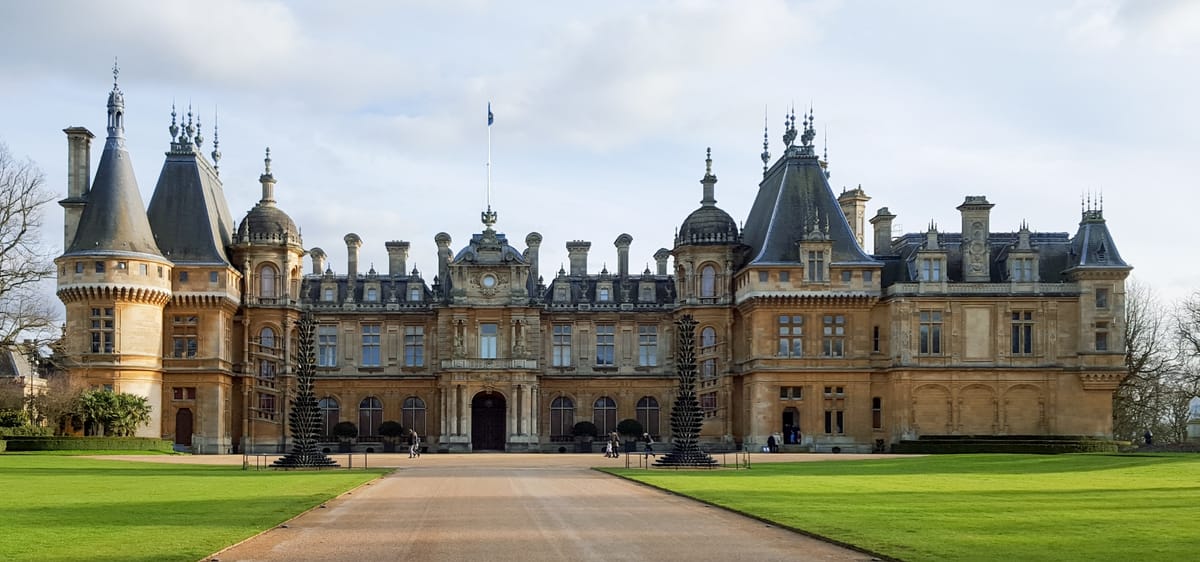
Approach Waddesdon Manor up its long drive and the Vale of Aylesbury seems to fall away. Ahead, on a levelled hilltop, stands a pale yellow château of turrets, spires and steep slate roofs, more at home beside the Loire than among English hedgerows. It was never meant to be a farmhouse or a family seat. It was built to dazzle.
Join us as we trace how a young, recently widowed banker turned a bare hill into one of Britain's most visited country houses.
A Hill Made to Order
In 1874 Baron Ferdinand de Rothschild, then 35, bought the Waddesdon estate in Buckinghamshire from the Duke of Marlborough. He belonged to the Viennese branch of the banking family, and had come to England and made his life here. The land was open farmland with no house and no garden, but it offered a commanding hill, Lodge Hill, where he could build exactly what he pictured.
His aim was a weekend retreat for entertaining guests and for displaying a growing collection of art and antiquities. He had a particular passion for French art of the 18th century, and the house was designed around it.
Building a French Château in England
Ferdinand turned to the French architect Gabriel-Hippolyte Destailleur, who had restored many Loire châteaux, and to the landscape designer Elie Lainé. Destailleur drew on several famous buildings, including Blois and Chambord, and combined their features into a single, asymmetrical house of bright Bath stone. Its roofline of spires, turrets and pinnacles remains its most striking feature.
The scale of the work was remarkable. The top of the hill was levelled over several years, and the foundation stone was laid on 18 August 1877. Mature trees were hauled in to create the setting, and a private steam tramway is recorded as carrying stone to the site. The main building was finished by the early 1880s, and the wider scheme, including the gardens, continued until 1889. The house opened with a grand party in May 1880.
A House for Entertaining
Waddesdon was designed as a stage for society. Ferdinand's guests included the Prince of Wales, the future Edward VII, as well as politicians and members of the cultural elite. In 1890 Queen Victoria visited, and she was reportedly fascinated by the electric lighting, which was designed to resemble candles.
The rooms were furnished with Sèvres porcelain, French furniture, tapestries and English portraits. Outside, Ferdinand wanted the grounds to offer something beautiful at every turn, and the Victorian gardens were laid out with that purpose. Ferdinand never had children, and he died in 1898.
Alice, James and the Twentieth Century
Alice de Rothschild
Waddesdon passed to Ferdinand's sister Alice, who added pieces from her own collection and ran the house with a famously firm hand. She kept the estate and its contents intact through the early years of the new century.
James and Dorothy
On Alice's death the estate went to her great-nephew James de Rothschild, known as Jimmy, who inherited in 1922. With his wife Dorothy he enriched the French collections further. The house also took on a new role during the Second World War, when it sheltered evacuee children.
When James died in 1957 he left Waddesdon and much of its contents to the National Trust. The bequest came with a substantial endowment, and the house opened to the public in 1959. Members of the Rothschild family have remained closely involved ever since.
Waddesdon Today
The house is now owned by the National Trust and managed by the Rothschild Foundation, a family charitable trust. It is a Grade I listed building, listed on 21 December 1967, and a major restoration took place between 1990 and 1997. In 2019 it welcomed more than 463,000 visitors, placing it among the most visited National Trust properties.
Inside, visitors find paintings, sculpture, furniture and the Rothschild Treasury, which holds more than 300 precious objects. Outside there are sweeping lawns, an aviary and gardens that change with the seasons. Food, wine and changing exhibitions continue the tradition of hospitality that Ferdinand began, and income from the shops and restaurants goes towards the care of the house, collections and gardens.
Waddesdon's legacy lies in its survival as a complete, lived-in collection. Few houses show so clearly how a Victorian banker's taste, three generations of one family and an act of generosity combined to keep a vision intact. Seen from the drive on a clear morning, the château still looks like a dream carried out in stone.