
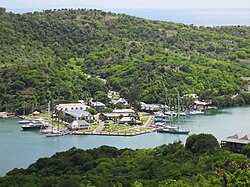
Where the Dockyard Waits: Nelson's Dockyard, Antigua
Arrive in English Harbour at first light and the water is still enough to mirror the masts. Yachts lie where Royal Navy frigates once swung at anchor, and the ochre-brick buildings along the quay look much as they did more than two centuries ago. This is Nelson's Dockyard, on the southern coast of Antigua, a place that was built for war and has lived on as a working harbour.
Come with us as we trace how a sheltered inlet became a Georgian naval base, why it was left to fade, and how it was brought back.
A Harbour Made for Hurricanes
English Harbour has a narrow entrance and deep, protected water. Those qualities made it valuable in an age when a single storm could wreck a fleet. By 1707 Royal Navy ships were already using it as a station, although nothing had yet been built there to repair them.
That changed in the 1720s and 1730s as Britain's Caribbean sugar islands grew richer and more exposed to French rivalry. A modern naval yard took shape on the western side of the harbour from the mid-1740s. Its purpose was practical: to let ships be careened, repaired and refitted without the long voyage home across the Atlantic.
Built by Enslaved Hands
The dockyard rose in a society built on sugar and slavery. Enslaved Africans cut stone, fired brick, hauled timber and worked as shipwrights, sailmakers and labourers. Their skills and their forced labour sit at the centre of the site's story, and they are a large part of the reason UNESCO later recognised the place.
The surviving buildings reflect that busy workforce. They include a boat house and sail loft, storehouses, workshops and officers' quarters. A large stone structure that held copper and lumber stands beside the water. The ordered, practical architecture is typical of Georgian naval engineering.
A Young Captain and a Reluctant Posting
The dockyard carries Horatio Nelson's name because he served here, but he neither founded nor built it. He was stationed in Antigua from 1784 to 1787 as a young captain, enforcing the trade laws of the day. He is reported to have found the posting trying, and the climate and the company did little to win his affection.
The name came much later. The naval facility was originally known simply as the King's yard in English Harbour. After its abandonment it was called the Old Dockyard. Only when it was proposed as a heritage site did the Nelson name attach itself, chosen for the most famous officer to have passed through.
Decline and Silence
The dockyard's importance followed the fortunes of the Leeward Islands. After the Napoleonic Wars ended in 1815, the sugar economy weakened and the threat from France faded. Steam-powered warships were larger than the narrow harbour could comfortably handle. Late in the 19th century the Navy withdrew, and the buildings were left to weather, lose their roofs and be overgrown.
There were early attempts at rescue. In the 1920s a governor of Antigua wrote a short history of the yard and tried to raise money for its restoration, but without success. The harbour kept a quiet life as a refuge for local boats, and its ruins waited for a change in fortune.
Restoration and Recognition
The turning point came in the middle of the 20th century, when local enthusiasts and visiting yachtsmen began to see the old yard as worth saving. Restoration work followed, and the dockyard opened to the public in 1961, as tourism to Antigua was beginning to grow. After independence in 1981, the new nation passed legislation in 1984 that created Nelson's Dockyard National Park, which protects the yard, its surrounding forts and a wider landscape of hills and coast.
In 2016 UNESCO inscribed the area as the Antigua Naval Dockyard and Related Archaeological Sites. The listing covers the dockyard itself and the military remains around it, such as Fort Berkeley at the harbour mouth. It is often described as the only continuously working Georgian dockyard in the World, a claim that rests on its unbroken use as a place for boats and ships.
What to See Today
- The Dockyard Museum, housed in a former naval officer's building, with displays on the site's history and the people who worked here.
- The restored quayside buildings, which now hold galleries, shops, cafés and accommodation.
- Fort Berkeley, a short walk along the shore, with views across the harbour mouth.
- The trails of the National Park, which climb to viewpoints above English Harbour.
The harbour also hosts sailing events, including Antigua Sailing Week and classic yacht regattas, so the quay is busiest when the fleets come in.
A Living Piece of Caribbean Heritage
What makes Nelson's Dockyard memorable is that it has never become a museum piece. Sailors still provision and repair their boats beside Georgian walls, and visitors can walk among the same stores and workshops that once served the Navy. The site also invites a fuller reading of Caribbean heritage, one that places naval strategy beside the lives of the enslaved people who made it possible.
Antigua has many beaches, but few places so clearly show how the island's past shaped its present. In English Harbour the old yard still stands at the water's edge, patient and in use.