
Beneath the Harbour: The Story of Port Royal, Jamaica
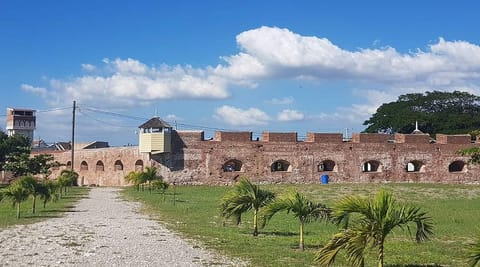
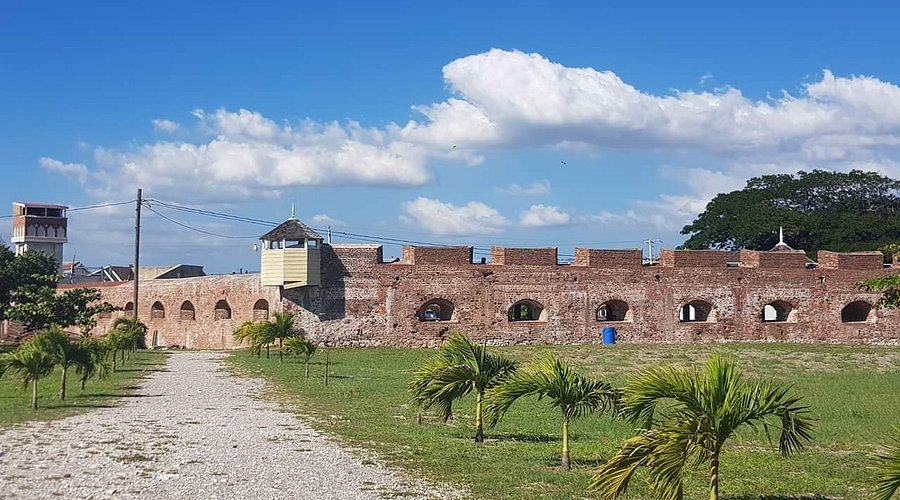
At the tip of a long, curving sand spit, a handful of low buildings and a squat brick fort face the water of Kingston Harbour. It is a quiet scene, with fishing boats at moorings and pelicans on the posts. Yet beneath the shallows lie the streets, cellars and warehouses of a town that, in the 1680s, was among the most densely built and most profitable in the English-speaking world.
Come with us to Port Royal, Jamaica, where a few minutes on a June morning in 1692 turned a thriving harbour town into an archaeological site.
A Spit of Sand and a Strategic Harbour
The Palisadoes, the narrow strip of land that shelters Kingston Harbour, had been used by the Spanish before English forces took Jamaica in 1655. The new owners saw at once what the Spanish had overlooked. A deep, sheltered anchorage, guarded by a single point of land, was ideal for ships and for defence.
The English built a fortification almost immediately. It was first named Fort Cromwell and renamed Fort Charles after the monarchy returned in 1660. Houses, taverns, shops and warehouses soon crowded around it. By the end of the 1650s, around two hundred buildings stood on the point, and the town went on growing, packing more and more into a very small space.
Buccaneers and Merchants
Port Royal's early fortune rested on a bargain. The colony's governors had too few ships and soldiers to defend Jamaica properly, so they welcomed privateers and buccaneers, who carried commissions to raid Spanish shipping and settlements and brought their plunder home to sell. The captains and crews spent their money in the town's taverns and lodging houses, and the merchants who supplied them grew rich.
The best-known figure of the age was Henry Morgan, whose raids on Spanish towns culminated in the sack of Panama in 1671. He later served as a senior colonial official in Jamaica, and the town's reputation for rowdiness owed much to men of his kind. But Port Royal was not only a pirate haven. It was also a working commercial port, with merchants, craftsmen, shipwrights and enslaved Africans, whose labour and forced trade were central to the colony's economy. Estimates of its population by 1692 range widely, from around 6,500 to 10,000.
Seven June 1692
Shortly before noon on 7 June 1692, the ground began to shake. Eyewitness accounts, including that of the town's rector, describe walls collapsing, the earth opening and the sea surging in over the fortifications. Much of the town was built on loose sand and gravel, which behaved like liquid under the shaking. Whole streets slid into the harbour.
Fort Charles survived, although its surroundings did not. Many people died in the initial disaster, and more perished in the disease and hardship that followed. Survivors were moved across the water, where the new settlement of Kingston grew up and in time became Jamaica's capital. The 1692 earthquake had ended Port Royal's age of fortune, and it also prompted the rise of the city that overtook it.
A Naval Station
Port Royal did not vanish. Rebuilt on the higher ground that remained, it suffered further blows: a fire in 1703 destroyed much of the new town, and hurricanes and another earthquake in 1907 added to the damage. Even so, its harbour remained too useful to abandon, and for much of the 18th and 19th centuries it served as a base for the Royal Navy in the Caribbean. The young Horatio Nelson is traditionally associated with the fort during his time on the Jamaica station in the late 1770s.
The 1907 quake left a curiosity that visitors still seek out. The Giddy House, a former artillery store within the fort's grounds, now sits at a pronounced tilt, and stepping inside it gives an odd feeling of unsteadiness.
Archaeology Under the Water
The disaster that destroyed Port Royal also preserved it. Because so much of the town sank quickly and was then covered by sediment, buildings, tools and household goods were left much as they were. Diving expeditions from the 1950s and 1960s, and later systematic excavations by American archaeologists, recovered pewter, pottery, bottles, timber and the foundations of brick houses, giving an unusually detailed picture of everyday life in a 17th-century colonial port.
Archaeologists have often compared the site to a time capsule, since it fixes a single moment in the town's history. It also records a darker side of that history: those who died in 1692 included merchants, the poor and enslaved people, and the site is regarded as a grave.
Port Royal Today
On 12 July 2025, the World Heritage Committee added the Archaeological Ensemble of 17th Century Port Royal to the World Heritage List, making it Jamaica's second site after the Blue and John Crow Mountains. The protected area takes in both the land and the submerged town, together with the forts that guarded it in 1692.
Today the community is small, and a short journey from Kingston along the Palisadoes brings visitors to Fort Charles, its museum and the streets of the modern village. Port Royal is a reminder that a town can be lost to the sea and yet continue to tell its story. Its legacy lies in the tale of the buccaneers, but also in the quiet evidence beneath the harbour of the people who lived, traded and died there.