
A Spit of Sand and Silver: Port Royal, Jamaica
At twenty minutes to noon on 7 June 1692, the merchants of Port Royal were going about a hot Tuesday morning, doing business on a narrow finger of sand at the mouth of Kingston Harbour. Within minutes the ground had shaken, the wharves had slid away and the sea had washed through the streets. A pocket watch recovered by archaeologists centuries later is said to have stopped at 11:43.
Join us as we trace the rise and fall of the town that became a byword for wealth, wildness and sudden disaster, and find out what survives of it today.
A Sandbar Worth Holding
The Palisadoes, a long curving sandspit, shelters one of the finest natural harbours in the Caribbean. The Spanish, who settled Jamaica from the early 16th century, made little of the spot. That changed in 1655, when an English expedition seized the island. The newcomers recognised the value of the harbour and fortified the end of the spit. The fort, first named for Oliver Cromwell, later became Fort Charles.
Houses, shops and warehouses soon crowded around the walls. By 1659 some two hundred buildings stood on the point, and by 1692 five forts guarded the approach. Space was so tight that merchants built upwards, in brick and timber, on foundations of loose sand.
The Buccaneer Boom
England was weak in the region and needed ships to defend its new colony. Jamaica's governors therefore welcomed privateers, who carried official licences to attack Spanish vessels and settlements. Port Royal was their base. Captured silver, cargo and enslaved people were landed on its quays, and taverns, goldsmiths and warehouses grew rich on the trade.
The most famous of these men was Henry Morgan, who led raids on Spanish towns including Portobelo and Panama in the late 1660s and early 1670s. He later served as lieutenant governor of the island. Port Royal became the unofficial commercial capital of Jamaica, even though Spanish Town remained the seat of government. The town was also built on the sugar economy and the labour of enslaved Africans, a part of the story that its archaeology now helps to tell. Caribbean pirates of a later, less respectable generation also passed through, and the town's reputation for drink and disorder grew with its wealth.
Eleven Forty-Three
The 1692 earthquake, estimated at around magnitude 7.5, struck without warning. The sandy ground liquefied, and the northern part of the town slipped towards the harbour, followed by a surge of water. Contemporary accounts describe wharves vanishing and ships tossed into the streets. Roughly two thirds of the town ended up below the waterline.
About 2,000 people are thought to have died in the disaster itself, with several thousand more lost to injury and disease on the island in the following days. Preachers of the time called it divine punishment for the town's sins. Modern geologists point instead to the unstable spit and to faults running across southern Jamaica.
Rebuilding and Retreat
Survivors did return, and part of the town was rebuilt. But the disaster had encouraged merchants to settle across the water, where Kingston was being laid out on firmer ground. Then came more blows: a fire in 1703 and a hurricane in 1722. Port Royal's commercial role passed steadily to Kingston, and by the end of the 18th century it was a naval station. A young Horatio Nelson served at Fort Charles in 1779. The dockyard continued into the early 20th century, and a further earthquake in 1907 left its mark on the fort. One of its buildings, the Giddy House, still leans at an angle that unsettles visitors.
Reading the Drowned Streets
The sea that destroyed Port Royal also preserved it. Brick walls, cellars, kitchens and timbers lie under sediment, and many objects were sealed in place at the moment of the quake. Underwater excavation began in the mid-20th century, and later projects led by American archaeologists recovered pewter, ceramics, tools and household goods. Together they give a rare, detailed view of ordinary life in an English colonial port.
Port Royal Today
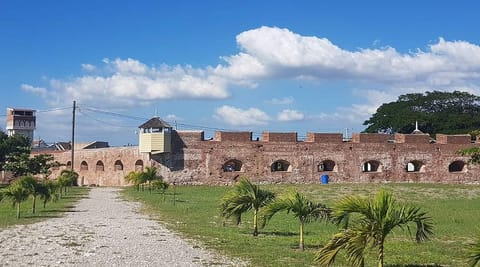
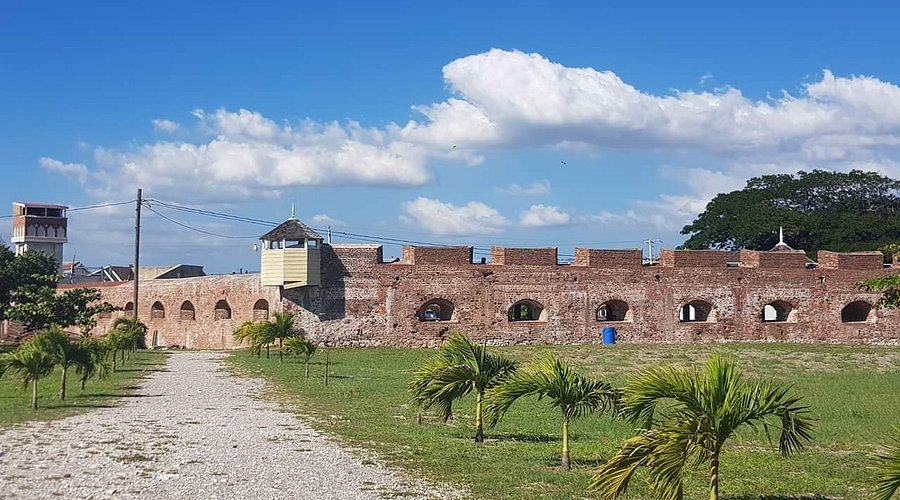
Today, Port Royal is a quiet fishing village at the end of the Palisadoes road, reached from Kingston by car or by boat across the harbour. Fort Charles still stands, along with the Giddy House, St Peter's Church and a small museum. In July 2025 the site was inscribed on the UNESCO World Heritage List as an archaeological ensemble, covering both the land and the submerged town.
A Lasting Legacy
Port Royal's reputation as a pirate haven has long overshadowed the fuller picture. It was a working harbour, a centre of trade, a place of enslavement and, for one brief morning, a catastrophe. Its fate shaped the growth of Kingston and remains a central chapter in Jamaica history. For visitors, the quiet waterfront is a reminder that the most dramatic parts of the past are often the least visible.