
Twice Fallen, Once Finished: The Story of the Quebec Bridge
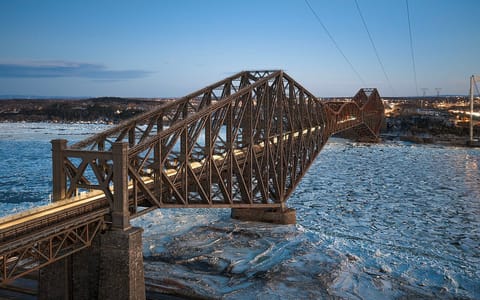
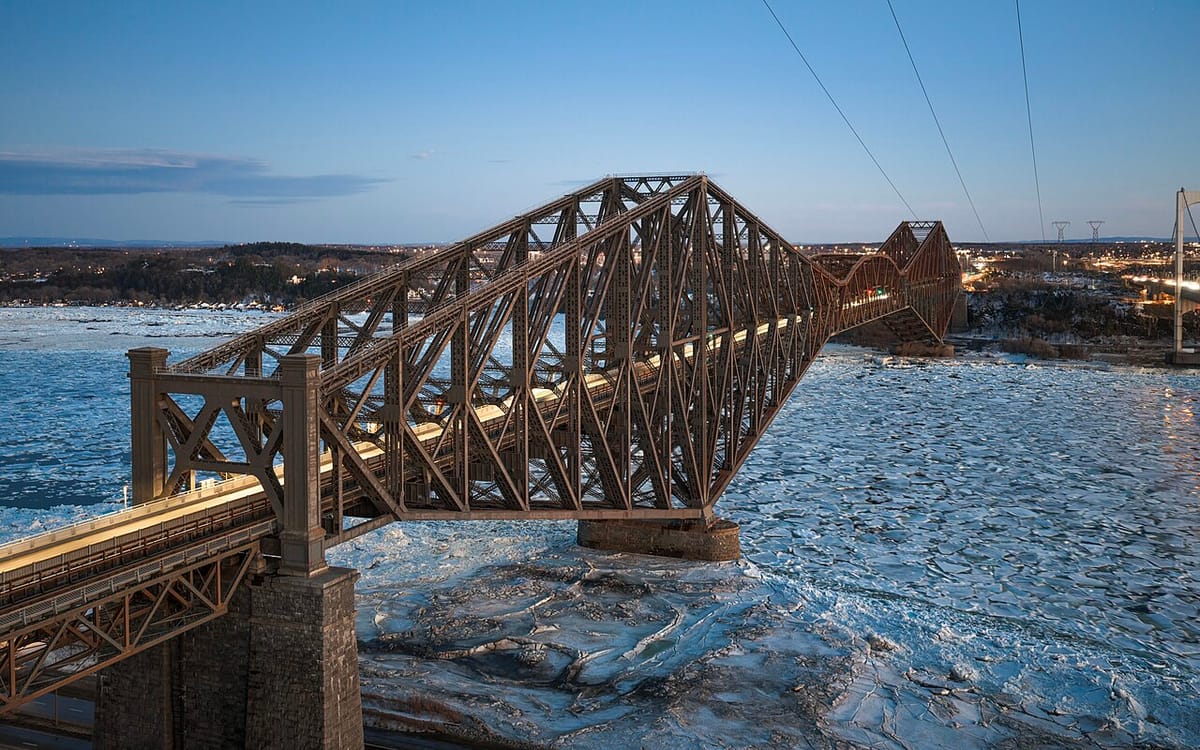
At Quebec City the St Lawrence River narrows to a deep, fast channel, and a great lattice of steel arches across it. Trains rumble over the top, cars cross on the deck beside them, and cyclists share the route. It looks permanent, almost stubborn. Yet this crossing took two attempts to build and left a long shadow over Canada engineering history.
Here is how the Quebec Bridge came to be, why it failed twice, and how it ended up as a National Historic Site.
A River That Divided the Province
For much of the 19th century, the only way across the river near Quebec City was by ferry, which could be slow in summer and treacherous when ice choked the channel. A fixed link between Quebec City and Lévis on the south shore was a long-held ambition. A company was formed in the 1880s to build one, but the task was daunting: the river is wide, deep and subject to powerful tides.
The chosen design was a cantilever bridge. In this type, great arms of steel reach outwards from massive piers, balanced against anchor arms on the shore side, and a central span is then suspended between the tips. It suited deep water, because it needed no scaffolding in the channel. The Forth Bridge in Scotland, completed in 1890, had proved the idea. Quebec's backers wanted to beat it.
The Collapse of 1907
Construction began in 1903, with the Phoenix Bridge Company of Pennsylvania as builder and the eminent American engineer Theodore Cooper as consulting engineer. To save money on piers, the main span was lengthened, which meant a heavier structure than the early calculations had allowed for. Cooper worked largely from New York, and the site relied on the judgement of a small team.
In the summer of 1907 workers noticed that some of the steel members in the south arm were bending. Concerns were raised, but work carried on. On 29 August 1907, shortly before the end of the working day, the whole south arm and anchor arm fell into the river in a matter of seconds. Of the men on the structure, 75 were killed. Among them were 33 Mohawk ironworkers from Kahnawake, near Montreal, a community whose men had become renowned for working at height. The loss devastated families there, and it is remembered still.
What the inquiry found
A Royal Commission concluded that the failure began with the compression members in the lower part of the south arm, which buckled under a load far greater than the designers had estimated. It laid the blame on errors of judgement and calculation rather than on any fault in the materials. The disaster is still studied by engineering students as a lesson in checking assumptions and in listening to warning signs on site.
A Second Attempt and a Second Disaster
The Canadian government took charge of the project and appointed a board of engineers to oversee a fresh design. The new bridge was stronger and heavier, with a more robust arrangement of steel. Work resumed in the years before the First World War and continued through it.
The plan for the central span was to build it on the shore, float it out on barges and lift it into place with hydraulic jacks. On 11 September 1916, as the span was being raised, one of the supports gave way and the whole mass, thousands of tonnes of steel, plunged into the St Lawrence River. Thirteen men died. Together with the 75 lost in 1907, the bridge had cost 88 lives before it was finished.
A replacement span was built and, on 20 September 1917, was lifted successfully. The first train crossed on 3 December 1917, and the bridge was formally opened in 1919.
The Iron Ring and a Profession's Conscience
The disaster of 1907 influenced the culture of engineering in Canada. In the early 1920s a ceremony was devised in which newly qualified engineers receive a plain iron ring, worn on the little finger of the working hand. The ring is meant to be a reminder of the obligations of the profession. The ceremony is still held at engineering schools across the country, and the link with the Quebec Bridge is part of its story.
The Quebec Bridge Today
The finished bridge has a main span of 549 metres and a total length of 987 metres. More than a century on, it remains the longest cantilever span ever built. It carries freight and passenger trains, along with road traffic and a cycle path. It has been recognised as a National Historic Site of Canada.
Its maintenance has been a long saga of its own. It was transferred to Canadian National Railway in the 1990s, and efforts to paint and repair the whole structure were often stalled by cost. In November 2024 ownership returned to the federal government, with a crown corporation now responsible for the steelwork, while CN looks after the rail deck and the Quebec government the roadway. A programme of repainting and steel repairs, planned to run for around 25 years, is under way.
A Lasting Legacy
The Quebec Bridge is a monument to ambition, but also to humility. Its two failures taught engineers to question their own calculations and to respect the people who build. Today it is the achievement that most people see, but behind it lies a story of loss that is worth remembering each time a train crosses the river.