
Steel Over the Gorge: The Story of the Victoria Falls Bridge
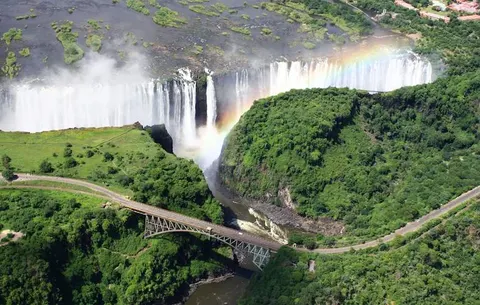
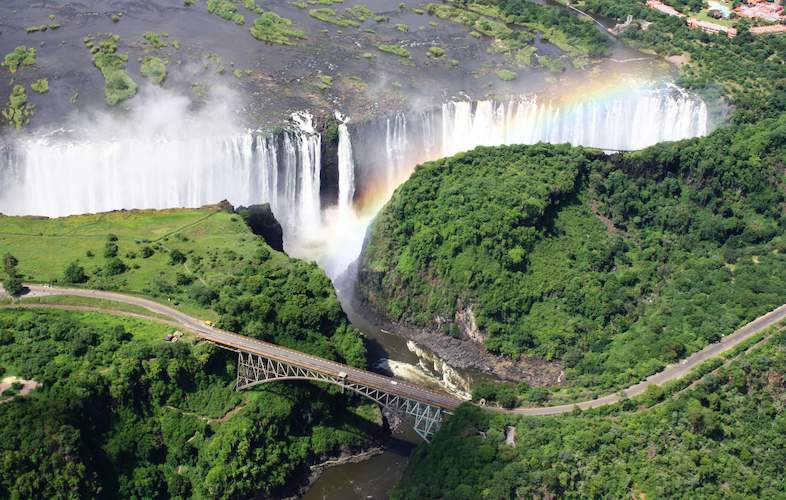
Walk out along the deck on a still morning and you will feel the bridge before you see it. A low hum rises from the Zambezi, 128 metres below, and a fine mist drifts up from the falls just upstream. Overhead, a lattice of dark steel curves across the Second Gorge, joining one country to another. The Victoria Falls Bridge is more than a crossing. It is a piece of Edwardian ambition that still carries trains, vehicles and walkers over one of the great sights of the continent.
Come with us to the edge of the gorge to see how it was planned, built and put to use.
A Line Meant to Reach Cairo
The bridge began as part of a much larger dream. Cecil Rhodes wanted a railway running the length of Africa, from the Cape to Cairo, and the Zambezi stood in its way. He never visited the falls himself and died in 1902, before building began. Yet he is recorded as asking for a bridge where passing trains would catch the spray of the falls. That wish shaped the choice of site, in the Second Gorge, close enough to give passengers a spectacular view.
The railway pushed north from Bulawayo and reached the falls in 1904. Engineers still had to find a way across a chasm too deep for piers and too wide for a simple girder.
Designing for a Difficult Site
The design was the work of George Andrew Hobson of the consulting firm Sir Douglas Fox and Partners. Ralph Freeman, who later became known for the Sydney Harbour Bridge, assisted with the stress calculations. The challenges were considerable. The structure had to be built without scaffolding, because there was no way to prop it from the river bed. It also had to withstand constant spray, and it should not spoil the landscape.
The answer was a single trussed steel arch. Its main span measures 156.5 metres, with a rise of about 90 feet. Hobson later received the Institution of Civil Engineers' George Stephenson Gold Medal for his account of the project.
Building Across the Void
The steelwork was made in England by the Cleveland Bridge and Engineering Company. It was shipped to the port of Beira in Mozambique and carried inland on the newly laid railway. On site, the chief construction engineer was Georges Camille Imbault, a young Frenchman who first viewed the gorge on 2 September 1903. He was chosen for his skill with cables and wire ropes, and his selection reportedly surprised some of Rhodes's circle, who had expected a British engineer.
Work began in 1904. Crews built outwards from both rims of the gorge, holding the growing arms in place with cables and gradually reaching towards the middle. Surveyors checked the centre line daily to be sure the two halves would meet. They did, on 1 April 1905, when the main arch was joined. The whole job took about 14 months, a remarkable pace for such a site.
The Opening
The bridge was officially opened on 12 September 1905 by Professor George Darwin, son of Charles Darwin and then President of the British Association. It was first known as the Great Zambesi Bridge before the name of the falls became attached to it.
A Crossing Between Two Countries
For its first decades the bridge served the railway, opening up the interior for goods and passengers. Its role changed as the region did. The river is now the border between Zimbabwe and Zambia, and the bridge links the town of Victoria Falls on the southern bank with Livingstone on the northern side. Border posts stand at both ends. It remains the only rail link between the two countries, and one of only a few road crossings.
Its engineering has been widely recognised. The American Society of Civil Engineers lists it as a Historic Civil Engineering Landmark, and it passed its centenary in 2005.
The Bridge Today
Today the historic bridge is as much a destination as a route. Visitors can walk onto the deck for views of the falls on one side and the gorge on the other. Guided tours explain how it was built, and one of them goes beneath the deck to the steelwork itself. Others come for the bungee jump from the span, which has made the structure famous with a different audience.
A few practical points are worth knowing. Crossing the border on foot involves passport checks on both sides. Early morning and late afternoon bring softer light and fewer people. Spray from the falls can make the walkway wet, so sturdy shoes help.
A Lasting Span
More than a century on, the Victoria Falls Bridge still does what its builders intended. It joins two nations, carries traffic across the Zambezi and frames the landscape rather than competing with it. Rhodes never saw it, and his grand railway to Cairo was never completed. The arch he set in motion remains, a graceful piece of Edwardian engineering above the water.